Germany updates: Merz elaborates on Ukraine, Gaza policies
Published May 27, 2025last updated May 28, 2025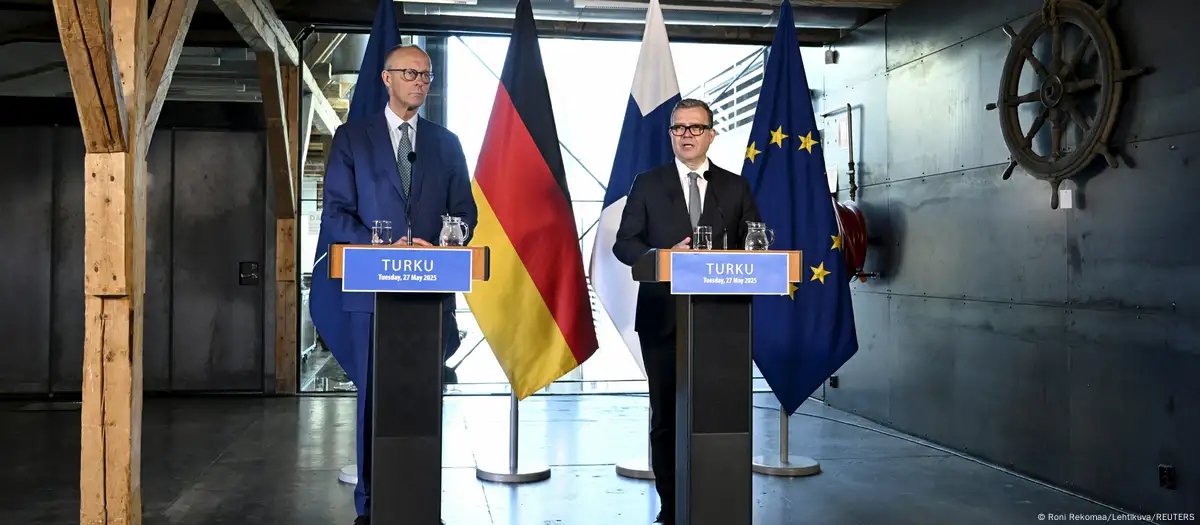
What you need to know
German Chancellor Friedrich Merz, who is in Finland to meet with Nordic leaders, has elaborated on his statement that Germany is allowing Ukraine to use long-range weapons against Russia.
Merz also said that if Russia rejects the offer of Vatican mediation in the Ukraine war, it is obviously not interested in peace.
He also reiterated that Israel's latest military actions in Gaza did not seem necessary to fight Hamas terrorism or defend Israel's existence.
Meanwhile, a Syrian man pleaded guilty of carrying out a knife attack in the German town of Solingen last August in which three people were killed.
These updates have been closed. Thank you for reading.
Here is a roundup of top news stories from Germany on Tuesday, May 27:
Israel forcing Germany to reconsider support, says former Israeli ambassador to Berlin
Shimon Stein, who served as Israel's ambassador to Germany from 2001 to 2007, spoke to DW about German Chancellor Friedrich Merz's recent shift in tone towards Israel.
Israel's European allies have grown increasingly frustrated over Israel's military campaign in Gaza and the worsening humanitarian situation in the Palestinian enclave.
Merz has said that Germany cannot remain silent if Israel continues to break international law in its war with Hamas. In Merz's coalition government, some have called for a halt on arms exports to Israel.
"We have reached a point when German interests are not being upheld the way it understands its interest with respect to whatever Israel does," Stein said.
He highlighted Israel's military objectives in Gaza, Israeli Prime Minister Benjamin Netanyahu's "undefined total victory" and the "crazy plan" proposed by US President Donald Trump to turn "Gaza into a Riviera and evict two million Palestinians."
Germany's top diplomat heads to US for talks on Ukraine, Mideast, trade
Germany's new foreign minister, Johann Wadephul, is set to travel to Washington for talks with US Secretary of State Marco Rubio focused on the Ukraine and Middle East conflicts, NATO ties, and strained trade relations.
In his first visit to the United States since taking office, Wadephul said the longstanding German-American partnership had been vital to his country’s postwar freedom and prosperity.
"We Germans owe almost no other country as much as the United States," he said in a statement before departure.
Wadephul said his top priority was ending the war in Ukraine through an immediate ceasefire and lasting peace.
Calling Russia "the greatest threat to Euro-Atlantic security for the foreseeable future," Wadephul emphasized that Europe is assuming greater responsibility for its own defense.
He reiterated Germany's support for a NATO proposal to boost combined defense and security-related spending to 5% of GDP — split between 3.5% for defense and 1.5% for infrastructure and related areas.
On the Middle East, Wadephul said Germany stands by Israel's security but also recognizes "the unbearable suffering of the people in Gaza." He urged progress toward a ceasefire, the release of hostages, and a major scale-up in humanitarian aid.
Addressing trade tensions following US President Donald Trump’s return to office, Wadephul pushed for dialogue. "We don't want to erect new tariff barriers, but rather build stable bridges of partnership and trust," he said, voicing support for a negotiated EU-US solution to reduce unnecessary trade obstacles.
"Only in this way will we succeed in preserving prosperity on both sides of the Atlantic and strengthening our economic security," he added.
German army must spend new funds responsibly — federal auditors
The massive boost in German defense spending must be wisely utilized, and the German army should implement major reforms to ensure this is the case, Germany's federal auditors said on Tuesday.
In a report, the Bonn-based Bundesrechnungshof said the Bundeswehr must focus on its core mission of defending Germany and its allies and reduce administrative processes despite receiving the increased funding.
"'Whatever it takes' must not become 'money doesn't matter!'" said Kay Scheller, president of Bundesrechnungshof. "It is crucial that these funds are used responsibly to significantly increase the effectiveness of defense spending."
Germany drastically reformed strict constitutional rules on deficit spending in March, allowing the new government to boost military expenditure in view of the changed security landscape in Europe caused largely by Russia's aggression and the Trump administration's pivot away from support for the continent.
However, the auditors warned that "a permanent and solid financing of Germany's defense capability is not guaranteed by a budget that is heavily financed by debt and therefore structurally unsustainable."
The report also said that the German military had become "top-heavy" and required a greater number of
regular soldiers.
While the Bundeswehr had 60,000 fewer soldiers in 2024 than in 2010, a decrease of 24%, the number of officers rose by 5%.
German solidarity with Israel does not mean support for Gaza campaign, foreign minister says
German Foreign Minister Johann Wadephul on Tuesday commented on the intensified offensive by the Israeli army in the Gaza Strip, saying that Germany's solidarity with Israel should not be misconstrued as unquestioning support for the military operation.
"Our committed fight against antisemitism and our full support for the right to exist and the security of the state of Israel must not be instrumentalized for the conflict and the type of warfare currently being waged in the Gaza Strip," Wadephul said in an interview with public broadcaster WDR.
"We are now at a point where we have to think very carefully about what further steps to take," he said, without giving further details.
Wadephul's comments echo those of Chancellor Friedrich Merz, who on Tuesday reiterated his doubts about the renewed Israeli offensive, saying it did not seem to him to serve the purpose of combating Hamas' terrorism or defending Israel's right to exist.
Israel's expanded offensive, dubbed "Gideon's Chariots," has led to further deterioration of the already dire humanitarian situation in Gaza and has left people unable to access food and medicine.
Europol arrests two in Germany in crackdown on international drug traffickers
The EU law enforcement agency, Europol, said on Tuesday it had arrested two people in Germany, along with 11 in Belgium and one in Italy, as it broke up an alleged international drug trafficking gang.
Europol said investigators searched 11 properties and seized 780 kilograms (1,719 pounds) of cocaine as part of the operation.
The agency believes that an Italian family led the gang, which is thought to have had suppliers in Colombia and laboratory technicians in Belgium.
The gang is suspected of sourcing cocaine paste in Colombia, smuggling it into Europe via several ports and then storing it in warehouses in Belgium, where the substance was processed for sale.
Investigators also suspect the gang of smuggling heroin and engaging in money laundering.
Germany to increase public investment in 2025
Germany will increase public investment to €110 billion ($125 billion) this year — up from some €75 billion in 2024 — as the country's new coalition government attempts to modernize the economy and bring it back to growth, Finance Minister Lars Klingbeil said on Tuesday.
"At the same time, we will implement comprehensive structural reforms and continue to strictly consolidate the budget," he said in an emailed statement.
"My top priority is to put Germany on a growth path now. This is how we boost the economy and secure jobs," said Klingbeil, who is also deputy chancellor.
The new investments are to be financed not only through Germany's core budget, but also through a special fund earmarked for the modernization of aging infrastructure and another meant to finance the transition to a greener economy.
The draft of the 2025 budget that is currently being prepared is due for Cabinet approval on June 25.
The German economy has been in recession for two straight years.
Syrian man accused of deadly Solingen knife attack pleads guilty
A Syrian man who allegedly knifed three people to death at a street festival in the western city of Solingen last August entered a guilty plea as his trial began in Düsseldorf on Tuesday.
Issa Al H., 27, told the court through his lawyer that he bore "heavy blame" and had "killed innocent people," and thus deserved and expected a life sentence.
The attack in Solingen fueled an ongoing debate on asylum policy in Germany, as the suspected attacker, who is thought to have been motivated by extremist Islamist ideology, had been slated for a deportation that failed on organizational grounds.
In addition to the three fatalities, 10 people were injured in the attack, some of them critically.
The man, whose full name is not given by DW according to guideline laid down in the German Press Code, is accused of carrying out the attack in collaboration with the terrorist group "Islamic State" (IS), which claimed the attack a day after it occurred.
So far, the accused has not spoken about any connection with the group.
Interior Minister Dobrindt to present bill abolishing 3-year citizenship path
German Interior Minister Alexander Dobrindt is set to present a draft bill to the German Cabinet on Wednesday that would reverse citizenship rules introduced by the previous government allowing people to become German nationals after just three years in the country.
"The express naturalization after three years residency was misguided," Dobrindt told the mass-circulation Bild daily.
"We are going to end that now. German citizenship must stand at the end of a process of integration and not at the start," he said, adding that three years in Germany was too short a time "to become integrated into the way of life in Germany."
Dobrindt, who belongs to the conservative Bavarian Christian Social Union (CSU), the sister party to Chancellor Merz's Christian Democrats (CDU), said abolishing the fast-track citizenship provisions would reduce "pull factors" for illegal immigration.
The previous three-way coalition of center-left Social Democrats, environmentalist Greens and business-focused Free Democrats (FDP) introduced laws last year under which naturalization after three years' residency was possible in the case of "exceptional integration achievements."
Applicants must have a strong C1 level in the German language to quality for the 3-year path. They must also be involved in volunteering or have very good performance at school or work to prove their exceptional integration in German society.
Naturalization without such "exceptional integration" was made possible after five years' residency, down from the previous eight years.
Despite the fast-tracking laws, the processing of citizenship applications in some parts of Germany can take up to two years in certain situations.
Solingen knife attack trial begins in Dusseldorf
A deadly knife attack at a street festival in the western German city of Solingen last August fueled the ongoing heated debate on asylum policy and security, with the suspected attacker being a rejected asylum-seeker from Syria.
DW's Ralf Bosen has this analysis of the case and its repercussions.
Merz voices concern at intensification of Israel's Gaza offensive
Speaking in Turku, Finland, Merz has elaborated on criticism of Israel's latest military actions in the Gaza Strip that he already voiced in Berlin on Monday.
"We are deeply saddened by the fate and terrible suffering of the civilian population," Merz said at a joint news conference with the Finnish premier, adding that he viewed the events of the past few days "very, very critically."
Merz reiterated Germany's commitment to Israel's right to existence and self-defense, and said Germany "condemns Hamas' terror without ifs or buts."
But, he said, "we are more than concerned about the intensification of the Israeli army's military activities in Gaza."
"I cannot see any logic anymore in the massive military strikes by the Israeli army in the Gaza Strip as to how they serve the goal of fighting terror and freeing the hostages," he said, speaking of those taken hostage during the Hamas-led terror attacks on October 7, 2023.
He said Israel's actions no longer seemed to him "vital for the defense of Israel's right to exist and the fight against Hamas terrorism."
Finland's Prime Minister Petteri Orpo also called the Israeli actions "not at all acceptable," calling also for more humanitarian aid to be delivered to Gaza residents.
Merz warns that no end to Ukraine war is in sight, clarifies long-range weapons statement
Chancellor Friedrich Merz has said that Russia's apparent reluctance to enter peace negotiations means its invasion of Ukraine could continue for "a longer duration."
"Wars typically end because of economic or military exhaustion on one side or on both sides, and in this war we are obviously still far from reaching that [situation[," Merz said at a joint press conference with Finnish Prime Minister Petteri Orpo in Turku.
"So we may have to prepare for a longer duration," Merz added.
He said that if the Russian side was not prepared to take up an offer of mediation recently put forward by the Vatican, it showed that Moscow had no interest in agreeing a ceasefire or peace deal.
He said Germany and the EU would strengthen their pressure on Russia in a bid to bring it to the negotiating table.
Merz also said the decision announced on Monday to remove restrictions on the provision of long-range weapons to Ukraine was one taken months ago. He confirmed that Ukraine can use weapons it receives against military targets on Russian territory.
Welcome to our coverage
The DW newsroom in Bonn wishes all our readers and users einen schönen guten Tag as it brings you reports covering the main headlines in Germany.
This blog will provide you the latest news, analysis, multimedia content and DW on-the-ground reporting on events in and connected with Europe's biggest economy.