Unpacking Germany's campaign for a UN Security Council seat
June 2, 2026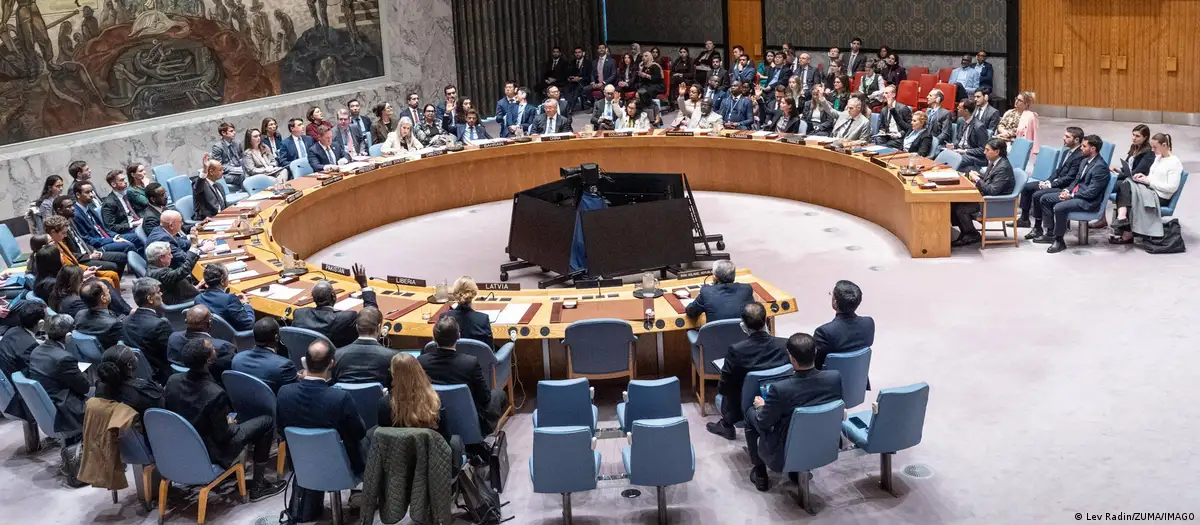
Germany is in the running for a seat on the Security Council when the UN General Assembly elects new members to the most powerful body within the United Nations on Wednesday. According to the UN Charter, the Security Council bears "the primary responsibility for the maintenance of international peace and security."
The council's decisions are binding on all UN member states. It can impose sanctions, deploy peacekeeping missions and authorize the use of military force. The Security Council has five permanent veto-wielding members: the United States, Russia, China, the United Kingdom and France.
"I would say the chances are good, but it's a competition, and it's democracy," German Foreign Minister Johann Wadephul told DW during a visit to UN headquarters in New York in April. "So we can win. We can lose. Both is possible. We have good arguments. We engage in this world. We are engaged in the UN system. It (Germany) is the second largest donor. And we have some experience because we have for six times been already as a non-permanent member in the Security Council."
Germany is No. 2 contributor to UN
On its website, the Foreign Ministry cites Germany's financial contributions to bolster its case: "As the second-largest contributor to the UN system, Germany has been a reliable partner to the UN for more than 50 years."
Johannes Varwick, a professor of international relations at Martin Luther University of Halle-Wittenberg, does not believe that success is guaranteed for Germany. "For decades, Germany was widely accepted as a driving force behind multilateral political solutions in many parts of the world. Now there are many divisive issues," he tells DW, citing the Israel-Gaza conflict, the Iran war and the Ukraine war as examples. Ultimately, Varwick said the financial argument could be the deciding factor.
Germany accused of double standards
What does Germany seek to do with the seat? In a short film titled "More than a Seat at the Table," which was produced specifically to campaign for Germany's bid, the message is: "We are ready to take a seat to stand up. For respect, justice and peace."
On its website, the Foreign Ministry writes: "On the Security Council, Germany wants to focus on the issues of conflict prevention, crisis resolution, climate and security." Since these are goals that almost anyone would support, they can hardly be used as a unique selling point for Germany.
Some aspects of the German bid sound like a counterpoint to US President Donald Trump's strongman policy, such as when the German Foreign Office calls for a "rules-based international order" and the validity of international law. "The UN system is under pressure," German Foreign Minister Wadephul told DW in New York. However, he continued, "I believe that diplomacy remains very important so that the law of the jungle does not prevail." He did not mention Donald Trump by name.
According to Johannes Varwick, even Germany's insistence on international law has earned it criticism at the UN. Some accuse Germany of applying a double standard: "For example, by siding so firmly with Israel on the Gaza issue. I think almost everyone at the United Nations understands that Germany has different historical ties to Israel — there's no question about that." Varwick is referring here to the Holocaust, the murder of some six million Jews during the Nazi era in Germany. "But the fact that one stands so clearly on the side of the aggressor — as many perceive it — while at the same time holding high the banner of international law in Ukraine in a very dogmatic manner, somehow doesn't add up," he explains.
Reform of Security Council seems hopeless
German Foreign Minister Wadephul would like to restore the United Nations' role in international conflict resolution. With regard to the wars in Ukraine and Iran, he has called for the UN to "become the linchpin of current crisis diplomacy."
In both wars and in many other conflicts, the United Nations has remained rather passive, and the reason for this is largely due to the fact that at least one of the parties involved in these conflicts holds veto power on the Security Council: Russia in the war in Ukraine and the US in the war in Iran. They have blocked resolutions directed against them, effectively paralyzing the Council itself.
Wadephul sees this as further proof that the Security Council must be reformed — something that UN Secretary-General Antonio Guterres has also been pushing for. They argue that the current makeup of the Council, especially the veto-wielding members, still resembles the global political landscape immediately after World War II and is not reflective of today's world.
For years now, Germany, Japan, Brazil and India have each been calling for a permanent seat, as well as two additional seats for African states. In addition, they want to see seats allocated to four or five non-permanent members, primarily to give greater weight to underrepresented regions such as Africa, Asia and Latin America.
But nothing has ever come of this. And it doesn't look likely to happen any time soon, because the existing five veto powers would have to agree to give up their privileges. Johannes Varwick, too, says that such reform attempts, however justified, are "doomed to failure."
The UN's diminishing influence
The question, however, is to what extent the Security Council and the United Nations as a whole are still relevant at all. In a report released in late August, the Stockholm International Peace Research Institute (SIPRI) spoke of "the near-total marginalization of institutions like the United Nations, due to a combination of financial, political, and geopolitical factors."
New alternative groups and power blocs have long since emerged, such as the G20, the group of the twenty most important industrialized and emerging economies, or BRICS Plus, where key non-Western states have joined forces, including China, Russia and India. These groups have thus been able to bypass the United Nations.
This is not in Germany's interest, Varwick argues in his analysis of the significance of the United Nations: "Strengthening traditional UN multilateralism must remain the strategic goal of German foreign policy. This is very difficult and arduous, but the world would not be better off if forums such as the G20 or BRICS were to emerge as successors to this UN multilateralism."
Austria and Portugal also strong candidates
Germany has served a total of six terms on the Security Council, most recently from 2019 to 2020. In its current 2027–2028 bid, Germany faces competition from two other EU countries, Austria and Portugal, which are also strong contenders, especially since Germany's application was submitted relatively late. To succeed, Germany needs two-thirds of the votes from the 193 member states.
In an interview with DW, Johann Wadephul advised the General Assembly: "One should choose a country that has experience and is interested in fostering greater understanding of other countries and other continents." Needless to say, he sees Germany as the frontrunner here. Whether enough other countries share this view will reveal itself on June 3.
This article was translated from German.