Germany news: Merz questions coal reform amid Mideast crisis
Published March 27, 2026last updated March 27, 2026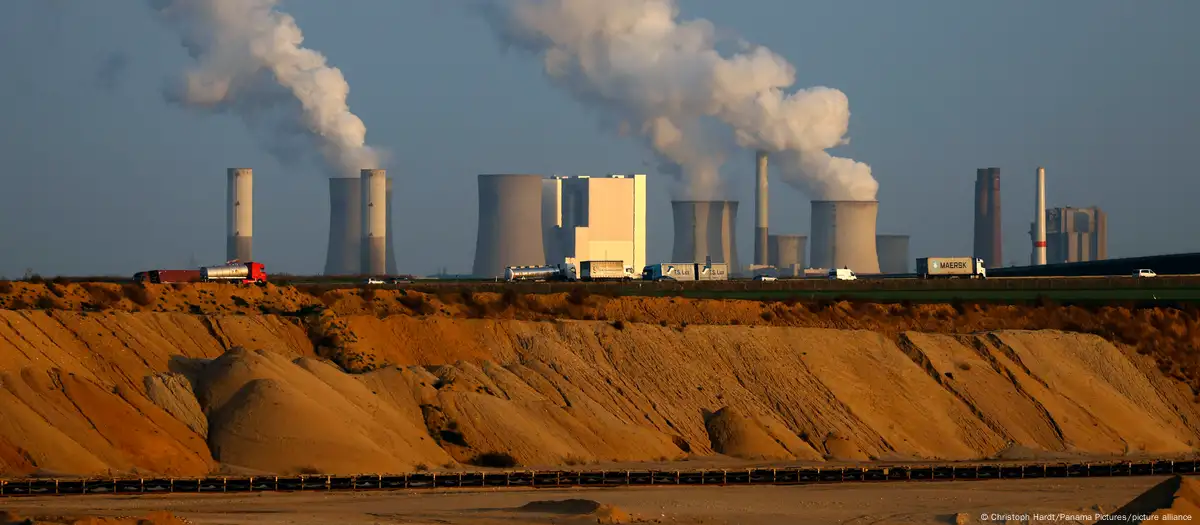
What you need to know
- Chancellor Merz questions plans to abandon coal amid energy crisis
- Deutsche Bahn records a €2.3 billion loss in its annual report
- Former member of the Red Army Faction, Daniela Klette, is facing new charges related to attacks in the 1990s
- Germany's center-left Social Democrats are meeting to discuss strategy after a string of election defeats
- A humpback whale stranded on a sandbank off of Germany's Baltic Sea coast since Monday has freed itself
Here are some of the latest headlines from Germany on Friday, March 27:
Germany's coal-fired plants could run longer due to Iran war
Amid the ongoing energy crisis sparked by the war in the Middle East, Chancellor Friedrich Merz questioned Germany's plans to abandon coal as a source of power.
"We may need to keep our coal plants online for longer," he said at an event organized by the Frankfurter Allgemeine Zeitung in Frankfurt.
Germany has used coal as its primary energy source for many decades. However, its share has dropped to less than 22% by 2024, with renewable energy sources at nearly 60%. The county is in the process of eliminating coal to minimize pollution, with the last coal-fired plants to be phased out by 2038.
"I am not ready to gamble with the core of our energy supply just because we agreed on some deadlines years ago," Merz said on Friday.
The conservative chancellor also pledged to keep expanding renewable energy sources, but noted they would need to be supplemented by natural gas.
He also ruled out returning to nuclear power in the near future.
READ: Germany: Mental health patients face uphill battle for help
Waiting lists for psychotherapy are full-to-bursting in Germany, with patients often waiting more than a year for treatment.
The situation could significantly worsen if planned cuts to psychotherapists' fees take effect in April.
Demonstrations have already taken place in cities across Germany, and a nationwide day of protest is also planned to take place on March 28.
Lufthansa cabin crew votes in favor of strike
Cabin crew at Lufthansa and its German regional airline, Lufthansa Cityline, have voted overwhelmingly to go on strike, their union said in a statement on Friday.
According to the union, support for a strike was 94% at Lufthansa and 99% at CityLine, without a single "no" vote.
"Turnout for the strike votes was higher than it has been in a long time. This shows how great the pressure is, but also how strong the unity is among the cabin crew," said Sara Grubisic, deputy chair and board member for collective bargaining policy at the Independent Flight Attendants' Organization (UFO).
"If the employers continue to stall or resort to confrontation, it's clear that the cabin crews in both airlines are ready to take the next steps," she added.
However, a strike is not planned immediately.
"We have not closed the door to talks recently and will continue to do so," said chief negotiator Harry Jaeger.
Lufthansa said it hopes "to achieve positive outcomes for our employees through further discussions."
In mid-February, Lufthansa pilots and cabin crew went on strike on the same day. The airline had to cancel around 800 flights, affecting nearly 100,000 passengers.
Deutsche Bahn execs' salaries total €17.3 million
After reporting a net loss of €2.3 billion on Friday (see entry below), German rail operator Deutsche Bahn later said its executives were paid a total of €17.3 million last year, including severance payments and bonus payments.
Just under €5.5 million went to former chief executive Richard Lutz, according to the group's latest annual report for 2025. Lutz's salary was €1.4 million, and he received severance pay of just under €3.5 million plus bonuses, known as variable remuneration, totaling around €570,000.
Total severance payments to departing top executives, including Lutz, amounted to around €11.3 million.
Remuneration for new members of the six-person management body was significantly more modest and totaled just under €3.7 million.
New DB chief executive Evelyn Palla received €1.17 million last year —slightly less human resources board member Martin Seiler's €1.22 million.
Syrian accused of leading pro-Assad militia on trial in Berlin
A Syrian man accused of committing murder and crimes against humanity while leading a militia group supporting former Syrian President Bashar Assad went on trial in Berlin.
The 41-year-old, who arrived in Germany as a refugee in 2015, was living in Berlin when he was arrested in late September. He is alleged to have helped Assad's dictatorial regime crush anti-government dissent after uprisings across the country in 2011.
German prosecutors said the man and his fellow militants targeted protesters, brutally beating them before turning them over to Assad's henchmen. After that, demonstrators "were subjected to severe torture and inhumane conditions" in various government-run prisons.
The defendant stands accused of murder in the case of a Syrian man who suffered a heart attack while being beaten with truncheons and abused with an electric prod.
In addition to the murder charge, the defendant was also charged with eight counts of crimes against humanity.
The trial is expected to wrap up in mid-July.
Poll shows low confidence in SPD leadership
A majority of Germans have said they do not trust Social Democratic Party (SPD) leaders to steer the party out of its crisis after recent election losses.
According to the ZDF "Politbarometer," 75% of respondents said Lars Klingbeil, Germany's vice chancellor and finance minister from the center-left SPD, and Bärbel Bas, federal labor minister and SPD co-leader, are not capable of putting the party back on track.
Among SPD supporters, 56% shared that view, while just 29% expressed confidence in the leadership duo.
The poll also showed internal debate over the party’s direction, with 48% of SPD supporters calling for a stronger emphasis on left-wing policies, while 22% want the opposite.
Among all voters, opinion is split, with 37% favoring a more left-leaning SPD and 36% preferring fewer left-wing positions.
If a federal election were held Sunday, the SPD — Germany's oldest political party — would receive 13%, a record low.
The conservative CDU/CSU bloc and the far-right Alternative for Germany (AfD) would each poll at 26%, while the Greens would reach 15% and the socialist Left Party 10%.
Invasive ant discovered in Germany for first time
A potentially dangerous invasive ant species has been detected in Germany for the first time after a student spotted it during a zoo visit in Stuttgart.
A biology student identified unusual ants at the city's Wilhelma Zoo, and researchers later confirmed a full colony of the Asian needle ant in a nearby park.
Scientists said the species can deliver painful stings that may trigger allergic shock, similar to wasp stings, and in rare cases can be life-threatening.
"The insects are classified as particularly problematic by the European Union due to their potential for causing damage and their potentially allergy-inducing stings," experts from the Senckenberg Society for Natural Research in Frankfurt announced.
The species was upgraded to the highest threat category of the EU last summer.
Experts warned that the discovery shows the ants are already establishing a local population capable of surviving winters in Germany.
The species, native to East Asia, has spread in the US and parts of Europe, where it displaces native insects and disrupts ecosystems.
Researchers believe the ants likely arrived via imported plants or goods and say rising temperatures are helping them spread.
They are calling for monitoring programs to track the species and prevent wider expansion.
Castle fire likely caused by animal
Officials in the central German state of Thuringia said a technical defect in a storage room caused a recent fire at Runneburg Castle.
The 12th-century building caught fire earlier this week in what local authorities said was very nearly a disaster.
Investigations by police and fire experts now believe the blaze was likely caused by a faulty electrical cable. Police added that the defect was likely triggered by a rodent or other small animal chewing on the cable's insulation.
Authorities said a fire smoldered inside the building for days before becoming a full-fledged blaze.
Local authorities said they had discovered no signs of arson at the culturally important site.
Representatives from Thuringia's Castle and Garden Foundation said it was too early to put a price tag on damage sustained during the fire.
Runneburg Castle is considered one of the best-preserved examples of Romanesque architecture in the whole of Germany.
Union, employers split on pension reform
Germany's private pension reform has drawn sharp criticism from unions, while employers say it falls short despite some improvements.
The industrial union IG Metall has said the new system creates "no secure retirement provision, but a new labyrinth of subsidized schemes that are ultimately financed solely by employees and offer no guaranteed benefits."
Union official Hans-Jürgen Urban also warned the government was moving ahead before its pension commission delivers recommendations, risking making the process a "farce." The commission is expected to present its proposals by the end of June.
Employers' association BDA called the reform "a step forward—but a small one," saying financial prospects were improved and complexity reduced.
However, BDA chief Steffen Kampeter said the plan still does not go far enough, criticizing in particular the €1,800 cap on subsidized contributions as insufficient to meet retirement goals.
Kurdish community criticizes planned visit of Syrian President al-Sharaa to Berlin
Germany's Kurdish community has criticized the planned visit of Syria's interim President Ahmed al-Sharaa to Berlin, calling for strict conditions from the government.
Ali Ertan Toprak, chairman of the KGD umbrella group of Kurdish organizations, told RND newspapers that al-Sharaa lacks democratic legitimacy and accused him of serious human rights abuses, war crimes, and crimes against humanity.
Toprak said the Syrian leader bears responsibility for violence against civilians, particularly Kurds, Yazidis, Alawites, Druze, and Christians.
He urged Chancellor Friedrich Merz to clearly address human rights violations and demand concrete guarantees for minority protection.
"There can be no political normalization without demonstrable improvements in the human rights situation, without the introduction of democratic structures, and without the inclusion of all ethnic groups in the distribution of power," said Toprak. He added that financial aid must be tied to these conditions.
READ: Merz criticized for selective approach to international law
Dozens of legal scholars have called on the German government to condemn the US operations in Iran and Venezuela.
They argue that if violations of international law go unpunished, the rule of law erodes.
Read the full story here.
Ex-Red Army Faction member Klette faces new charges over 1990s attacks
Former Red Army Faction member Daniela Klette is facing new charges, with Germany's federal prosecutors accusing her of multiple serious crimes linked to past attacks.
TheFederal Prosecutor's Office said it has charged the 67-year-old with attempted murder, involvement in explosive attacks, kidnapping for extortion, and aggravated robbery, with a court in Frankfurt to decide whether and when a trial will begin.
Prosecutors allege Klette was part of the so-called third generation of the Red Army Faction and took part in several attacks between 1990 and 1993.
These include an attempted bombing of a Deutsche Bank building in Eschborn in 1990, which failed to detonate, and a 1991 shooting attack on the US embassy in Bonn involving at least 250 rounds.
She is also accused of involvement in a 1993 bombing of a prison in Weiterstadt that caused an estimated €73 million in damages.
Authorities said Klette later lived under a false identity in Berlin for decades, while alleged accomplices Ernst-Volker Staub and Burkhard Garweg remain at large.
Klette is already on trial in a separate case over a series of robberies between 1999 and 2016, allegedly carried out to finance life underground.
She was arrested in Berlin in February 2024 after years in hiding, where neighbors knew her as a quiet private tutor.
Deutsche Bahn posts €2.3bn loss as outlook weakens
German rail operator Deutsche Bahn has reported a €2.3 billion ($2.65 billion) net loss after lowering the expected value of its long-distance business due to ongoing infrastructure problems.
The state-owned company said the loss widened by about €500 million compared with the previous year.
A €1.4 billion reduction in the value of its DB Fernverkehr unit, which operates long-distance passenger trains, was cited as the main reason for the loss. The division now expects significantly lower future revenue as rail infrastructure and punctuality improve only slowly.
The sale of logistics subsidiary DB Schenker has also removed a key source of profit, although the proceeds did help cut debt by nearly €12 billion to €20.7 billion.
Despite the loss, CEO Evelyn Palla said a turnaround is emerging, with operating profit reaching €297 million and revenue rising about 3% to €27 billion.
"Satisfaction would be out of place," said Palla, who has been in office since October. "Only when we are once again generating sustainable annual surpluses and can finance investments from our own resources will we have reached our goal."
But she warned that it will take at least 10 years to get the rail network in good working order.
READ: Whale swims to freedom after days stranded off German coast
Rescuers managed to free a humpback whale that had been stuck on a sand bank off Germany's Baltic coast on Friday.
The whale had been stranded for several days on the Timmendorfer Strand, with numerous rescue attempts failing to shift the marine mammal.
Read more here.
Germany moves to replace unpopular Riester pension system
Germany's parliament has voted to replace the underperforming "Riester" pension system with a new state-backed savings model.
The current system, introduced in 2002, has proven unpopular because it delivered low returns, was complex and costly, and offered limited benefits — especially for lower-income earners. The reform aims to fix this by making saving simpler, cheaper, and potentially more profitable.
Finance Minister Lars Klingbeil called the reform a "real milestone" and a "game changer," saying it strengthens the third pillar of pensions alongside statutory and occupational schemes.
He said changes agreed in parliament make private retirement savings more attractive for low-income earners and families, adding that saving will now pay off "from the first euro" and costs have been reduced.
The SPD-CDU/CSU coalition approved the reform, which will effectively phase out new Riester contracts. The Left Party voted against while the Greens and far-right AfD abstained.
Eligibility will be expanded to include self-employed workers, while state subsidies are to be simplified and increased, particularly for families.
Klingbeil also said his ministry will soon present plans for a "starter pension," under which the state would contribute about €10 (roughly $11.50) per month into retirement accounts for children and young people.