Germany news: Alpine pass reopened after large protest
Published May 30, 2026last updated May 31, 2026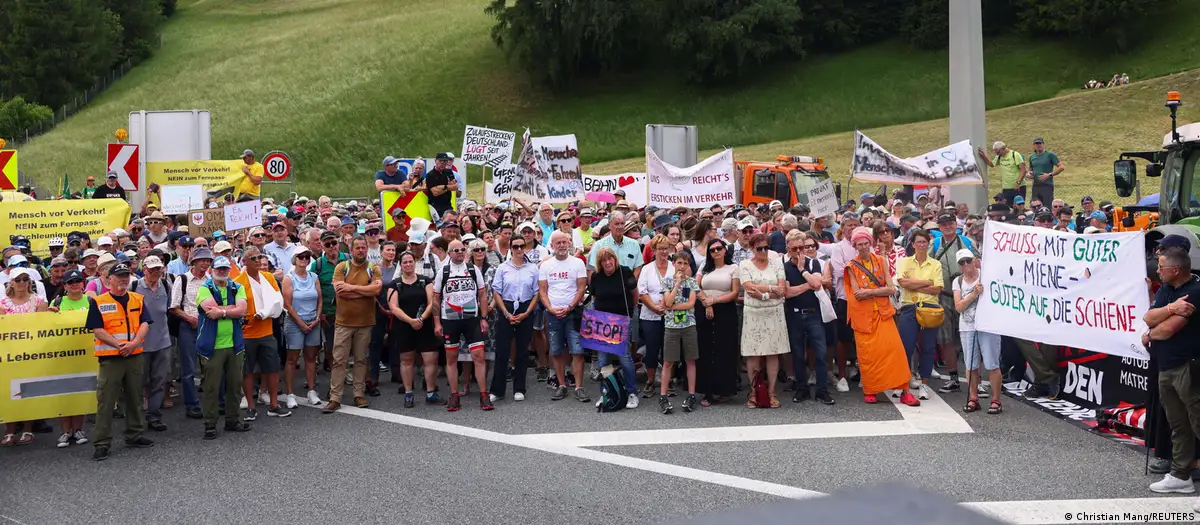
What you need to know
- Hundreds of trucks were turned away from the Brenner Pass, a major Alpine route, due to a rally against traffic jams and noise pollution
- Russian President Vladimir Putin restated his call that his friend ex-Chancellor Gerhard Schröder act as EU negotiator on Ukraine
- Germany's family minister says legal changes should be considered to limit screen time for kids
- Autopsy to be carried out on 'Timmy' the whale after the corpse was brought to shore in Denmark
Here is a roundup of stories from and about Germany on Saturday, May 30, 2026:
Tired of missing our real-time updates? Click here to add us as a Preferred Source on Google. Then tap the "Star" or "Preferred" to keep DW News at the top of your feed.
We're pausing our coverage
We'll be pausing our coverage of the news coming out of Germany this weekend, but we'll be back bright and early on Sunday morning.
All lanes open at Brenner Pass after large protest
The Brenner Pass linking Austria and Italy has been reopened following a rally against heavy traffic.
"All lanes are open again," a spokesman for the motorway operator Asfinag told the DPA news agency.
Thousands of people had crowded the Alpine pass earlier on Saturday, demanding an end to pollution, noise and traffic jams caused by heavy traffic on the key road.
While officials warned of possible traffic jams due to the rally, no major disruptions were reported in the area.
Police said 219 trucks were turned back during the hourslong protest.
IN DEPTH: Vaping becoming more popular among young people in Germany
A recent study shows that e-cigarettes are becoming increasingly popular among young people in Germany, with even elementary school kids picking up vapes. Social media influencers are fueling the hype, but a senior government official hopes to ban flavors that appeal to young people.
Read our full report here.
Thousands protest new gas-fueled power plants in Germany's Hamm
Some 5,000 people took part in a protest in the northwestern German city of Hamm against government plans to construct new gas-fueled power plants, protest organizers said on Saturday.
Police estimated the number of attendees at around 2,700 people.
Germany's ambitious strategy of switching to renewable energy sources and becoming climate-neutral by 2045 has been put under increasing pressure due to the geopolitical conflict with Russia and the more recent disruption in the Strait of Hormuz.
In response to the twin crises, the government is focusing on ensuring consistent energy supply rather than managing the long-term transition. Some climate activists have decried the shift as a quiet rollback of the official environmental goals.
The government has now pledged to construct new gas-powered plants, which would eventually be fueled by environmentally friendly hydrogen.
Even so, activists in Hamm say the state should not be investing in fossil fuels. Several environmental groups, including Fridays for Future and Greenpeace, helped organize the protest on Saturday.
"We want future, not gas, and we are joining forces against the government's rollback of climate policy," the organizers said.
Thousands protest rising traffic in Brenner region
Several thousand people gathered at the Brenner Pass on Saturday to protest against the growing amount of traffic using the transport corridor, which links northern and southern Europe.
Demonstrators in the Austrian town of Matrei am Brenner carried signs reading "Enough is enough" and "Peace in the valley," while calling for measures to reduce the adverse effects of heavy traffic on residents' health and well-being.
Some protesters also criticized the delayed planning of the rail access line in Germany's southern state of Bavaria, which is intended to relieve congestion on the motorway.
Karl Mühlsteiger, the mayor of the nearby municipality of Gries am Brenner, called the number of demonstrators "sensational."
Authorities in Austria and Italy have temporarily closed the Brenner corridor to through traffic on both sides of the border.
So far, however, no major traffic disruption has been reported. Motorists were urged to avoid non-essential travel because of the planned protest.
However, a fire on a railway line north of Verona in Italy disrupted train services along the Brenner corridor, with authorities still unclear as to the cause.
The Brenner corridor is expected to remain closed on the Austrian side of the border until 7 p.m. (1700 GMT). On the Italian side, restrictions are in force until 8 p.m.
Among other things, the Brenner Pass is often used by holidaymakers from Germany wanting to vacation in southern European countries such as Italy.
According to motorway operator Asfinag, nearly 11 million cars and around 2.5 million trucks used the toll motorway in 2025, making it the busiest link from north to south in the Alps.
Steinmeier urges commitment to democracy at historic Hambach event
German President Frank-Walter Steinmeier has called for renewed civic engagement to protect democracy at commemorations of the Hambach Festival.
The 1832 event at Hambach Castle, in the state of Rhineland-Palatinate, is seen as a key milestone in Germany’s democratic tradition, where participants demanded Germany unity, freedom and democracy.
Speaking in the town of Neustadt an der Weinstrasse, Steinmeier said defending democracy is "our shared responsibility" and praised widespread grassroots initiatives across the country.
The president said citizens must counter pessimism and actively support democratic values, highlighting the role of volunteers, associations and civil society.
He warned against leaving the legacy of the Hambach Festival to those who oppose democratic principles, calling that a betrayal of history.
The far-right Alternative for Germany has frequently attempted to politically appropriate the historic festival to frame itself as a contemporary defender of German patriotism and free speech.
IN DEPTH: Germany's Havertz set for second Champions League final
Millions of eyes across Europe will be trained on television screens on Saturday night for the climax of the European football season, the UEFA Champions League final.
Holders Paris Saint-Germain take on recently-crowned English champions Arsenal in Budapest, and former Leverkusen and German international Kai Havertz is likely to feature for the London side.
His performance will be closely watched by Germany coach Julian Nagelsmann, with the World Cup in the US, Canada and Mexico just weeks away.
DW's Jonathan Harding has this to say about the 26-year-old football star and the hopes Germany is pinning on him: Kai Havertz: Arsenal and Germany's man for the big moment
'More Merz' is needed, not less — Hesse's state premier
Two prominent politicians from Chancellor Friedrich Merz's Christian Democratic Union (CDU) have rejected media speculation that there have been discussions within Germany's conservative CDU/CSU bloc on a possible change in leadership.
The premier of the western state of Hesse, Boris Rhein, told a local party congress: "We don't need less Merz: We need more Merz."
Rhein warned his party not to play the game of the political opposition with what he called rumors.
"We are the majority, we are the center, we are Merz," he said to applause.
At the same congress, the leader of the CDU's parliamentary group, Jens Spahn, called the speculation "nonsense."
In a speech, Spahn pointed to what he said were successes of the conservative-led coalition government.
Merz was a chancellor who was ready to get his hands dirty and who had a clear sense of what direction to go in to reform Germany and rebuild its economy.
"And he has our full support in this," he said.
Their statements come after media reports saying that the CDU/CSU was possibly considering replacing Merz in view of the coalition's current troubles.
The reports mentioned Hendrik Wüst, the CDU premier of the state of North Rhine-Westphalia, as a potential replacement for Merz.
People close to the chancellor have vehemently denied the reports.
Germany, France step up nuclear deterrence talks
Germany and France have begun talks on closer cooperation in nuclear deterrence, according to a report.
The news magazine Der Spiegel said Chancellor Friedrich Merz's security adviser Günter Sautter held initial discussions in Paris with several partner countries.
The report said the Bundeswehr could take part in the conventional component of French nuclear exercises for the first time as early as September.
The move follows a joint initiative by Merz and French President Emmanuel Macron to deepen cooperation on deterrence, including the creation of a bilateral steering group.
While Berlin did not confirm details of the Paris meeting, a government spokesperson described the process as ongoing, with further steps expected.
France has proposed expanding its nuclear deterrence role in Europe, including joint exercises and potentially deploying nuclear-capable aircraft in allied countries.
AfD pushes for state-run migration enforcement
The far-right Alternative for Germany (AfD) in the northeastern state of Mecklenburg-Western Pomerania has drawn up election campaign plans calling for state-level migration enforcement.
Delegates adopted a program calling for a "dedicated border and repatriation police force within the state police."
The party also proposes setting up a detention facility for deportations and tightening controls on migration at the regional level.
The plans go beyond current state powers in Germany, where immigration policy is largely handled at the federal level.
The AfD is also seeking to end funding for certain migration-related groups and introduce stricter conditions tied to political neutrality.
It also wants renewed use of the Nord Stream gas pipelines and is opposed to wind power expansion.
Meanwhile, the program calls for a return to nuclear energy and the abolition of CO2 taxation.
Autopsy to be carried out on 'Timmy' the whale
Experts in Denmark are to carry out a post-mortem examination of "Timmy," the humpback whale whose repeated strandings, eventual rescue and subsequent death made headlines in Germany and abroad for weeks.
The autopsy is to be conducted on the Danish island of Anholt, near which the whale was found dead more than two weeks ago.
His carcass was dragged by a vehicle from shallow waters off the island onto the beach on Saturday morning and is to be examined in the coming week.
Danish officials had previously warned the public that the carcass was at risk from exploding from the gases produced by its decomposition.
"Because the animal has been lying in the sun for so long, it will smell terribly," said whale researcher Peter Teglberg Madsen, who has been assisting with whale autopsies in Denmark for 25 years.
"It will be quite overwhelming if you’re not used to it," he added.
Madsen believes the rescue attempt carried out by a private initiative using a barge was "pure animal cruelty."
"It was tossed about by the waves, exposed to the noise of the engines, only to be simply dumped into the sea — that must have been incredibly stressful and frightening for the animal," he said.
German troops arrive in Lithuania for first major combat exercise
Two additional German battalions have arrived in Lithuania for drills entitled "Freedom Shield" to be conducted together with the 45th Armored Brigade of the Bundeswehr already in the Baltic country and other NATO troops.
The battalions brought with them Leopard tanks and Puma armored personnel carriers, a spokesman for the brigade said.
Some 2,900 soldiers from eight NATO countries — including 2,300 from Germany — will assemble at Lithuania's Pabrade military training area for the drills.
They are to train there “under real-world conditions with all elements of the modern battlefield," including drones, mortars, artillery, attack helicopters, battle tanks and armored personnel carriers, the spokesman said.
The Bundeswehr deployed the brigade in Lithuania in 2025 in response to the growing threat from Russia amid its invasion of Ukraine.
The two battalions deployed for the exercise are to be relocated entirely to Lithuania as soon as the necessary infrastructure is in place.
The drill is reportedly to take place twice a year until then.
Family minister urges parents to cut kids' screen time
Parents should be put under more pressure to limit the time their children spent looking at smartphones and tablets, German Family Minister Karin Prien has said.
"I believe it should be a social standard that children below three years of age have absolutely no contact with digital end devices," Prien told the weekly Welt am Sonntag.
Prien, a member of ChancellorFriedrich Merz's conservative Christian Democrats (CDU), said that legal pathways to achieve this goal should at least be considered.
"After all, we regulate other obligations of parents in the Civil Code," she said, noting that corporal punishment is banned in Germany, for example.
"But we have to tell parents much more clearly what consequences their behavior has for the development of their children," she said, saying that these were "dramatic" — also because parents themselves were spending too long at screens.
Prien also called for children to be tested for speech and general development around their fourth birthday, saying children with special needs should receive extra help before beginning school.
The minister said that it was essential for schools to focus on basic skills such as reading, writing and arithmetic.
She said the fact that "around a quarter of children in Germany leaves primary school without being able to read properly" was something the country could not afford.
Putin doubles down on Schröder proposal
Russian President Vladimir Putin has proposed once more that former German Chancellor Gerhard Schröder could act as the EU's negotiator if there are peace talks to end the conflict in Ukraine triggered by Moscow's invasion.
"When I mentioned Mr Schröder's name, I had in mind someone who can be trusted," Putin said in the Kazakh capital Astana on Friday.
He said that Schröder's status as his friend did not speak against such a nomination.
"What's wrong with that?" Putin said, saying it was a matter of trust.
EU leaders have given a cool reaction to Putin's suggestion.
Schröder, who was chancellor from 1998 to 2005, has come under fire for his involvement with Russian energy companies since retiring from politics.
Munich Airport briefly halts flights over drone sighting
Operations at Munich Airport were temporarily suspended on Saturday after a suspected drone sighting.
Federal police said two pilots reported a suspicious object that may have been drones, prompting authorities to halt takeoffs and landings.
"In coordination with German air traffic control, the security authorities then decided to close the runways," a police spokesman told the AFP news agency.
After assessing the situation, however, authorities determined that there was no threat.
And a spokesperson for the airport later reported that flights at the airport had resumed.
There was a similar suspension of services because of drone sightings at the airport in October last year.