Cypriot president visits Berlin before Cyprus EU presidency
November 13, 2025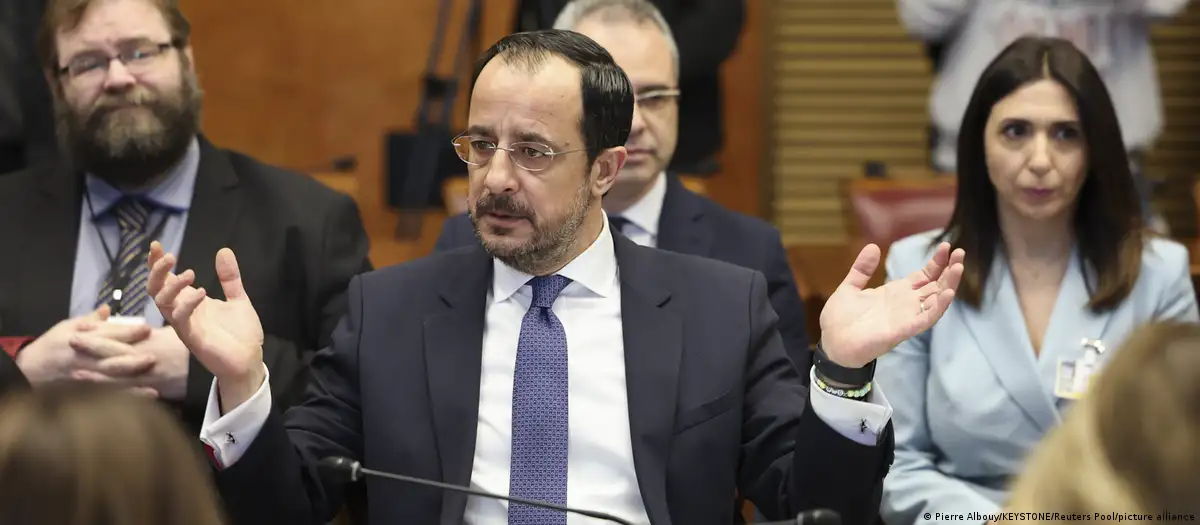
Just over six weeks before Cyprus assumes the presidency of the Council of the European Union, Cypriot President Nikos Christodoulides travels to Berlin for a meeting with German Chancellor Friedrich Merz on November 14.
Konstantinos Letymbiotis, spokesperson of the Cypriot Government, confirmed that Cyprus's EU presidency will feature largely at the meeting.
"At the center of Friday's meeting — the first between Christodoulides and Merz — will be the key issues included in the agenda of the six-month EU presidency, which Nicosia will assume on January 1, 2026," Letymbiotis told DW.
According to Letymbiotis, Christodoulides will present the main pillars of Cyprus's EU presidency program to Merz, including, among other things, EU defense, border management and the promotion of EU enlargement, including the Western Balkans.
EU competitiveness and the EU multiannual financial framework — the bloc's long-term budgetary plan — are also likely to be top of the agenda in Berlin, reflecting the importance the German government attaches to these issues. On the initiative of Chancellor Merz, 19 EU member state leaders recently wrote to European Council President Antonio Costa, calling for the simplification of legal regulations to strengthen the EU's competitiveness.
EU defense policy
According to DW sources, the Christodoulides–Merz meeting will also place particular emphasis on defense, specifically on strengthening member state cooperation and developing the European defense industry.
As such, it's likely the EU's Security Action for Europe (SAFE) program and Turkey's desire to participate in the EU's new security architecture as a subcontracting third country will also be discussed.
Cyprus has previously expressed concern over Turkey's possible involvement, stating that countries that threaten the security and defense interests of the EU and its member states cannot participate in European defense programs.
The Republic of Cyprus's opposition to Turkish participation is directly linked to what is known as the Cyprus question or "Cyprus problem," in other words the de facto division of the island into the internationally recognized Republic of Cyprus and the self-declared Turkish Republic of Northern Cyprus after a Greek-backed coup followed by a Turkish military intervention in 1974.
However, Cypriot government sources note that although EU candidate countries can participate in the SAFE program by signing a bilateral agreement with the EU, such an agreement would have to be unanimously approved by the European Council, i.e. by all EU member states.
Relations with NATO
Another issue that will be raised at the meeting in Berlin is the EU–NATO relationship.
Cyprus has said that its goal during its presidency of the EU Council is to ensure that cooperation "continues to be conducted inclusively, and in a mutual, transparent, and beneficial manner for all parties at all levels," since "relations with partners across the Atlantic remain a cornerstone of European security."
Although Cyprus is not itself a member of NATO, President Christodoulides has publicly expressed his wish for Cyprus "to seize opportunities so that, when conditions are right, the Republic of Cyprus can become a NATO member state."
NATO member Turkey, however, categorically rejects the idea of Cyprus joining NATO, saying it cannot accept the accession of a state it does not recognize.
For this reason, Christodoulides is expected to limit himself to reaffirming Cyprus's role as an "ambassador" of the EU in the Eastern Mediterranean and to calling for a stronger EU presence in the region, which "could take the form of financial support to countries such as Egypt, Lebanon and Jordan," spokesperson Letymbiotis told DW.
The 'Cyprus problem' looms large
Recent developments relating to the Cyprus problem are also expected to be discussed by Merz and Christodoulides.
In late October, Tufan Erhurman, a moderate and supporter of a federal solution, was elected by Turkish Cypriots as their leader.
Although negotiations about a resolution to the Cyprus problem take place under the auspices of the United Nations, the Republic of Cyprus has long believed that Germany has an important role to play in the process due to Berlin's strong diplomatic relations with Ankara.
Cypriot government sources say that one indication of Germany's potential in this respect was former Chancellor Olaf Scholz's strong support for the appointment of Maria Angela Holguin Cuellar as the UN Secretary-General's personal envoy on Cyprus, as well as his intervention with Ankara to overcome its initial objections to her appointment.
Christodoulides is expected to reaffirm in Berlin his readiness to pick up negotiations where they left off in Crans-Montana, Switzerland, in 2017.
According to UN Secretary General Antonio Guterres, although the parties at the time came very close, there was still a gap that could not be bridged, primarily due to differences on security arrangements and troop withdrawals.
President Christodoulides will also likely emphasize that Cyprus supports the revival of the EU's accession negotiations with Turkey, which have been frozen since 2018, as long as this revival is in accordance with Ankara's Cyprus-related obligations and meets the criteria set out in the European Council Conclusions of April 17-18, 2024, regarding EU and Turkey relations.
Edited by: Aingeal Flanagan