German Chancellor Merz visits India's tech hub Bengaluru
Published January 12, 2026last updated January 13, 2026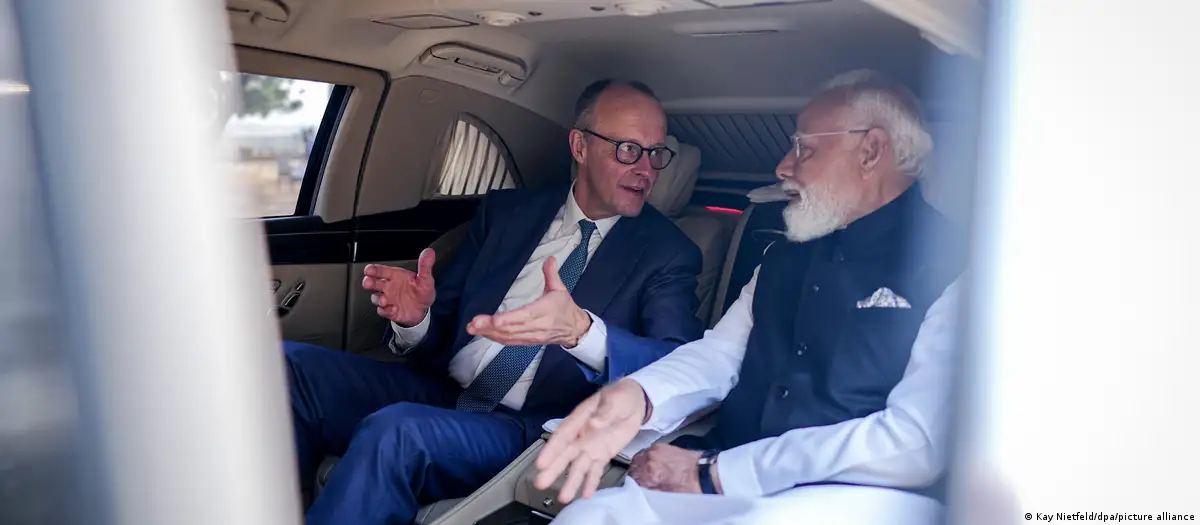
What you need to know
- Germany's Friedrich Merz is in India on his first trip as chancellor
- Merz visited Ahmedabad on day one, including the Gandhi Ashram
- He met India's Prime Minister Narendra Modi, who hailed bilateral trade between the two countries
- Merz is also paying a short visit to Bengaluru on Tuesday
- The visit comes weeks ahead of the EU-India summit
This blog is now closed. It covered Merz's visit to India on Monday, January 12, and Tuesday, Janurary 13, 2026:
Thank you for joining us
Germany's Friedrich Merz has boarded a plane out from Bengaluru, marking the end of his first visit to India as chancellor.
His first stop was Ahmedabad in western Gujarat state, where he met with Indian Prime Minister Narendra Modi, who gave Merz a tour of independence leader Mahatma Gandhi's residence and took him to a kite festival.
In a joint statement released after their meeting, Merz and Modi hailed the two countries' strategic partnership, highlighting a commitment to increasing defense cooperation and bilateral trade.
There was no announcement on a planned €8 billion ($9.3 billion) deal to jointly build submarines in India.
Later, Merz made his way to Bengaluru, a major tech hub in southern India's Karnataka, where he hailed the "dynamism" of German industry in India.
Alongside other EU member states, Germany has been working to strengthen partnerships with countries around the world amid growing tensions with the United States and security concerns due to the Russian invasion of Ukraine.
Germany also seeks to boost the global competitiveness of its firms, with the traditional export powerhouse's economy ailing in recent years.
Merz's visit comes weeks ahead of a summit between India and the European Union.
How did Germany view Merz's visit to India?
In its coverage of Chancellor Friedrich Merz's trip to India, German media emphasized Europe's need to reposition itself in a shifting global order, while also pointing to the benefits Germany could achieve through deepening cooperation with India's rapidly growing economy.
A column in the German business daily Handelsblatt said that Merz's meeting with Indian Prime Minister Narendra Modi showed "how the world is reorganizing itself," adding that Germany "urgently" needs new economic and strategic partners.
It described India as a "promising market" and an "enormous opportunity" for Germany and the European Union as a whole.
But it emphasized that India "isn't a simple partner," pointing to New Delhi's ties with Moscow.
In its reporting, the paper highlighted Modi and Merz's opposition to a "renaissance of protectionism" amid the United States' extensive use of tariffs in its trade relations.
The newspaper Die Zeit also emphasized Berlin's desire to reduce India's dependence on Russia, pointing to the fact that New Delhi did not vote to condemn Moscow's invasion of Ukraine in the UN General Assembly.
Die Zeit speculated whether India could become a "a new friend in a new world order," tying Berlin's efforts to strengthen its ties to India with the European Union's plans to strike a free trade deal with South American bloc Mercosur.
The newspaper FAZ said that the idea that "India won't catch up" economically is a common view in Germany, and cited Indian economist Arvind Subramanian as warning that its progress could be "undermined by corruption, cronyism and nationalism."
However, it also struck a more optimistic note, saying that India was seeing high growth rates that could "fundamentally transform" the South Asian country.
Far-right AfD criticizes Merz visit
The head of the far-right Alternative for Germany (AfD), Alice Weidel, criticized Merz for his two-day visit to India, describing it as a "sight-seeing tour" in a post on the platform X.
She also said that India "gets €1 billion [$1.16 million] climate development money per year."
The party opposes climate protection policies and has called for massive cuts to development aid.
How did Indian media react to Merz's visit?
Here is a rundown of some of the topics discussed in Indian media related to German Chancellor Friedrich Merz's two-day visit to India.
The Times of India newspaper described the talks between Merz and Modi as "crucial," hailing a new and "more pragmatic phase" in relations between the two countries, highlighting the planned increase in bilteral trade and tech cooperation.
Meanwhile, a column in Indian daily The Indian Express spoke of the emergence of a new "Indo-Europe" as India and Germany strengthened their strategic partnership.
"Neither India nor Europe can afford to rely solely on an inward-looking US to manage the risks arising from a tightening China-Russia continental alignment," the author of the column argued, pointing to "US President Donald Trump's renewed unilateralism and Chinese leader Xi Jinping's assertive statecraft."
However, India's NDTV broadcaster cited Foreign Secretary Vikram Misri as saying that New Delhi was not being "ideological" in pursuing defense cooperation with Germany, as New Delhi also continues to cooperate with Russia.
"I would not say that sourcing from one is linked to sourcing from another," he said, while noting a "change" in Germany's approach to defense and security cooperation with India.
India maintains a close relationship with several Western countries, and is a member of the US-led Quad security forum, while also having strong defense and economic ties to Russia.
Indian travelers to experience 'relief' over transit visa waiver
Indian media also accorded particular attention to a new measure to simplify transit for Indian passport holders in German airports, with broadcaster NDTV calling it a "quiet but meaningful relief."
Germany is the site of major air transit hubs Frankfurt and Munich, where Indian citizens will no longer need to apply for transit visas in the case of layovers on the way to airports outside of the Schengen zone.
Merz hails 'unbelievable dynamism' in German industry in India
During his visit to India, Merz described the South Asian country as a major hub for the technological development of German industry.
"Impressive expertise is concentrated here," he said while visiting a site for German tech firm Bosch in Bengaluru, according to Reuters news agency.
Merz went on to say that economic development there was showing "unbelievable dynamism."
He said that Bosch had some 40,000 employees in India.
Merz pointed to work on hydrogen technology for trucks as well as applying artificial intelligence for industrial uses.
He said that the SAP software company had a substantial presence in India, employing around 17,000 workers, adding that Germany's pharmaceutical industry also saw opportunities in the country.
Merz also noted that people in India were showing growing interesting in the German language, with some 250,000 people attending German courses.
He said that Bengaluru was the city in the world receiving the most German visas, with some 40,000 being issued every year.
Merz warns against political influence on central banks
German Chancellor Friedrich Merz expressed concern on what he described as "strong" political influence on central banks while speaking in the southern Indian city of Bengaluru.
"I have been concerned for some time now, not just for the last few days or weeks, about how strong the political influence on central banks around the world is becoming," Merz was cited by Reuters news agency as saying during his visit to India.
"For good reasons, we in Europe, including Germany, have always considered the independence of the central bank to be of paramount importance. I hope that this will remain the case," the chancellor stressed.
The comments come after US Federal Reserve Chairman Jerome Powell said that President Donald Trump was threatening him with a criminal indictment as a way to put pressure on the central bank in Washington.
Trump has repeatedly called for the Fed to slash interest rates, while Powell has insisted the body will continue to set monetary policy based on "evidence and economic conditions."
We are seeing 'last days and weeks' of Iranian regime: Merz
German Chancellor Friedrich Merz said he believes the world is witnessing the "last days and weeks" of Iran's current regime under Supreme Leader Ayatollah Ali Khamenei, as widespread protests rock the Islamic nation.
"The population is now rising up against this Regime," Merz said on the sidelines of his visit to India, adding that Tehran has "no legitimacy through elections by the population anyway."
Merz said he hopes that the conflict can come to an end peacefully. Germany and its partners are currently "in close contact with each other to ensure that there can be a peaceful Transition in Iran to a democratically legitimate government," he said.
Iran has been gripped by a wave of protests since late December. While it began as protests by shopkeepers over mounting economic hardships, the regime's crackdown morphed it into a larger movement against the country's hardline Islamic rulers.
Iran Human Rights, a human rights organization based in Oslo, said at least 648 people have been killed since the protests begun.
Chancellor Merz expressed concern about the escalating violence and called on "the mullah regime" to "stop this violence immediately."
"If a regime can only hold on to power through violence, it is effectively finished," he said.
Merz arrives in Bengaluru
German Chancellor Friedrich Merz has arrived in Bengaluru on the second and last day of his India tour.
Bengaluru, formerly Bangalore, is the country's most influential technology hub and startup capital. Many German companies, including Bosch Siemens and SAP, have a strong presence in the city.
'Positive momentum' in €8 billion submarine deal, India's foreign secretary says
As India and Germany agreed to deepen security ties, an €8 billion ($9.3 billion) submarine deal has yet to be sealed.
The potential deal would see Germany's Thyssenkrupp Marine Systems build six submarines for the Indian Navy, in partnership with Indian state-run Mazagon Dock Shipbuilders.
For New Delhi, this means getting its hands on superior German defense technology as it replaces its ailing Russian-built fleet of submarines.
The deal is crucial for Berlin too as it would wean India off its dependence on Russia in the defense sector, while also allowing Germany to tap into India's lucrative market.
"There are technical, financial, commercial discussions that are involved in a deal of this kind. These discussions are continuing," said Vikram Misri, Foreign Secretary of India.
"All I can say is that the discussions have maintained a positive momentum but at this point in time since these have not concluded, it's difficult for me to say where we are exactly," he said.
India's Modi raises Baby Ariha case with Chancellor Merz, Indian official says
During talks of forging lasting defense and trade ties, India's Prime Minister Narendra Modi brought up a sensitive issue with Chancellor Friedrich Merz — that of Baby Ariha.
The five-year-old was separated from her Germany-based parents by authorities in Berlin in September 2021 on allegations of abuse. She was seven months old at the time.
While the abuse allegations against the parents were later dismissed, Ariha was not returned to her parents.
The baby girl, an Indian citizen, remains in the German social care system to this day, despite several diplomatic attempts to have her brought to India.
"Please be assured that we do not view this issue in isolation from our other issues or broader relationship with Germany. It carries the same priority as our other key matters," Vikram Misri, Foreign Secretary of India, told Indian media on Monday.
Speaking at a press briefing on the chancellor's visit to India, Misri said New Delhi was "fully engaged with the German government on this matter" and "committed to discussing it at every stage."
"We are also trying to ensure that Baby Ariha’s upbringing, as far as possible, takes place in an Indian environment—whether it is spending time with Indian people, participating in Indian festivals being celebrated in Germany, or making arrangements for her to learn Hindi," the foreign secretary said.
Shah's custody battle has become a diplomatic issue between New Delhi and Berlin and was raised during previous visit German officials' visits to India.
Recap of Merz's day in Ahmedabad
The German leader kicked off his state visit to India on a cultural and historical note.
Accompanied by Indian Prime Minister Narendra Modi, the two leaders toured the residence of Mahatma Gandhi followed by some lighthearted kite flying. Afterward, Merz focused on trade with India in delegation-level talks with the premier.
Here are some of the key outcomes from Monday:
- Merz and Modi reaffirmed shared 'commitment to rules-based international order'
- They stressed commitment to deepened defense cooperation
- They signed a declaration of intent to develop a road map dealing with cooperation in the defense industry
- Modi committed to concluding the EU-trade agreement by end of January
- Both condemned the Iranian government's crackdown on protesters
Welcome back to our coverage
It's day two of German Chancellor Friedrich Merz's two-day maiden state visit to India.
While it's still early in the day, the German leader is on his way to the southern city of Bengaluru — often referred to as India's Silicon Valley.
During the day, Merz will visit the premises of German engineering company Bosch and the Center for Nano Science and Engineering at the Indian Institute of Science.
These visits are meant to highlight the strong technology-based ties between Berlin and New Delhi.
Stick with us as we continue to report on Chancellor Merz's India visit.
Thank you for joining us
We’re pausing our live coverage of Friedrich Merz’s trip to India, his first as chancellor.
Coverage will resume tomorrow when he visits the southern city of Bengaluru to explore projects involving German companies.
WATCH: Germany's Merz makes first official visit to India
India's Prime Minister Narendra Modi has welcomed German Chancellor Friedrich Merz, who is on a two-day visit. Merz is traveling with a large business delegation as Germany seeks to deepen economic and security ties.
What was Merz's 'big win' in his meeting with Modi?
The big win of the visit was the clear commitment by India to get the trade agreement with the European Union done by the end of January.
Following last week's EU vote in favor of Mercosur, this is much needed proof that the European Union can find other strong partners alongside — but not instead of — the US.
Overall, 27 declarations of intent and announcements were signed by Merz and Modi. They ranged from defense cooperation to rare earth supply chains — better promotion of hockey talent — the recruitment of health workers — to artificial intelligence.
Just hours later, the US Ambassador in New Delhi announced Washington was inviting India to join a new American-led AI supply chain initiative.
Overall the biggest win for Merz is that India — for now — wants to stick with the rules-based international order supported by Europe.
On Russia, Merz didn’t get as clear an answer as he would have liked during his 40 minute one-on-one car ride with Modi.
Merz wants Modi to stop buying Russian oil that indirectly funds Putin's war on Ukraine. Merz emerged from the vehicle with a conciliatory tone. He understands that a country with 1.4 billion people and few own natural resources can’t be picky about where their energy comes from.
Former Indian ambassador: Germany-India ties now 'truly strategic' amid global disruption
DW correspondent Adil Bhat spoke to the former Indian ambassador to Germany Gurjit Singh about German Chancellor Friedrich Merz's visit to India this week.
Singh said the visit came at a moment when global relations are "in flux" and countries are seeking stability through trusted partnerships.
"This relationship is looking at strategic balance and stability based on mutual respect for values and bilateral trust," he said, adding that the agreements signed during the visit show "a truly diversified and strategic partnership in many more areas than ever before."
On differences over Russia and other international issues, Singh said: "Our differences remain, but they are not hurdles to intensification of a relationship whose time has truly come."
India-Germany partnership and China
The former Indian ambassador downplayed suggestions that Berlin’s India push is mainly about replacing China in supply chains, saying the relationship has its own strategic logic.
"I think it is futile to look at the Indo-German relationship in the context of China for either of them," he told DW, while emphasizing that the Indo-German relationship "stands on its own."
On the issue of Russia, Ukraine and other diplomatic and strategic differences between India and Germany, Singh said, "Our differences remain, but they are not hurdles blocking the partnership."
He noted that defense and security cooperation has been given top priority in the joint statement, and said Germany’s "clear preference for India as a partner in the Indo-Pacific" is shaping the next phase of the bilateral ties.
Defense ties a key talking point despite no submarine announcement
Singh said defense and security cooperation has become a key pillar in India-Germany ties, even though an expected submarine-related announcement did not materialize during Chancellor Merz’s visit.
"The expected announcement of a deal on the submarines did not happen... nevertheless, in the joint statement, point one is defence and security cooperation," Singh told DW.
He said closer cooperation is now envisaged through personnel exchange, joint exercises, and Germany’s "clear preference for India as a partner in the Indo-Pacific."