Berlin closely watching latest German regional election
March 21, 2026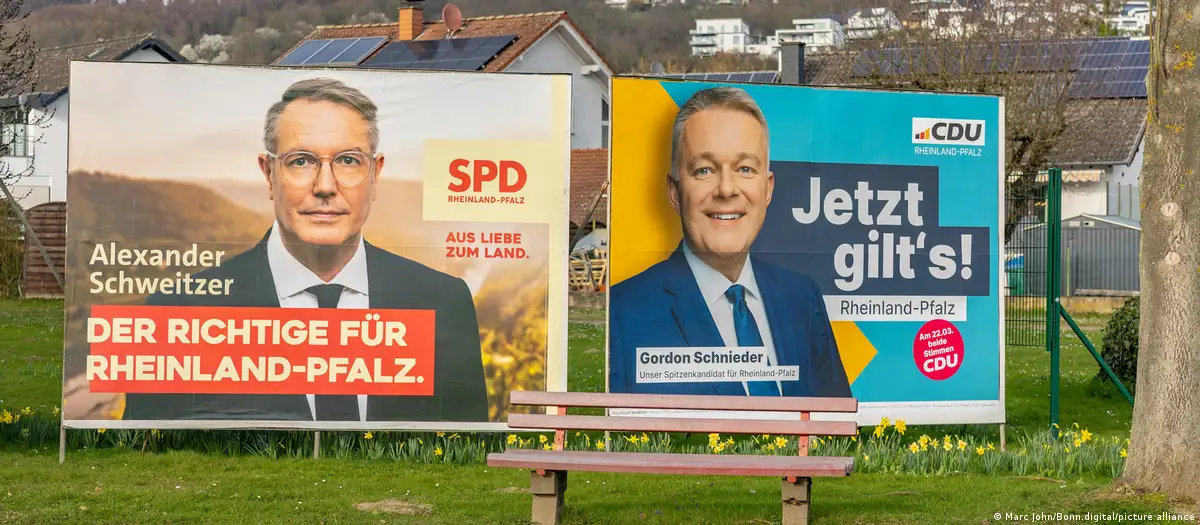
The largest US air base outside the United States is located in Ramstein, Rhineland-Palatinate. This state in southwestern Germany is also the ancestral home of US President Donald Trump. It's home to the world's tallest cold-water geyser, which shoots up 60 meters (about 200 feet), and, of course, there's the wine. Nearly three-quarters of Germany's wine production comes from the regions along the Rhine, Moselle, Nahe and Ahr rivers.
So it's no coincidence that Mainz, the capital of Rhineland‑Palatinate, hosts the country's only ministry explicitly responsible for viticulture. The portfolio is held by the neoliberal Free Democrats (FDP), who govern the state together with the center-left Social Democrats (SPD) and the ecologist Greens. Since 2016, this coalition has formed Germany's last remaining "traffic‑light" government — named after the parties' colors: red, yellow and green.
The SPD has, in fact, been governing for 35 years in the federal state that was the homeland of Germany's former long-term Chancellor Helmut Kohl of the center-right Christian Democratic Union (CDU).
Can the SPD hold on to its majority?
The state election on March 22 is shaping up to be a pivotal moment. A final pre‑election survey by the polling institute infratest dimap, published 10 days before the vote, saw the CDU narrowly in front with 29%, just ahead of the SPD at 28%.
But the Christian Democrats' lead over the SPD was significantly larger only a few months ago, and it has been narrowing steadily ever since. At this stage, everything suggests a razor-thin contest — and the prospect of an election night full of suspense.
What already seems clear is this: responsibility for viticulture will fall to another party in the future, not the FDP. Pollsters currently place the Liberals below 3%, well below the 5% threshold that would allow them to enter the state parliament. The Greens appear headed for modest losses, standing at 8% in the surveys. And for the first time, the socialist Left party has a real chance of entering the state parliament, polling at 5%.
AfD may double its share
In Rhineland‑Palatinate, however, the big election winner could also be the far-right populist Alternative for Germany (AfD). It is currently polling at 19% — more than twice its share in 2021.
Since no party is willing to work with the AfD, much suggests that the next government will take the form of a coalition of SPD and CDU. The real question is: who will lead it?
Top candidates with similarities
The incumbent is Alexander Schweitzer of the SPD, while his challenger is Gordon Schnieder of the CDU.
Both are in their early 50s, fathers of three, come across as down‑to‑earth and are strikingly tall. Schnieder stands at 1.94 meters (6.36 feet) and Schweitzer at 2.06 meters. He is currently the tallest head of government in Germany.
The two men don't offer the kind of sharp contrast you might expect, and that was evident throughout the campaign. The two rivals rarely went on the attack; more often than not, they treated each other with notable courtesy, and their relationship is considered good.
The differences: Schweitzer follows a vegan lifestyle, while Schnieder is fond of boiled beef and schnitzel. For the election, however, this matters far less than their contrasting favorability ratings.
Schweitzer is significantly more popular with voters than Schnieder. In a hypothetical direct vote between the SPD and CDU candidates, Schweitzer would reach 41%, while Schnieder would receive only 23%. Pollsters have noted that Schweitzer's ability to win voters over with his personality — and Schnieder's difficulty doing the same — could have further consequences.
Berlin is watching closely
The election in Rhineland‑Palatinate is the second of five state elections taking place in Germany during this "super election year" of 2026. This is noteworthy not only because the federal states wield substantial influence within the Federal Republic. State elections also serve as an important barometer for the national parties.
In the first state election of the year, in Baden‑Württemberg, the SPD recorded its worst postwar result, winning just 5.5%. The party has been in shock ever since. In post‑election surveys in Baden‑Württemberg, many respondents said they were disappointed with the federal government, which had promised a great deal, but delivered very little. According to pollsters, this dissatisfaction is clearly shaping the state elections.
Both the CDU and the SPD are in urgent need of a success in Rhineland‑Palatinate. They have been governing together at the federal level for 10 months — a short period in which their approval ratings have already fallen sharply.
Should the SPD now also lose the state premier's office in Rhineland‑Palatinate after 35 years, it would trigger enormous unrest within the party. The debate over a renewed shift to the left would gain momentum — a development that would spell trouble for the coalition with the CDU.
If the CDU were to lose, it would repeat the humiliation of Baden‑Württemberg. There, the party had long been considered the clear favorite, only to be narrowly overtaken by the Greens in the final stretch. Could the same thing now happen to them in Rhineland‑Palatinate — this time against the SPD? In that case, CDU leader and Chancellor Friedrich Merz would also have to brace for a debate about the party's political direction.
Tensions may be exacerbated by the election
Merz had promised his supporters that he would push through more conservative policies. Many CDU voters — and party members as well — are disappointed that this has not been possible so far in a coalition with the SPD. Merz is expected to show greater assertiveness toward the Social Democrats.
But that would create major problems with an SPD shifting further to the left, away from its conservative coalition partner. It would then become uncertain how long the coalition at the federal level could hold together.
The outcome of the state election in Rhineland-Palatinate remains on knife's edge. Pollster infratest-dimap found that one in eight eligible voters (12%) said their party preference could still change by election day.
This article was originally written in German.
While you're here: Every Tuesday, DW editors round up what is happening in German politics and society. You can sign up here for the weekly email newsletter, Berlin Briefing.