Ukraine updates: Zelenskyy, Merz attend Denmark summit
Published October 2, 2025last updated October 2, 2025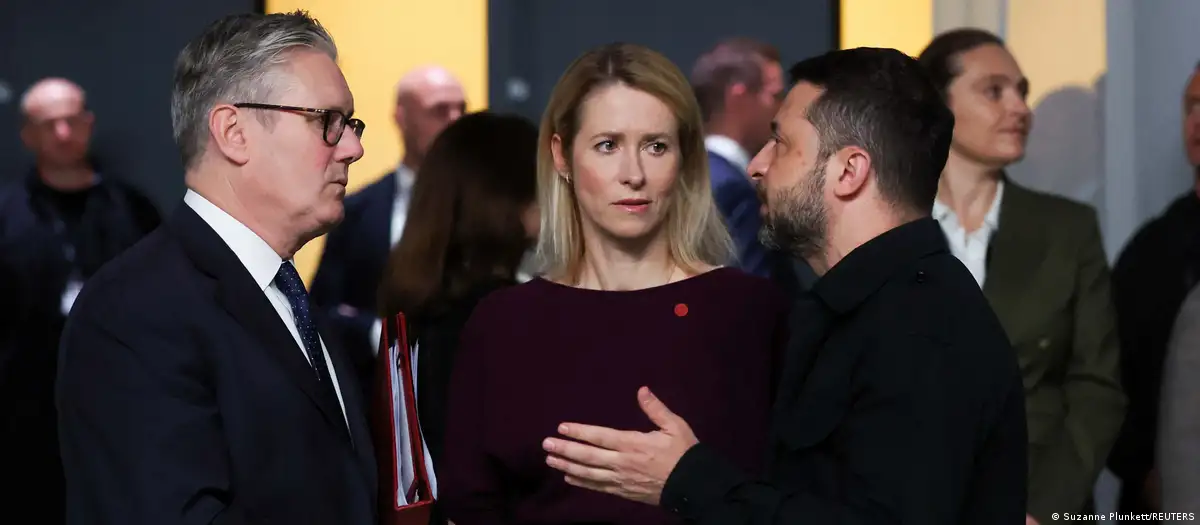
What you need to know
European Political Community (EPC) leaders met in Copenhagen to discuss various security threats facing the continent
The meeting takes place as increasing drone incursions into European airspace have raised fears among nations
The meeting was followed by discussions ranging from defensive measures to economic security and migration
Meanwhile, The Wall Street Journal on Thursday is reporting that the US will begin providing Ukraine with intelligence that would assist its efforts to undertake long-range strikes against Russia.
This blog is now closed. Read here for the latest on Russia's full-scale invasion of Ukraine and Europe's response on October 2, 2025:
Putin: 'We are closely monitoring the rising militarization of Europe'
Russian President Vladimir Putin was highly critical of European and particularly German boosts to defense spending during a speech at a foreign policy forum in Sochi in southern Russia on Thursday.
"The ruling elites of Europe continue to whip up hysteria," Putin said. "They can't believe what they're saying, that Russia is going to attack NATO. ... They're either incredibly incompetent if they truly believe it, because it's impossible to believe this nonsense, or they're simply dishonest."
He said that Russia was "closely monitoring the rising militarization of Europe" and that it had to for its own safety.
"Are these just empty words, or is it time for us to take countermeasures?" he asked the audience. "Germany, for example, says that the German army should be the most powerful in Europe. Good. We listen carefully, understanding what is meant."
While Germany has voiced ambitions to become the biggest-spending NATO military force in the EU, this leaves some ambiguity about whether it truly seeks a military more powerful than nuclear-armed France's, or NATO but non-EU member Britain's — let alone whether it meant to compare directly to Russia.
Putin also claimed that Russia was making gains across almost the entire front in Ukraine, listing a series of locations and saying Russian troops had entered the strategic city of Pokrovsk.
Discussing US President Donald Trump's reference to Russia as a "paper tiger," Putin said he was not sure if it was meant seriously.
"Are we are a paper tiger? Then what is NATO in this case?" Putin asked, suggesting the West would "deal with the paper tiger" if Russia were one.
Turning frozen Russian assets into loans to Ukraine: Belgium concerned, Germany optimistic, Moscow furious
Belgian Prime Minister Bart de Wever on Thursday voiced very strong criticism of a plan floated by European Commission President Ursula von der Leyen and others to use some €140 billion ($164.3 billion) in frozen Russian Central Bank assets — most of which are held at the Brussels-based securities depository Euroclear — to finance reparations loans for Ukraine.
It is estimated that another $300 billion are being held in various other countries around the world though no concrete figures exist.
German Chancellor Friedrich Merz, who backs the plan, said, "I will support any path that allows Russian assets to be used to further assist Ukraine and ensure that this war ends as soon as possible." Merz added that he expects a final decision to come at the next EU summit in three weeks.
The German leader was upbeat on the subject, saying that he was leaving Copenhagen "with the firm feeling that there is a very strong consensus."
De Wever argued the plan carries significant legal risks as well as potentially endangering the life of Euroclear's chairman.
The proposal would only see funds returned to Russia if Moscow agrees to pay reparations to Ukraine when the war ends, something Moscow has scoffed at. De Wever demanded EU leaders give guarantees that Belgium would not be left alone in the event that the funds must be released back to Russia.
Noting that international law forbids the confiscation of sovereign assets, De Wever said: "There's no free money. There are always consequences."
The Kremlin blasted the "delusional" proposal as "pure theft" and threatened retaliation if it went through.
"In accordance with the principle of reciprocity, any EU attack on our property will be met with a very harsh response. They know this," Foreign Ministry spokeswoman Maria Zakharova told reporters in Moscow.
Russia and Ukraine exchange prisoners
Russia's Ministry of Defense on Thursday announced that a prisoner exchange had taken place with Ukraine despite the failure of negotiations to end the ongoing war between the two countries.
In a statement on the messaging app Telegram, the ministry wrote that "185 Russian servicemen have been returned." Another 20 civilians were also reported released and 185 Ukrainian soldiers were returned to Ukraine by Russia.
Ukrainian President Zelenskyy confirmed the exchange of 185 prisoners of war.
"Alongside our defenders, civilians are also returning home — 20 of our people. Everyone will definitely receive all the support they need," Zelenskyy said on social media. "Since the start of the full-scale invasion, we have already brought over 7,000 of our people home."
The exchange was the latest in a series of moves agreed to during direct talks in Istanbul, Turkey, on July 23.
Orban lobbies hard against Ukraine, again
Hungarian Prime Minister Viktor Orban on Thursday continued to irk European partners by opposing closer ties with Ukraine.
"Copenhagen, day two. The situation is serious," Orban railed in a social media post: "Outright pro-war proposals are on the table. They want to hand over EU funds to Ukraine. They are trying to accelerate Ukraine's accession with all kinds of legal tricks.
"They want to finance arms deliveries," he continued, "I will stand firmly by the Hungarian position."
In subsequent posts, the Hungarian leader accused the EU of prioritizing the pursuit of "endless war" over peace.
Hungary has consistently attempted to block war funding for Ukraine as well as Kyiv's accession to the EU. Asked if there was any chance of Ukraine joining the bloc as promised by Brussels, Orban replied "no."
Ukrainian President Zelenskyy, on the other hand, has urged Europe to "keep its promises," as officials in Brussels and Kyiv say Ukraine has completed the required legal preparation for accession talks to move forward.
Hungary — along with Slovakia — has also refused to stop purchasing Russian oil despite calls from EU partners and US President Donald Trump to do just that.
On Wednesday, Zelenskyy told EU leaders, "Those who choose ties with Russia instead of America, are going against both Europe and the US."
Macron calls for pressure on Russian shadow fleet
French President Emmanuel Macron on Thursday called for European nations to "increase pressure" on Russia's so-called shadow fleet as French authorities extended the detention of two senior crew members from a Benin-flagged Russian-linked tanker stopped by France's naval forces on Saturday.
The two individuals, Chinese nationals who identified themselves as the captain and first mate of the Boracay, were taken into custody in the French city of Brest on Tuesday.
The tanker's captain will go to trial in February over the crew's alleged refusal to cooperate, a French prosecutor said Thursday. The first mate was later released without charge.
The ship was stopped off the western coast of France after data had located it off the coast of Denmark at the same time numerous drone incursions were reported in Danish airspace between September 22 and 25.
Prosecutors say the men have "refused to cooperate" and "failed to justify the nationality of the vessel."
French military personnel remain onboard.
"We would like to thank our navy commandos and the crews of the French navy who intervened this weekend aboard a tanker belonging to the Russian shadow fleet," wrote French Prime Minister Sebastien Lecornu wrote on X.
Russia's shadow fleet facilitates the illicit transfer of fuel, thus helping fund Moscow's war in Ukraine. The vessels sail under foreign flag with transponders often turned off as they cruise the world's oceans and transfer fuel to other nations' ships.
More recently, it is thought that some drones violating European airspace may be being operated from the vessels.
Report: US to supply Kyiv with intel for long-range strikes
The Wall Street Journal and Reuters news agency on Wednesday reported that the US will provide Ukraine with intelligence allowing Kyiv to conduct long-range strikes on Russian energy infrastructure assets.
The Kremlin quickly dismissed the report, with spokesman Dmitry Peskov saying, "The United States of America transmits intelligence to Ukraine on a regular basis online."
"The supply and use of the entire infrastructure of NATO and the United States to collect and transfer intelligence to Ukrainians is obvious."
Washington admits that it has long shared intelligence with Kyiv but Wednesday's report claims the new US approach will make it easier for Ukraine to attack oil and gas pipelines, refineries, power stations and other Russian infrastructure assets.
Though Ukraine says it has developed its own long-range missile, dubbed the Flamingo, Kyiv has also requested US Tomahawk missiles until production of the domestic weapon can be ramped up.
Tomahawks have a range of 2,500 kilometers (1,550 miles). This would provide Kyiv with far more reach than the medium-range missiles it currently possesses and put the Russian capital Moscow easily within striking distance.
No decision has yet been finalized on the delivery of long-range US missiles, though this is under consideration according to two officials cited in the reports.
EPC leaders gather in Denmark
Leaders from the European Political Community (EPC) are gathering in Copenhagen, Denmark, Thursday to discuss a host of issues tied to increased security and economic threats, as well as that of migration.
As the 47 leaders convene, issues regarding European support for Kyiv are taking the fore, with Danish President Mette Frederiksen warning that a hybrid war is already taking place beyond Ukraine's borders.
Hungary's Prime Minister Viktor Orban, known for being friendly to Moscow and Russian President Vladimir Putin, again criticized European support for Kyiv, railing against what he characterized as "outright pro-war proposals."
Meanwhile, Belgium's Prime Minister Bart de Wever called on European leaders to guarantee risk sharing should frozen Russian assets be used to support Kyiv.
Ukraine's President Volodymyr Zelensky is attending the meeting, as are French President Emmanuel Macron and German Chancellor Friedrich Merz.
Welcome to our coverage
DW brings you the latest headlines from and related to Ukraine as Moscow's full-scale invasion of its neighbor continues more than 3 1/2 years after being launched.
Some 47 European Political Community leaders are gathering to discuss economic security, migration and the growing threat posed by drones on Thursday. The meeting is taking place in Denmark, where several of the unmanned aircraft have been sighted in recent days.
Ukraine's President Volodymyr Zelenskyy will be in attendance as will French President Emmanuel Macron and German Chancellor Friedrich Merz.
In a potential change of tack, the US is also reportedly prepared to help Kyiv conduct long-range strikes inside Russia by providing enhanced intelligence.