Ukraine: Trump says deal would come at trilateral summit
Published August 14, 2025last updated August 15, 2025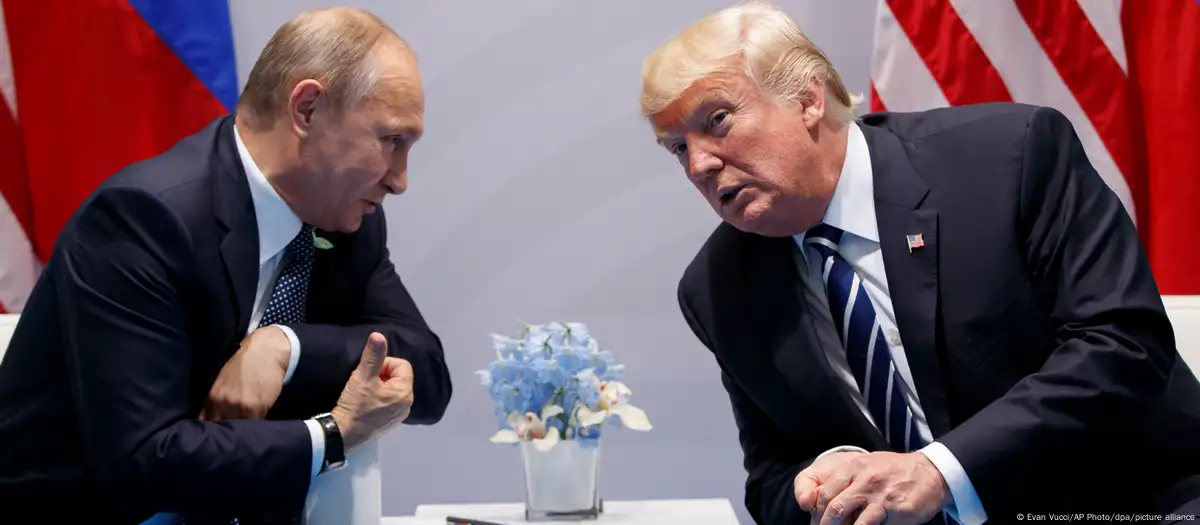
What you need to know
US President Donald Trump told Fox News on Thursday he believed Russian President Vladimir Putin would make a deal.
US Secretary of State Marco Rubio stressed that while the Alaska summit might succeed in bringing a halt to the fighting in Ukraine, a long-term resolution to the war will need more time.
Meanwhile, the Kremlin has warned of predicting the outcome of the summit.
In London, Ukrainian President Volodymyr Zelenskyy met British Prime Minister Keir Starmer, as European leaders prepare a unified stance on Ukraine ahead of the summit.
This blog is now closed, please click here to follow developments on the Trump-Putin talks in Alaska.
Here is a roundup of news about Russia's war on Ukraine on Thursday, August 14:
Merz: Putin has 'opportunity' to agree to Ukraine ceasefire
German Chancellor Friedrich Merz said that Russian President Vladimir Putin will have "an opportunity" to end the war in Ukraine when he meets with US President Donald Trump in Alaska.
However, he said that peace must be agreed upon with Ukrainian participation.
"The goal must be a summit also attended by President [Volodymyr] Zelenskyy" of Ukraine where "a ceasefire must be agreed", Merz said on social media.
He added that Trump "can now take a major step toward peace" more than three years since Moscow's invasion of Ukraine.
Why was Alaska chosen to host the Putin-Trump summit?
Alaska was once a Russian colony until it was sold to the United States in the mid-18th century.
Here, DW takes a look at why it's the perfect place to hold the upcoming talks between US President Donald Trump and Russian leader Vladimir Putin: Why Alaska is ideal for hosting the Putin-Trump summit
Trump: European leaders may attend second meeting with Putin
European leaders might be invited to a potential second meeting between US President Donald Trump and Russian President Vladimir Putin, along with Ukrainian President Volodymyr Zelenskyy, Trump hinted on Thursday.
"We're going to have a meeting with Putin, Zelenskyy, myself, and maybe we'll bring some of the European leaders along," Trump said at the White House. "Or maybe not."
Trump is scheduled to meet Putin in Alaska on Friday but has been downplaying its magnitude, saying the main purpose of the meeting is to set the stage for a second summit. The Kremlin has also played down expectations and cautioned against predicting any concrete outcomes.
Asked whether he might offer Putin access to rare earth elements or agree to a reduction of NATO troop numbers in Europe as concessions to Russia, Trump had no specific response.
Why does the US use secondary sanctions, and do they work?
Will Donald Trump's threat to use secondary sanctions slow Russian aggression or dampen its economy?
Some see them as a powerful deterrent, while others think they are impossible to effectively enforce.
Read the full story on Trump's threats of secondary sanctions on Russia.
Trump says peace possible between Putin and Zelenskyy
US President Donald Trump was optimistic about the possibility of peace between Russian President Vladimir Putin and Ukrainian President Volodymyr Zelenskyy.
"We have a meeting with President Putin tomorrow. I think it's going to be a good meeting," Trump told reporters. "But the more important meeting will be the second one we're planning."
He added that the follow-up meeting, which could include European leaders, could happen shortly after the first on Friday.
"I want to set the table for the next meeting. I'd like to see it happen very quickly," he said speaking in the Oval Office on Thursday. We're going to find out where everyone stands. If it's a bad meeting it will end very quickly, and if it's a good meeting we will end up having peace in the very near future."
Russia bans Reporters Without Borders as 'undesirable' group
The Russian Justice Ministry has designated Reporters Without Borders (RSF) as an "undesirable" organization, a move that effectively bans the rights group from operating in the country.
The ministry published the classification on its website Thursday, making it illegal for Russian organizations or individuals to maintain any relations with RSF. Deutsche Welle is among more than 250 foreign organizations, mostly from EU countries, the United States, and Ukraine, have been given the same status.
Founded in 1985, RSF campaigns for press freedom worldwide and supports imprisoned journalists. Its Paris headquarters has not yet commented on the designation.
The group also issues an annual press freedom index, ranking Russia 171st out of 180 countries in 2025, keeping it among the nations with the least press freedom.
Kremlin says no joint statement expected after Putin-Trump summit
Contrary to earlier reports, no joint statement is planned after the summit between Russian President Vladimir Putin and US President Donald Trump, Kremlin spokesman Dmitry Peskov said Thursday.
"No, nothing is to be expected, nothing has been prepared, and it is unlikely that there will be any document," Peskov told Russian news agency Interfax. He said that while a joint press conference is planned, Putin will outline any agreements or arrangements reached during the meeting.
The summit, taking place Friday in the US state of Alaska, was arranged at very short notice, Peskov said. He cautioned against predicting its outcome in advance.
Speaking later on Russian state television, Peskov described Trump as having an "extremely unusual approach" to difficult issues, something he said is highly valued in Moscow and by Putin personally.
He added that Ukraine's perspective should be considered "in subsequent stages," stressing that this meeting is currently a bilateral Russian-US discussion at the highest level.
WATCH: Putin to face Alaska protests amid hope for peace in Ukraine
The Trump-Putin meeting, held on a military base near Anchorage, Alaska, has sparked protests and concern among locals and Ukrainian refugees. While some fear the absence of Ukraine's president signals weak prospects for peace, others hold out hope that the talks may lead to an end to the war.
Watch the DW report from Anchorage:
Trump floats trilateral summit on Ukraine to 'divvy things up'
US President Donald Trump said on Thursday that any deals on ending the conflict between Ukraine and Russia will need to come after his Alaska summit with Russia's Vladimir Putin.
Speaking to Fox News Radio one day ahead of the anticipated summit, the US president said a second meeting would also be attended by Ukrainian President Volodymyr Zelenskyy.
"The second meeting is going to be very, very important, because that's going to be a meeting where they make a deal," Trump said. "And I don't want to use the word 'divvy' things up. But you know, to a certain extent, it's not a bad term, okay?"
Rubio says long-term resolution will take longer
US Secretary of State Marco Rubio stressed that while the Alaska summit might succeed in bringing a halt to the fighting in Ukraine, a long-term resolution to the war will need more time.
"To achieve a peace, I think we all recognize that there'll have to be some conversation about security guarantees. There'll have to be some conversation about ... territorial disputes and claims, and what they're fighting over," Rubio told reporters at the State Department.
The US top diplomat added that Trump hoped "to achieve some stoppage of fighting so that those conversations can happen."
Trump hopeful Putin will make a deal
US President Donald Trump told Fox News on Thursday he believed Russian President Vladimir Putin would make a deal.
"This meeting sets up the second meeting, but there is a 25% chance that this meeting will not be a successful meeting," Trump told Fox News Radio.
The US president said he suspected Moscow sought a meeting due to threats of additional US sanctions against it.
Trump has given Russia more than one deadline to end the war, under the threat of increasing sanctions, before his meeting with Putin was scheduled.
Despite promising to end the war in Ukraine on his first day in office, Trump's administration has attempted to play down the importance of the summit with Putin, saying on Tuesday it would be a "listening exercise for the president."
Kremlin warns of predicting outcome of Alaska summit
The Kremlin warned on Thursday of predicting the outcome of US President Donald Trump's Friday summit with Russian President Vladimir Putin in Alaska.
Kremlin spokesperson Dmitry Peskov was cited by Interfax as saying there were no plans to sign any documents following the summit.
Peskov hailed Putin and Trump's "political will to resolve existing issues through dialogue," arguing that this sentiment was missing from the European side.
When asked whether the summit would discuss a potential exchange of territories to settle the conflict, a suggestion floated by Trump and vehemently rejected by Ukrainian President Volodymyr Zelenskyy, Peskov said "issues related to the Ukrainian settlement will be discussed."
Putin is due to be accompanied by Foreign Minister Sergei Lavrov, presidential aide Yuri Ushakov, Defense Minister Andrei Belousov, Finance Minister Anton Siluanov and the president's special representative for foreign investment and economic cooperation, Kirill Dmitriev.
UAE-mediated POW exchange secured the release of 168 prisoners, Foreign Ministry
A United Arab Emirates-mediated exchange of prisoners of war between Russia and Ukraine has secured the release of 168 POWs, the Gulf country's Foreign Ministry said on Thursday.
Ukrainian President Volodymyr Zelenskyy had announced the exchange earlier, but said it led to the release of 84 prisoners of war (see below), apparently not including the released Russian POWs.
The UAE ministry clarified 84 prisoners were exchanged from each side.
This brings the total number of POWs exchanged as part of Emirati mediation to 4,349, the Foreign Ministry said in a statement carried by the state news agency.
The ministry argued that the success of such mediation efforts was testament to "the strong and special nature of the UAE's relationship to Russia and Ukraine."
WhatsApp decries Russia ban on its calls service
Meta's WhatsApp messaging app has decried a Russian ban on its call service, while Moscow claimed the curbs were necessary to fight fraud and "terrorist" activities.
On Wednesday, Moscow banned calls on WhatsApp and Telegram. Russia's Digital Ministry said calls would resume once "they start complying with Russian legislation."
WhatsApp condemned the decision.
"WhatsApp is private, end-to-end encrypted, and defies government attempts to violate people's right to secure communication, which is why Russia is trying to block it from over 100 million Russian people," a spokesperson for Meta-owned WhatsApp told the AFP news agency.
Some 100 million of Russia's population of roughly 143.5 million are WhatsApp users.
Telegram, which is owned by Russian entrepreneur Pavel Durov, said it "actively combats misuse of its platform, including calls for sabotage or violence, as well as fraud" and removes "millions of pieces of harmful content every day."
Moscow has often claimed that Kyiv used Telegram to recruit people or commit acts of sabotage in Russia.
Russia has recently launched some homegrown messaging apps, with less stringent privacy rules, that it hopes will take over foreign-owned ones.
Trump, Putin to 1-on-1 meeting and 'working breakfast' in Alaska summit
The US and Russian heads of state will have a "working breakfast" as part of their Alaska summit on Friday, the Kremlin said on Thursday.
US President Donald Trump and Russian President Vladimir Putin will first sit down for a one-on-one meeting, "naturally with the participation of interpreters," Kremlin aide Yuri Ushakov told reporters.
Then, their two delegations will meet.
Afterwards, talks will continue over a "working breakfast," Ushakov said, before the pair do a joint press conference.
The summit is due to start Friday at 11:30 a.m., local time (1930 GMT/UTC).