Trump, Xi reach deal to cut tariffs and boost trade
Published October 30, 2025last updated October 30, 2025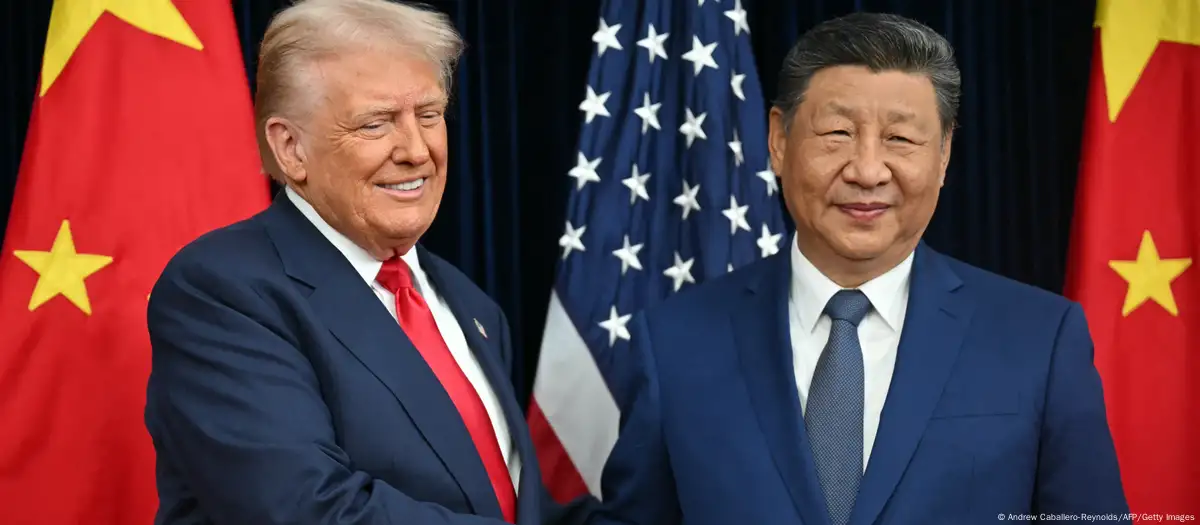
What you need to know
- Trump and Xi agreed to a deal which would see the US reducing tariffs on China from 57% to 47%
- Beijing would keep China's rare earth exports flowing, buy US soybeans and crack down on fentanyl trafficking
-
Trump met with Xi for about one hour and forty minutes in the South Korean city of Busan
These live updates have been closed. Thank you for reading.
Below, you can review news from the talks between US President Donald Trump and Chinese President Xi Jinping, as well as other developments from the APEC summit in South Korea, from Thursday, October 30.
How successful was the Trump-Xi meeting?
Thursday's high-stakes encounter between US President Donald Trump and Chinese President Xi Jinping was meant to help resolve months of global tariff tensions and smooth trade between the world's two largest economies.
While Trump gave the "amazing" talks a 12 out of 10, Beijing was more cautious, calling on the United States to keep the lines of communication open.
Read DW's full analysis of the meeting panned out here.
China expresses hope that US will not resume nuclear testing
"China hopes the United States will earnestly abide by the obligations of the comprehensive nuclear-test-ban treaty and its commitment to a ban on nuclear testing, and take concrete actions to safeguard the global nuclear disarmament," Chinese Foreign Ministry spokesman Guo Jiakun said on Thursday.
Beijing's statement comes in response to US President Donald Trump pledging to resume nuclear testing to keep pace with Russian and Chinese arsenals.
"Because of other countries testing programs, I have instructed the Department of War to start testing our Nuclear Weapons on an equal basis," wrote Trump in a social media post.
Trump's announcement followed news that Russia had tested a nuclear capable underwater drone this week.
The US signed the Comprehensive Nuclear-Test-Ban Treaty, which bans all atomic test blasts — both military and civilian — in 1996.
The US conducted two nuclear attacks on Japan during World War II and over 1,000 nuclear tests until a September 1992 moratorium initiated by George H. W. Bush.
Xi says consensus reached with US on key issues
Chinese President Xi Jinping said Beijing and Washington have reached a consensus on economic and trade priorities after a meeting between Xi and US President Donald Trump.
Xi told Trump China and the US should not fall into a "vicious cycle of retaliation" against each other, according to Chinese state news agency Xinhua.
The meeting in Busan, South Korea, came amid ongoing trade tensions between the two superpowers, which have disrupted global supply chains.
Urging for long-term interest of cooperation, Xi told Trump there is a need for both sides to "refine and finalize follow-up work as soon as possible, maintain and implement the consensus and provide tangible results to set minds at ease about the economies of China, the United States and the world," the Chinese state media reported.
Beijing confirms Trump will travel to China next year
A Chinese Foreign Ministry spokesperson said on Thursday that US President Donald Trump will visit China in 2026.
Earlier, following the talks between Trump and President Xi Jinping in South Korea, the US president said Xi was also expected to visit the United States.
"I'll be going to China in April, and he'll be coming here sometime after that, whether it's in Florida, Palm Beach or Washington, DC," Trump told reporters aboard Air Force One.
US to reduce tariffs on China from 57% to 47%, says Trump
US President Donald Trump called his meeting with his Chinese counterpart Xi Jinping a "great success" on Thursday, saying the two leaders agreed to a deal which would see the US reducing tariffs on China from 57% to 47%.
In return, Beijing would keep China's rare earth exports flowing. Trump added that China would also buy "tremendous amounts" of US soybean and crack down on fentanyl trafficking. The agreement is to stay in force for at least one year.
The two-hour meeting on the sidelines of the APEC summit in Busan, South Korea marked the first in-person meeting between Xi and Trump since 2019.
Trump called Xi a "tremendous leader of a very powerful country" and said several issues were "brought to finalization" at the meeting.
The US president also added that the two leaders would be visiting each other's countries.
"I'll be going to China in April, and he'll be coming here sometime after that, whether it's in Florida, Palm Beach or Washington, DC," Trump told reporters on Air Force One.
Chinese markets surged on hopes of easing trade tensions.
Trump says he cut fentanyl tariffs on China to 10%
After talks with Xi Jinping, Donald Trump said that he had agreed to cut fentanyl-related tariffs on China to 10% from 20%. He announced that the dispute between China and the United States had been "settled."
The US president also said his meeting with Chinese leader Xi Jinping resulted in a one-year deal to supply crucial rare earths.
"All the rare earths has been settled, and that's for the world," Trump told reporters aboard Air Force One, adding that the deal would be renegotiated annually.
US soybean farmers battered by US-China trade war
The US agricultural sector has been caught in the crossfire of the US-China trade war.
Soybean growers have been the hardest hit, seeing a $3 billion (€2.6 billion) drop in trade with China in the first half of 2025 compared with the same period in 2024.
China has traditionally been the biggest customer of US soybeans, buying nearly half of the crop in 2024.
But Chinese retaliatory tariffs on soybeans effectively halted US sales of the legume to China from May onwards.
Brazil and Argentina have rushed in to fill the gap.
Ahead of the Xi-Trump meeting, Treasury Secretary Scott Bessent, who had led trade negotiations with Chinese officials last week, directly addressed the concerns of soybean farmers.
"When the announcement of the deal with China is made public... our soybean farmers will feel very good about what"s going on, both for this season and the coming seasons, for several years," he told US broadcaster ABC news earlier in the week.
Trump, Xi meeting over; no comments to press
The meeting between Xi Jinping and Donald Trump is over.
Trump has reportedly boarded his Air Force One plane and left South Korea for the United States.
The two leaders talked for about an hour and 40 minutes.
They made no comments to journalsits at the end of the talks. The outcome of the talks was not immediately clear.
Trump orders US nuclear testing for first time in more than 30 years
Shortly before landing in Busan for his meeting with Xi, Trump posted that he would step up testing of nuclear weapons.
In the post on his Truth Social platform, the US president said that he had instructed the defense department to "immediately" start testing nuclear weapons "because of other countries (sic) testing programs."
His post followed Russian President Vladimir Putin's announcement on Wednesday that Russia had successfully tested a Poseidon nuclear-powered super torpedo.
Military analysts say the weapon, which can be nuclear armed, is capable of devastating coastal regions by triggering vast radioactive ocean swells.
Just days earlier, Russia also tested a new nuclear-capable Burevestnik cruise missile and also held nuclear launch drills.
Russia has the most nuclear weapons after the US, Trump noted is post. "China is a distant third, but will be even within 5 years," he wrote.
There was no indication that the US would start detonating warheads.
The US last tested a nuclear weapon in 1992 underground in Nevada. From 1945 to 1992, the United States conducted 1,030 nuclear tests, far more than any other country.
The US-based Arms Control Association has a great fact sheet about which countries conducted nuclear arms testing and whereif you want to know more.
Xi: US and China have a basic consensus on a deal
In his preliminary statement, Xi Jinping also told Donald Trump that trade negotiators from both countries had reached a basic consensus on a trade deal.
Officials from both countries met last week in Malaysia to lay the groundwork for their leaders.
Afterward, China's top trade negotiator Li Chenggang said they had reached a "preliminary consensus."
That statement was affirmed by US Treasury Secretary Scott Bessent, who on Sunday told broadcaster NBC that he believed "we have the framework for the two leaders to have a very productive meeting for both sides."
Xi: US and China should be 'partners' despite 'frictions'
At the start of the meeting with Donald Trump, Chinese President Xi Jinping said the US and China should be "partners and friends" despite "frictions."
"Given our different national conditions, we do not always see eye to eye with each other," he said through a translator. "It is normal for the two leading economies of the world to have frictions now and then."
But, Xi added, the two countries should strive to be "partners and friends."
"China and the US can jointly shoulder our responsibility as major countries and work together to accomplish more great and concrete things for the good of our two countries and the whole world," Xi said.
Trump: Relationship with China 'very good,' could cut fentanyl tariff
Aboard Air Force One on his way to South Korea, US President Donald Trump told reporters he may reduce tariffs that he placed on China earlier this year related to its role in making fentanyl.
"I expect to be lowering that because I believe that they're going to help us with the fentanyl situation," Trump said, later adding, "The relationship with China is very good."
China is the main source of fentanyl precursors, the chemicals used to make the opiod fentanyl, which is one of the main contributors to fatal overdoses in the United States.
20% of US import tariffs on China have been tied to the country's role in fentanyl production.
In the days leading up to the meeting, US officials also signaled that Trump doesn't intend to make good on a recent threat to impose an additional 100% import tax on Chinese goods.
On October 10, Trump threatened a 100% import tax because of China's rare earth restrictions.
It's not the first threat of significant tariffs. In April, Trump announced plans to jack the rate on Chinese goods to 145%, only to abandon those plans as markets recoiled.
Welcome to our coverage
US President Donald Trump is meeting face-to-face with Chinese leader Xi Jinping.
It's a chance for the leaders of the world's two largest economies to stabilize relations after months of turmoil over trade issues and tariff threats.
We'll bring you news, information and analysis as it comes in.