Rwanda ties Mozambique troop deployment to EU funding
April 16, 2026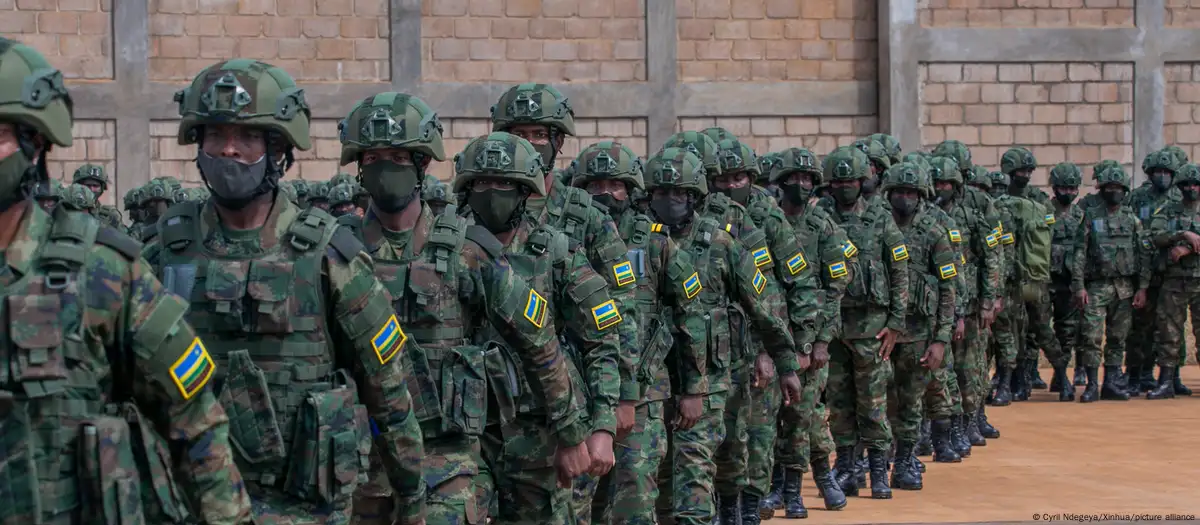
Rwanda's President Paul Kagame has threatened to withdraw his troops from Mozambique's conflict-ridden northern province of Cabo Delgado as early as May, using the move primarily to put pressure on Europe.
The mission against Islamist insurgents could soon come to an end if the European Union (EU) doesn't provide a reliable funding commitment. The warning comes amid reports that Brussels may end its support for the operation. Since 2022, the EU has contributed around $46 million (€39 million) — a sum estimated to be less than a fifth of Rwanda's total costs.
How much does Rwanda's military mission really cost?
However, the true overall costs are disputed. Mozambican security expert Borges Nhamirre from the think tank Institute for Security Studies told DW that the figures presented by Kigali are difficult to verify.
Rwanda, for example, reportedly invoices transport costs through its state airline RwandAir — but "no one knows whether these costs actually occurred at that level.” It is therefore possible that the total costs are being overstated.
Europe needs Mozambique's gas — and Rwanda's security presence
For Mozambique, a withdrawal would represent a major security shock — for Europe, a geopolitical risk. Rwanda itself is unlikely to be interested in a rapid pullout from Cabo Delgado. An abrupt end to the mission therefore appears unlikely, Nhamirre told DW.
"The most likely scenario is that Rwandan troops will remain there in one form or another.” Too much is at stake — including for Kigali itself. "If they withdrew now, it would not be good for Rwanda's many business interests."
Rwanda's engagement is long-term in nature. Expected profits are closely linked to the development of gas projects, which are only gradually gaining momentum. Private Rwandan security firms are also hoping for lucrative contracts from international companies investing in the region. "Above all, the European Union has its own interest in the stability of the gas fields," Nhamirre said.
The largest investors come from France, Italy and other European countries. Initial shipments have already reached Europe.
Rwandan troops are difficult to replace
Since 2021, Rwandan troops have been securing the region at the request of the Mozambican government, enabling the resumption of major energy projects that had been interrupted due to terrorist activity. Today, more than 4,000 soldiers are deployed. Their key advantage is experience and local networks.
"The Rwandans now have an institutional memory,” Nhamirre said. A quick replacement is hardly realistic. New forces would first have to adapt to a complex environment — fighting a guerrilla movement that "disguises itself as fishermen or farmers” and hides within the civilian population.
However, Kigali is increasingly under political pressure. EU and US sanctions over Rwanda's role in the conflict in eastern Democratic Republic of the Congo are complicating any extension of funding.
For Nhamirre, this is more than a political problem: "A major paradox is emerging.” The EU is supporting the Rwandan mission in Cabo Delgado while simultaneously politically opposing Rwanda's involvement in eastern Congo. There is a "very high risk” that European funds could unintentionally flow into both conflicts.
Controversial debate within EU institutions
The debate is correspondingly controversial within the European Parliament and other EU bodies. Portuguese MEP Helder Sousa Silva, of the conservative European People's Party (EPP) and member of the Security and Defence Committee, warns against hasty conclusions. Allowing funding for the Rwandan deployment in Cabo Delgado to lapse would be "serious and should not be trivialized.” The mission in Mozambique must be assessed separately from Rwanda's role in Congo. "It is about the security of Cabo Delgado and ultimately the stability of Mozambique."
At the same time, Sousa Silva acknowledges the political sensitivity of the decision. EU sanctions against Rwanda over its alleged support for M23 rebels in eastern Congo have complicated the situation for member states. The EU nevertheless has a strong interest in supporting the Rwandan Defence Forces (RDF) in Cabo Delgado. The financial burden for Europe is manageable: "The issue was never resources, but collective political will within the EU.”
Europe must remain a strong political and economic actor in the region. In his view, withdrawal would have far-reaching consequences, the MEP warns: "If Europe pulls back, other players with questionable intentions will fill the vacuum."
Cabo Delgado: The situation remains fragile
For Mozambique, the situation remains unstable. The country's own security forces are still not capable of stabilizing the conflict zone on their own, according to Nhamirre.
"At the same time, the conflict highlights the limits of an approach focused primarily on military protection of infrastructure. The root causes of violence — poverty, exclusion and lack of prospects — remain unresolved.”
Rwanda's threat is therefore primarily a calculated instrument of pressure. Kigali is signaling: there's no security without compensation. For Europe, the question is whether it is willing to pay that price.
This article was originally written in German.