US says Lebanon not part of ceasefire deal, Iran says it is
Published April 8, 2026last updated April 9, 2026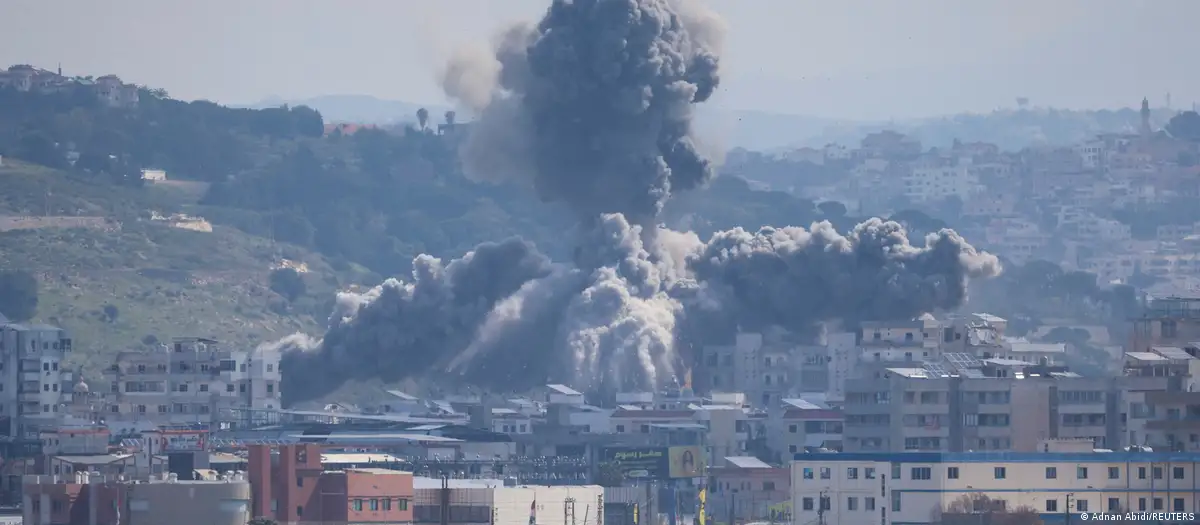
What you need to know
- Trump has said Lebanon is not part of the ceasefire deal, calling it a 'separate skirmish'
- Iran has said it will unilaterally end the ceasefire if Israeli attacks continue against Lebanon
- Trump says he has agreed 'to suspend the bombing and attack of Iran for a period of two weeks'
- US Defense Secretary Pete Hegseth said that the US has achieved a 'historic and overwhelming vitory on the battlefield'
- Iran's Supreme National Security Council has reportedly accepted the two-week ceasefire
- The agreement hinges on Iran reopening the Strait of Hormuz
- World leaders and global markets have welcomed the news of the truce
- The ceasefire deal comes after Trump had escalated his rhetoric towards Iran, warning Tuesday that a 'whole civilization' would 'die' unless Tehran reopened the crucial waterway
- US-Iran talks set to begin in Pakistan on Friday
- Israel strikes Lebanon after saying the ceasefire deal doesn't include Lebanon
These updates have been closed. Thank you for reading.
For our latest coverage of the conflict in Iran and the Middle East, please continue reading here.
Below, you can review DW's coverage from Wednesday, April 8:
Son of ousted shah: No regime change in Tehran
The son of Iran's last shah has rejected US President Donald Trump's claim that the US accomplished a "regime change" in Iran.
Iranian Supreme Leader Ali Khamenei was killed in an airstrike on February 28. Days later, he was succeeded by his son Mojtaba Khamenei,
"What regime change? They're the same people — even if maybe weakened," Reza Pahlavi told French broadcaster LCI. "We still have the same person heading parliament. The same people are still in the judiciary. It's Khamenei's son who has replaced him. For us, this is not a regime change."
Pahlavi, who has been living in exile in the US since childhood, said Iranians still needed to free themselves of the country's theocratic rulers.
"What remains constant in our struggle as Iranians is to free ourselves of this regime," he said.
Macron calls for Lebanon to be included in ceasefire
French President Emmanuel Macron spoke with both Iranian President Massoud Pezeshkian and US President Donald Trump on Wednesday evening, he said in a statement on X.
He said the ceasefire agreement "was the best possible" decision, adding that he hopes "the ceasefire will be fully respected by each of the belligerents, across all areas of confrontation," stressing that this also includes Lebanon.
"This is a necessary condition for the ceasefire to be credible and lasting," he said. "France will play its full part, in close coordination with its partners in the Middle East."
Lebanese Health Ministry puts single-day death toll at 182
Lebanon's Health Ministry has put the death toll from Israel's large-scale attacks on Wednesday at 182, the highest single-day death toll since the most recent conflict with Israel began on March 2.
The ministry added that 890 people had been wounded.
A figure from the Lebanese civil defense service earlier put the death toll at 254.
Lebanese Prime Minister Nawaf Salam announced late on Wednesday that Thursday would be a day of mourning for all those who were killed.
Meanwhile, the International Committee of the Red Cross (ICRC) said it was "outraged by the devastating death and destruction."
"People across Lebanon were holding their breath for a ceasefire agreement, but a wave of deadly strikes plunged the country into panic and chaos," said Agnes Dhur, the ICRC's head of delegation in Lebanon.
"Many who had begun thinking of the moment when they might return to their homes have been rushing to streets and hospitals, searching for missing loved ones or seeking a safety that feels increasingly out of reach."
WATCH: Israelis remain skeptical despite Iran war ceasefire
The United States, Israel and Iran have agreed to stop hostilities for two weeks.
Many Israelis in Tel Aviv see little chance for long-term peace in the Middle East.
Vance says 'misunderstanding' over Lebanon being part of ceasefire deal
US Vice President JD Vance has said the idea on the Iranian side of negotiations that Lebanon was included in the ceasefire deal was the result of a "misunderstanding."
"I think this comes from a legitimate misunderstanding. I think the Iranians thought that the ceasefire included Lebanon, and it just didn't," he told reporters while in Hungary,supporting the election campaign of Prime Minister Viktor Orban.
His comments follow the line laid out by Trump, the White House and Israeli Prime Minister Benjamin Netanyahu, but contradict statements from Iran as well as Pakistani Prime Minister Shehbaz Sharif, who was the key intermediary who secured the last-minute ceasefire deal.
Vance also said Israel had agreed to show restraint, even after it carried out its largest attack since March 2, killing over 180 people.
"The Israelis, as I understand it ... have actually offered to, frankly, to check themselves a little bit in Lebanon, because they want to make sure that our negotiation is successful," Vance said.
"If Iran wants to let this negotiation fall apart... over Lebanon, which has nothing to do with them, and which the United States never once said was part of the ceasefire, that's ultimately their choice," the vice president said.
UN human rights chief condemns 'horrific' killing in Lebanon
Volker Türk, the head of the UN's human rights office, has decried the large-scale Israeli attacks on Lebanon on Wednesday.
"The scale of the killing and destruction in Lebanon today is nothing short of horrific," Türk said in a statement.
"Such carnage, within hours of agreeing to a ceasefire with Iran, defies belief. It places enormous pressure on a fragile peace, which is so desperately needed by civilians."
According to the Lebanese civil defense service, at least 254 people were killed on Wednesday alone and 1,165 wounded.
Türk pointed out that before Wednesday more than 1,500 people had been killed in Israeli attacks since March 24, with more than a million people being displaced.
He called on the international community to bring an end to this "nightmare."
Iran parliament speaker says ceasefire, negotiations 'unreasonable' amid violations
Iran's parliament speaker, Mohammad Bagher Qalibaf, said a "bilateral ceasefire or negotiations is unreasonable" as he listed three violations to the ceasefire he said were committed on Wednesday.
In a post on X, Qalibaf said Israel's continued attacks on Lebanon came in violation to the first clause of the ceasefire agreement, citing mediator Pakistan's confirmation. Both Israel and the US have maintained Lebanon is not included in the ceasefire.
The Iranian speaker also listed the end of attacks on Iran and Iran's right to enrichment as two other clauses, saying a drone was destroyed over Iran's city of Lar in Fars province despite the ceasefire.
The Reuters news agency cited unnamed Pakistani sources as saying it would be Qalibaf along with Foreign Minister Abbas Araghchi who will head to Islamabad for talks with the United States.
Israel says ceasefire is 'not end of campaign'
Israeli Prime Minister Benjamin Netanyahu has said that Israel is ready to return to fighting after the announcement of a two-week ceasefire agreement with Iran.
"Let me be clear: We still have objectives to complete, and we will achieve them — either through agreement or through renewed fighting," Netanyahu said in a televised statement.
"We are prepared to return to combat at any moment required. Our finger is on the trigger. This is not the end of the campaign, but a step along the way to achieving all our objectives."
He also insisted that the deal had been agreed in "full coordination" with Israel, saying "we were not surprised at the last moment" by the announcement.
NATO 'tested and failed,' White House says
The White House on Wednesday said US President Donald Trump believes the NATO military alliance was "tested and they failed" during the Iran war, ahead of a meeting between the president and the alliance's secretary general.
"It's quite sad that NATO turned their backs on the American people over the course of the last six weeks when it's the American people who have been funding their defense," White House Press Secretary Karoline Leavitt told reporters.
When asked if Trump would discuss a possible withdrawal from NATO, Leavitt said: "It's something the president has discussed, and I think it's something the president will be discussing in a couple of hours with Secretary-General [Mark] Rutte."
"Perhaps you'll hear directly from the president following that meeting," she added.
Trump has been vocal in his condemnation of the military alliance over what he has perceived as its failure to support his war on Iran.
The US president has been a skeptic of the 77-year-old alliance since his first term in office.
But his second term has seen, on multiple occasions, some of the biggest tests to NATO's unity to date, most notably when he threatened to take control of the Arctic island of Greenland from fellow-ally Denmark.
US, Israel insist Lebanon not part of ceasefire
White House Press Secretary Karoline Leavitt has confirmed Trump's stance on the ceasefire, saying that it does not include Lebanon.
President Trump had reportedly told PBS the same thing earlier in the day, contradicting statements from Iran that insist Lebanon is indeed covered by the deal. Iran has also threatened to end the ceasefire if Israeli attacks on Lebanon continue.
Israeli Prime Minister Benjamin Netanyahu also appeared to be of the opinion that Lebanon was not included in the deal, saying Israeli forces would "continue to strike" Hezbollah.
However, Leavitt said that Trump would discuss adding Lebanon to the ceasefire deal with Netanyahu.
"This will continue to be discussed, I am sure, between the president and Prime Minister Netanyahu, the United States and Israel and all of the parties involved," she told reporters.
On Wednesday, Israel launched its biggest attack on Lebanon since the beginning of the war with Iran, with the Lebanese civil defense service saying 254 people had been killed in one day alone.
US sees uptick in Strait of Hormuz traffic, White House says
The White House said it noted an uptick in traffic passing through the strategic Strait of Hormuz on Wednesday.
White House press secretary Karoline Leavitt told reporters that US President Donald Trump is opposed to tolls for ships passing through the strait.
"The immediate priority of the president is the reopening of the strait without any limitations, whether in the form of tolls or otherwise," Leavitt said.
News reports on the ceasefire agreement suggested it included a clause that entails that passage through the strait would be in coordination with the Iranian armed forces.
Another clause reportedly said that Iran would be compensated for the damages caused by the war via payments by ships passing through the strategic strait.
Both Iran and the US have publicly disagreed on several details regarding the ceasefire agreement, with the White House earlier saying that the agreement reported by Iranian media was different from the one approved by the US.
Investors again make timely bet ahead of ceasefire announcement — report
Reuters has reported on another instance of unknown investors placing a very timely bet ahead of an announcement by the Trump administration.
According to the news agency, a $950 million bet (around €815 million) was placed on the price of oil falling just hours before the announcement of the ceasefire overnight.
At around 7:45 p.m. GMT on Tuesday, investors sold 8,600 lots of Brent and US crude futures, according to LSEG data, reported by Reuters. The two-week ceasefire was announced at 10:30 p.m. GMT.
When markets opened on Wednesday morning, crude futures fell by around 15% to less than $100 per barrel.
While trading large amounts in oil futures is not uncommon, usually investors spread their bets across multiple exchanges and have them executed at different times.
Tuesday's unusual trades followed a similar incident on March 23 when $500 million in oil futures were sold just 15 minutes before Trump announced he would delay attacks on Iranian infrastructure, which also saw the price of crude fall around 15%.
US, Iran talks to begin in Pakistan on Saturday, White House says
Washington and Tehran will begin talks in Pakistan on Saturday, the White House announced, adding that US President Donald Trump was dispatching a negotiating team led by Vice President JD Vance.
White House press secretary Karoline Leavitt told reporters on Wednesday that Vance played a significant and key role in Iran since the beginning.
Media reports throughout the war had painted Vance as a "skeptical" voice within the Trump administration.
Traffic through Strait of Hormuz comes to halt as Iran threatens to collapse ceasefire
Iran stopped traffic through the Strait of Hormuz on Wednesday, Iranian media reported, as it threatened to withdraw from the ceasefire over Israel's deadly strikes on Lebanon.
Iran's Fars news agency said only two oil tankers passed through the strategic waterway on Wednesday, before traffic was suspended again.
Iran's Revolutionary Guard in a statement carried on state TV issued a "firm warning" to the US and Israel: "If the aggression against beloved Lebanon does not cease immediately, we will fulfil our duty and deliver a response."
Fars also cited an unnamed military representative as threatening Israel with further attacks if it continues its attacks on Lebanon's Hezbollah militant group.
The unnamed source added that the situation confirmed Tehran's suspicion that either the US has no influence over Israel or is tacitly tolerating its attacks.
WATCH: Iran-US ceasefire sparks celebrations, war of words
There have been celebrations across Iran over the two-week ceasefire which has seen US President Trump pull back from his threat to destroy Iran's "entire civilization."
Questions over whether the truce will hold remain.