India bets big on domestic drones for future warfare
June 12, 2026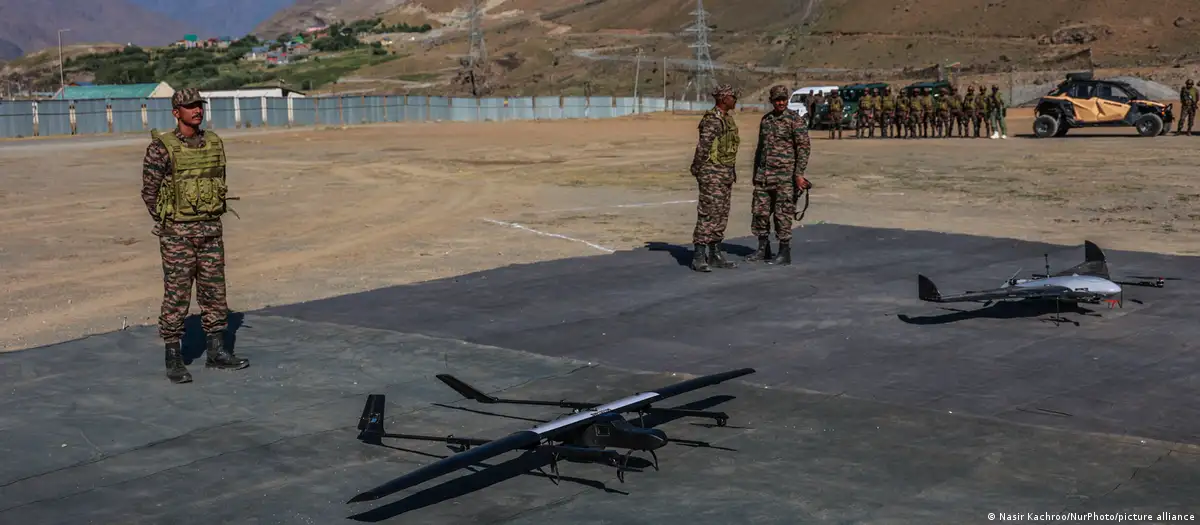
For decades, India's military relied primarily on troops, fighter aircraft, satellites and conventional surveillance systems to monitor its borders.
The 2020 military standoff with China in eastern Ladakh exposed the challenge of maintaining constant surveillance across vast stretches of difficult high-altitude terrain.
Now India is preparing to place a record military drone order worth over $2 billion (€1.7 billion) with domestic manufacturers, including major firms like Adani Group, Tata Advanced Systems and Larsen & Toubro as well as startups such as ideaForge and Asteria Aerospace, marking this its largest-ever unmanned systems procurement.
Drones are increasingly seen as the eyes and ears of the battlefield, capable of gathering intelligence, tracking troop movements, delivering supplies and carrying out precision strikes.
The drones are expected to be deployed along some of India's most sensitive frontiers including the Line of Actual Control with China, the borders with Pakistan and Bangladesh, and the Indian Ocean.
On the surface, it is a major defense purchase. In reality, it reflects a profound shift in how India views future warfare and how quickly drones have moved from the margins of military planning to the center of it. The shift has been shaped by a series of developments.
A wake-up call from the battlefield
In May 2025, India and Pakistan came to the brink of a wider conflict after the Pahalgam attack in India-administered Kashmir, with both sides deploying drones and advanced air power before a US-backed ceasefire restored a fragile peace.
In the aftermath, India launched Cold Start, the largest drone warfare exercise in its history, involving the army, navy and air force.
Tara Kartha, former member of the National Security Council Secretariat, told DW that India's first real wake-up call came with the drone attack on the Jammu Air Force Base in 2021.
"It exposed vulnerabilities that have only grown with the increasing use of drones for surveillance, smuggling and attacks," said Kartha.
"What matters now is not just technology, but how quickly militaries can innovate, adapt payloads and develop new tactics. The side that dominates this low-altitude drone battle is likely to gain the upper hand in the wider conflict," she said.
India is hardly alone in drawing lessons from recent conflicts.
The war in Ukraine has transformed military thinking around the world. Cheap drones have destroyed tanks worth millions of dollars, guided artillery fire and struck targets far behind enemy lines. What was once considered a supporting technology is now a central feature of modern warfare.
Military planners in New Delhi have been closely studying these developments.
The proposed procurement reportedly includes reconnaissance platforms, logistics drones, loitering munitions and strike systems. Together, they would provide the military with persistent surveillance and rapid-response capabilities across multiple theaters.
"The war in Ukraine reinforced the lesson that drones are no longer supporting tools but central to modern warfare," added Kartha.
Why India wants homegrown drones
But the story is not only about security. It is also about industrial policy.
Unlike many of India's major defense acquisitions, this order is expected to be sourced largely from domestic manufacturers.
The purchase aligns closely with Prime Minister Narendra Modi's push for self-reliance in defense production and comes as India seeks to build a homegrown drone industry capable of competing internationally.
The government has repeatedly argued that reducing dependence on foreign suppliers is essential for long-term strategic autonomy. Drones have emerged as one of the sectors where India believes it can build indigenous capabilities relatively quickly.
Wing Commander Rajiv Kumar Narang pointed out that recent conflicts in Ukraine, Iran, as well as Operation Sindoor — which was triggered by the Pahalgam attack — have reinforced the importance of self-reliance in drone technology.
Narang, who is the author of "India's Quest for UAVs and Challenges," said the Iran war demonstrated that indigenous systems, technology ownership and smart tactics can help offset an adversary's technological advantages.
"Countries that own their drone technology and can innovate quickly will have an edge in future conflicts," Narang told DW.
"For India, the challenge is no longer just building drones, but mastering the technologies behind them and rapidly inducting them into service," he added.
The domestic purchase will complement India's separate acquisition of 31 MQ-9B Predator drones from the United States.
While the American platforms provide long-range surveillance and strike capabilities, Indian-made systems are expected to operate in larger numbers closer to the tactical battlefield.
Together, they point toward the creation of a layered surveillance and combat network stretching from the Himalayas to the Indian Ocean.
Can strategy keep pace with procurement?
Konark Rai, managing director of Rudram Dynamics, a defense startup, said the success of India's drone push would depend less on headline procurement numbers and more on how effectively those systems are integrated into military operations.
"While India already has policies to support drone manufacturing and innovation, faster procurement, testing, certification and induction are now critical," Rai told DW.
Buying drones is one thing, Rai said, integrating thousands of unmanned systems into military operations is another. This involves training, doctrine, electronic warfare protection, cybersecurity and the ability to process enormous amounts of battlefield data in real time.
"The larger challenge is ensuring that drone acquisitions are matched by doctrine, training and operational concepts that can translate technological capability into battlefield advantage," he said.
Edited by: Ole Tangen Jr