Germany updates: Merz wants 'quick' EU tariff deal with US
Published July 3, 2025last updated July 4, 2025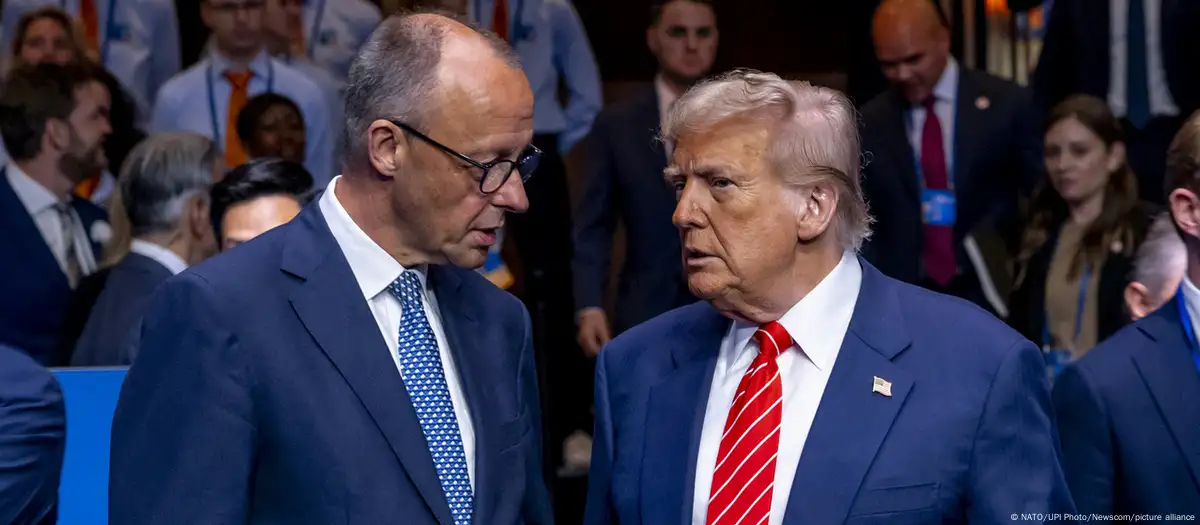
What you need to know
German Chancellor Friedrich Merz wants a "quick" solution to the ongoing standoff with the United States over tariffs.
German Interior Minister Alexander Dobrindt has said that needing third parties to negotiate with Afghanistan's rulers, the Taliban, is "not a permanent solution."
His remarks represent a shift in Germany's policy of not directly talking to the Taliban.
Also dominating the headlines in German media today is the coalition government's failure to reach a deal on reducing the electricity tax.
Meanwhile, a new survey shows the majority of Germans want a ban on a rule that allows young teens to drink.
These live updates have been closed. Thank you for reading. Follow our Friday blog for the latest from Germany on July 4.
Below, you can read a roundup of news, analysis and background of what Germany was talking about on Thursday, July 3.
Far-right AfD willing to talk with left-wing Sahra Wagenknecht Alliance
After a controversial meeting of Thuringia state leaders of the far-right Alternative for Germany (AfD) and the left-wing, anti-migrant populist Sahra Wagenknecht Alliance (BSW), a national AfD leader said he supported such talks at the federal level as well.
Welt-TV asked AfD chairman Tino Chrupalla if he and co-chairwoman Alice Weidel would be available for talks with Sahra Wagenknecht, to which he replied, "Yes, always."
He said the two parties are already talking "about what is moving Germany and how majorities can be changed."
The AfD is the strongest party in the eastern state of Thuringia, but not part of the ruling government because other parties have refused to cooperate with it. Instead, the BSW is in a coalition with the conservative Christian Democratic Union party of Chancellor Friedrich Merz and the Social Democrats.
But on a national level, the BSW failed to pass the 5% threshold to enter the federal parliament in February's election, earning 4.981% of the vote. At the national level, the AfD is the second strongest parliamentary party — though again not in the coalition because other parties refuse to work with it.
Chrupalla confirmed that Thuringia's BSW parliamentary group leader Frank Augsten and the AfD's Thuringian parliamentary group leader Björn Höcke have met.
"This is absolutely correct and, above all, in the interest of the citizens," he said. "This is what the citizens voted for."
Since 2021, the Thuringian AfD has been classified as a confirmed right-wing extremist group and monitored by the state Office for the Protection of the Constitution. Höcke is one of the leading figures of the far-right wing within the AfD. A German court ruled Höcke can legally be named a fascist.
The support for AfD-BSW talks in German came hours after the BSW said it wants to vote with right-wing parties against the European Commission under President Ursula von der Leyen in a censure motion in the European Parliament next week.
German defense ministry raises rainbow flag
As a commitment to diversity and against discrimination, the Ministry of Defense has raised the rainbow flag at its headquarters in Berlin and Bonn.
The defense ministry described the move as "a strong sign of solidarity, for comradeship and social responsibility."
As in previous years, the flag was flown on July 3. On this day in 2000, a decree was repealed that denied homosexual soldiers the possibility of promotion.
On Wednesday, German Chancellor Friedrich Merz (CDU) came under fire for saying a rainbow flag should not be raised at the Bundestag because the parliament is "not a circus tent."
The current German defense minister is Boris Pistorius (SPD).
Man detained after injuring four on a train
A man has been detained after wounding four people on a train in Germany, police said Thursday.
The incident took place in Strasskirchen, in the state of Bavaria, southern Germany, on an ICE express train headed to the Austrian capital of Vienna.
The train had around 500 passengers on board.
The suspect is alleged to have used a dangerous object in the attack.
The train line was suspended with emergency services and police responding to the incident.
Merz calls for 'quick and simple' EU tariff deal with US
German Chancellor Friedrich Merz has called for a "quick and simple" EU deal with the US on tariffs.
"It is better to achieve a quick and simple solution than a lengthy and complicated one that remains in the negotiation stage for months," Merz said at a banking event in Berlin.
Merz added that a deal was necessary "to remove the burden of tariffs on our businesses, which are far too high."
EU trade chief Maros Sefcovic is already in Washington seeking to strike an agreement. The deadline for negotiations before the tariffs come into effect is Wednesday next week.
The US has threatened to impose an additional 20% tariff on the EU on top of a base rate of 10%.
Germany's central bank had warned that further trade tensions with the US could push Europe's biggest economy to face two more years of recession.
Warnings issued in 2 German states due to wildfires
Authorities in the eastern state of Thuringia and in Bavaria, in the south, issued warnings of toxic smoke due to wildfires.
Residents in several districts in the two states were advised to close windows and doors and turn off air conditioning.
A forest fire in the Saalfelder Höhe municipality in Thuringia had spread to approximately 250 hectares. Officials say it's the largest wildfire in the state in the last three decades.
A total of around 600 hectares of land are ablaze in eastern Germany.
On Wednesday evening, emergency services evacuated the town of Heidehäuser, in the state of Saxony. The region was used in the past as a military training ground, and some ammunition is believed to be still buried underground.
German interior minister seeks direct deal with Taliban
German Interior Minister Alexander Dobrindt has called for a direct agreement with the Taliban to receive Afghan migrants deported from Germany.
The Taliban took over Afghanistan's government in August 2021 following the NATO withdrawal. Since then, Germany has not had official diplomatic ties with the Taliban government, which it did not recognize as legitimate.
Last year, Germany flew Afghan migrants who were convicted of crimes to Afghanistan. The deportation took place reportedly after secret negotiations with mediator Qatar.
What did Dobrindt say?
"My idea is that we make agreements directly with Afghanistan to enable repatriations," Dobrindt said in an interview with the German magazine Focus.
"We still need third parties to conduct talks with Afghanistan. This cannot remain a permanent solution," he added.
Dobrindt is a politician from the conservative Christian Social Union (CSU), the Bavarian sister party of Chancellor Friedrich Merz's CDU.
Why now?
Amid the rise of the far right in Germany, migration was a central topic in the CSU and CDU's election campaign in the February general election.
Merz has vowed to deport people to Afghanistan and Syria, and suspend asylum admission programs for German agencies' former local staff in Afghanistan.
Dobrindt said Germany was also in contact with Syria for a deal on deporting criminals of Syrian nationality.
Coalition fails to reach agreement on electricity tax reduction
A committee of the German coalition government failed to reach an agreement on reducing the electricity tax for private households and small and medium-sized businesses.
The reduction was one of the pledges listed in the coalition agreement between the conservative Christian Democrats (CDU) and the center-left Social Democrats (SPD).
An SPD lawmaker said it remained a goal for the coalition and that it would be debated further.
The lawmaker, Matthias Miersch, told broadcaster Deutschlandfunk that the relief already agreed for larger industries was more important, as jobs in those sectors were at stake.
The German Confederation of Skilled Crafts expressed frustration (ZDH), saying many businesses had been prepared for the planned electricity tax reduction.
Majority of Germans against rule allowing young teens to drink
A Forsa survey commissioned by commercial health insurance company KKH showed that 65% of Germans were in favor of abolishing a rule that allows young teenagers to drink alcohol.
Under the supervised drinking rule, teens as young as 14-year-olds could buy and consume beer and wine if they are with a legal guardian.
According to the poll, 52% also support raising the legal age for drinking beer and wine from 16 to 18.
The survey included more than 1,000 participants aged 18 to 70 from across Germany.
Health Minister Nina Warken has voiced support for an initiative by ministers from German states calling for a ban on supervised drinking.
Welcome to our coverage
Guten Morgen! We're watching the news in Germany today from Bonn, where the weather has cooled down again after an intense heat wave.
Today, Germany's Chancellor Friedrich Merz is scheduled to speak at a banking conference in Berlin, and the foreign minister is meeting with his Chinese counterpart.
We'll also highlight in this blog some explainers and analyses from our colleagues across DW.