Germany's new government clears final hurdle with SPD vote
Published April 30, 2025last updated April 30, 2025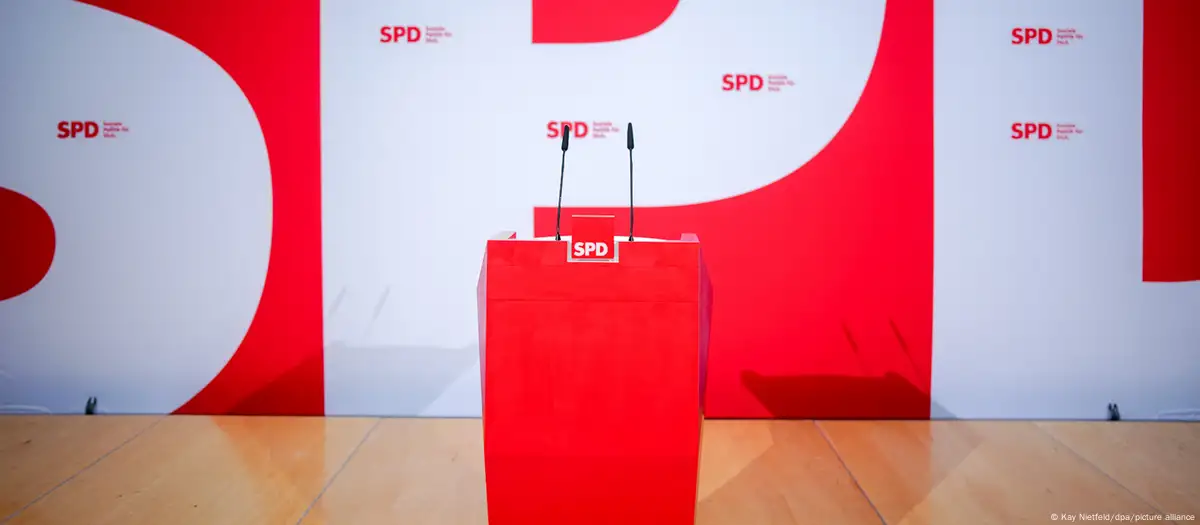
What you need to know
- The center-left Social Democrats (SPD) have voted in favor of a coalition with Merz's conservative bloc
- SPD's Lars Klingbeil has been named as Germany's next vice chancellor and finance minister
- Volkswagen and Mercedes-Benz report significant first-quarter profit declines
- Chancellor Olaf Scholz's cabinet will meet for what is expected to be its last session
These live updates have been closed. Thanks for reading.
Below you can see our roundup of news from Germany on Wednesday, April 30.
German inflation falls further to 2.2% in April
German inflation eased slightly to 2.1% in April, down 0.1 percentage point from March and the second decline in a row, according to the Federal Statistical Office (Destatis).
Once again, energy prices had a dampening effect on inflation, as oil prices fell in the wake of US President Donald Trump's tariff policy. By contrast, food prices rose by 2.8%.
Meanwhile, core inflation — a figure that excludes volatile prices of food and energy — rose to 2.9%, up from 2.6% in March.
Germany's inflation rate stabilized at 2.2% in 2024, after years of high price increases due to the coronavirus pandemic and Russia's full-scale invasion of Ukraine in February 2022.
Outgoing cabinet approves pension increase in July
Pensions for more than 21 million German retirees will rise by 3.75% on July 1, the outgoing cabinet decided in its final meeting on Wednesday.
For a standard pension with average earnings and 45 years of contributions, this means about €66 ($75) more per month. And for a smaller pension of €1,000, the increase will bring an additional €37.40 per month.
Labor Minister Hubertus Heil had already announced the increase in March. After the cabinet's decision, he called the increase "good news for pensioners."
"Thanks to the good wage development, the pension adjustment strengthens their purchasing power," Heil said.
"Stable pensions are not a handout, they are hard-earned and an expression of fairness," he added.
The pension increase will be set by decree by Heil's ministry. However, it still has to be approved by the Bundesrat, the upper chamber of the German parliament. The increase can then take effect on July 1.
China says allegations of espionage are 'unfounded and malicious slander'
China rejected accusations of spying on Wednesday after Germany's federal prosecutor's office charged Maximilian Krah, a former member of the far-right Alternative for Germany (AfD), and another German national for espionage on Tuesday.
"The so-called 'China espionage threat theory' is completely unfounded and a malicious slander," said Guo Jiakun, Chinese Foreign Ministry spokesperson in a press conference.
"We urge the German side to stop smearing and vilifying China, and to take concrete actions to uphold the positive momentum in the development of bilateral relations," Jiakun said, adding that China "has always upheld the principles of mutual respect."
The Chinese spy identified by German prosecutors as Jian G., a German citizen, has been suspected of working with Chinese intelligence since 2002, including during his tenure as an aide to Alternative for Germany (AfD) MEP Maximilian Krah from 2019 to 2024.
He is suspected of illegally accessing over 500 documents that the European Parliament, where his boss Krah served as a member from 2019 to 2025, classified as "particularly sensitive."
Prosecutors stated that a Chinese national named Yaqi X. has been charged with assisting Jian G. in accessing information about flights and passengers at Leipzig Airport. She was employed by a company that provided logistics services to the airport.
No niqab while driving: German court upholds ruling
A court in Germany has decided that a Muslim woman can't be granted an exemption to wear a niqab face covering while driving.
The Berlin-Brandenburg Higher Administrative Court (OVG) rejected an appeal by a Muslim woman who applied for an exemption to Germany's road regulations, a spokesperson said on Tuesday.
These ban face coverings to make sure anyone driving a vehicle is identifiable.
The woman has applied for exemption to wear the niqab, which covers the entire face except for the eyes, on religious grounds.
She argued that not wearing a face veil would expose her to the gaze of strangers when she was driving, violating her right to freedom of religion.
This ruling confirms a January decision by a Berlin administrative court on the same case, and the woman doesn't have further right of appeal, the spokesperson said.
Other courts in Germany have previously ruled on the issue of driving while fully veiled.
They have consistently rejected any exemption on religious grounds.
2006 World Cup tax evasion case against former DFB president dropped
The court in Frankfurt am Main has dropped the tax evasion case against former German Football Association (DFB) president Theo Zwanziger in connection with the 2006 World Cup in exchange for a fine.
Zwanziger will have to pay €10,000 ($11,370) to a charity, the court decided. The prosecution and defense had agreed on this amount.
The criminal proceedings concerned allegations of tax evasion in connection with the organization of the 2006 FIFA World Cup in Germany.
Zwanziger was accused of filing false tax returns for his association as the former president of the German Football Association (DFB), which allegedly resulted in millions of dollars in tax evasion. The ruling in his case means that none of the three original defendants are still on trial.
In September, the court dismissed the case against former DFB president Wolfgang Niersbach in exchange for a fine of €25,000. This was followed last week by the dismissal of the case against former DFB General Secretary Horst Schmidt, also in exchange for a fine.
Why the SPD voted to back the coalition deal with the CDU
This outcome was largely expected.
Three factors contributed to the decision: the SPD managed to secure seven ministries out of 16 despite a historically poor election result; fresh elections would likely have worsened their outcome while boosting the far-right AfD; and the party is familiar with coalition dynamics from past experience with the CDU.
SPD leadership views this approval as a sign of party support, though it is far from a "marriage of love."
Meanwhile, Lars Klingbeil, one of the SPD leaders, is set to become vice chancellor, a role traditionally tied to the finance ministry.
Klingbeil has established strong working relationships with Merz during coalition negotiations.
Boris Pistorius, the popular defense minister, is expected to retain his position.
However, challenges remain in appointing women and younger leaders to ministerial roles, and questions linger about who will take responsibility for the SPD's poor election result.
Rumors have it that Saskia Esken, the other party leader, may have to make way.
More announcements from the SPD are expected on Monday, the coalition treaty will officially be signed, and the new Cabinet will be sworn in on Tuesday.
Germany's unemployment rate declines slightly
In a sign of continued economic weakness in Germany, the number of unemployed in April fell only slightly by 36,000 to 2.932 million, according to the Federal Employment Agency (BA).
This means the unemployment rate fell by 0.1 percentage points to 6.3%. In March, unemployment in Germany rose by 26,000.
However, compared to April last year, the number of unemployed was 182,000 higher.
Due to the high level of unemployment, the BA is in danger of slipping into the red this year, according to the head of the agency, Andrea Nahles.
The agency will first use its reserves of €3.2 billion ($3.6 billion). "This is the cushion we have for the time being," Nahles said.
However, the BA expects to run a deficit if the poor development continues. A quick improvement is not expected.
German economy grows small after slowdown
Germany's economy performed slightly better in the first three months of the year than expected.
The gross domestic product rose by 0.2% in the first quarter of 2025, compared with the previous three-month period, preliminary data from the Federal Statistical Office (Destatis) showed.
Growth had been projected to reach just 0.1%.
This follows a 0.2% contraction in the final quarter of 2024.
The growth was supported by increases in both private consumption and investment.
SPD's Klingbeil to become next German vice chancellor
Lars Klingbeil, the co-leader of Germany's Social Democratic Party (SPD), is set to become the country's next vice chancellor and finance minister, according to party sources.
The party's executive committee reportedly approved Klingbeil's nomination unanimously, shortly after the SPD announced that its members had overwhelmingly approved a coalition agreement with the CDU/CSU bloc.
The 47-year-old Klingbeil forged a close partnership with incoming conservative chancellor Friedrich Merz during negotiations to form a coalition after Germany's general election in February.
Final hurdle passed for new German government
With SPD members approving the coalition agreement, Christian Democratic Union leader Friedrich Merz is set to be elected chancellor by parliament on May 6.
This would pave the way for the new government to take office exactly six months after the current center-left coalition collapsed over the sacking of former finance minister Christian Lindner.
In December, Chancellor Olaf Scholz called and lost a vote of confidence after the collapse of his coalition government, paving the way for new elections.
On February 23, Germans voted for a new Bundestag, the lower house of the parliament. The results were disappointing for the parties of the governing coalition, all of which lost their share of the vote, with Lindner's FDP failing to enter parliament.
The conservative CDU/CSU bloc appeared to be the winner with 28.6% of the vote.
The far-right Alternative for Germany (AfD) came in second with 20.8%, but the populist party is "firewalled" by Germany's established parties, meaning they have refused to work with the far right.
CDU leader Friedrich Merz decided to enter coalition negotiations with the SPD, which came in third with 16.4%.
Social Democrats approve coalition deal with conservatives, sources say
Germany's Social Democratic Party (SPD) has approved a coalition agreement with the conservatives, sources close to the party said.
According to the reports, 84% of participating members voted in favor of the deal.
This is more than the 66% in the last membership vote to form a government with the CDU/CSU bloc in 2017.
The vote, which ended just before midnight on Tuesday, took place over a two-week period.
Voter turnout was 56%, the sources said. A minimum of 20% of members needed to take part in the vote for it to be valid.
Mercedes-Benz profit falls 43% on lower sales
Weighed down by sluggish business in the key Chinese market, German luxury carmaker Mercedes-Benz reported a sharp drop in earnings at the start of 2025.
The company reported a 43% year-on-year drop in first-quarter net profit to €1.73 billion ($1.96 billion).
Revenue fell 7.3% to 33.2 billion yuan due to a global decline in vehicle sales. Operating profit fell nearly 41% to €2.29 billion, reflecting ongoing market challenges.
Mercedes-Benz also warned of a potentially significant impact on profitability from recently imposed US import tariffs.
However, the company said it remains difficult to assess the exact impact on demand due to the evolving situation and possible retaliatory measures.
Volkswagen posts 41% drop in first-quarter profit
German automaker Volkswagen reported a steep drop in first-quarter profit. The company cited heavy one-time charges and a weaker performance in China.
Europe's largest automaker posted a nearly 41% year-on-year drop in profit to €2.19 billion ($2.49 billion) for the first three months of 2025.
While group revenues rose nearly 3% to €77.6 billion, several headwinds weighed on the bottom line.
In addition to previously announced multi-billion-dollar special charges, Volkswagen earned significantly less from its joint ventures in China, a key market. Losses also worsened in the battery division.
Volkswagen reaffirmed its outlook for the year, although the forecast does not yet take into account the potential impact of new US trade tariffs under President Donald Trump's administration.
SPD is set to reveal coalition deal vote result
Germany's Social Democrats (SPD) on Wednesday will announce the result of a membership vote on a coalition deal with the conservative bloc of Christian Democrats (CDU) and its Bavarian sister party, the Christian Social Union (CSU).
Since the parties have already signed the coalition agreement, the approval of the new government depends on the SPD's party base.
The SPD's roughly 358,000 members had until 23:59 (2159 GMT) on Tuesday to vote on the 144-page agreement.
To pass, not only must a majority of members approve the program, but at least 20% of the party's membership must vote.
If the SPD approves the deal, the CDU's Friedrich Merz will be elected chancellor by parliament on May 6.
Welcome to our Germany coverage
Thank you for following our coverage of news in Germany on Wednesday, 30 April.
The process to secure Germany's next government appears to be coming to a close with one part of the coalition, the center-left Social Democrats (SPD) to give (or not) the final green light to the 144-page coalition agreement.
SPD members voted on Tuesday, with results expected on Wednesday, after the Christian Democratic Union/Christian Social Union (CDU/CSU) bloc gave their approval on Monday.
Chancellor Olaf Scholz's cabinet will meet on Wednesday for what is expected to be its last session. The outgoing chancellor will then travel to Paris for a meeting with French President Emmanuel Macron.
We're also expecting the release of the German inflation and unemployment figures for April.