Germany's Left Party rocked by antisemitism allegations
March 25, 2026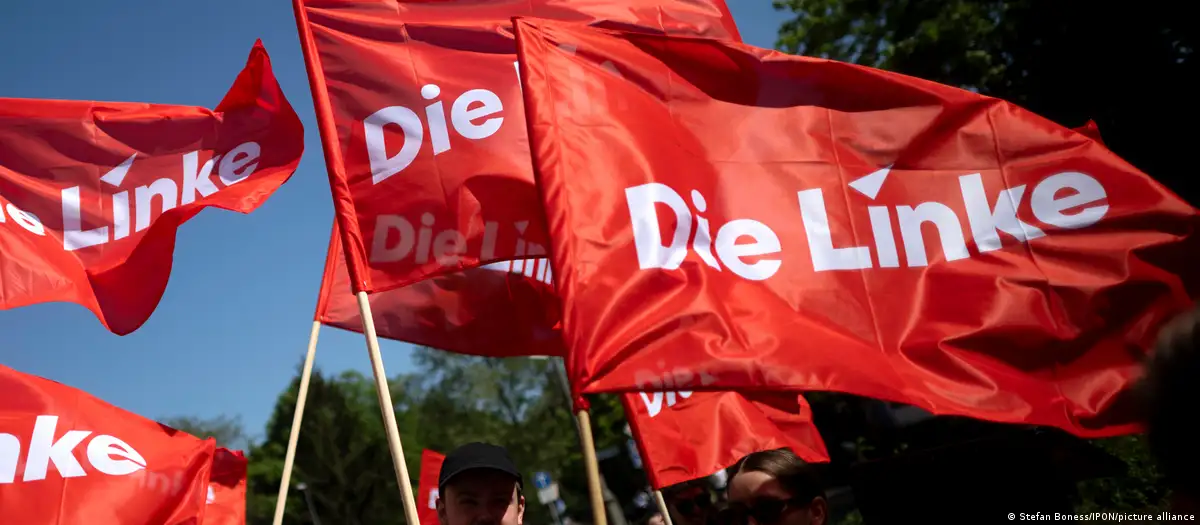
Where does legitimate criticism of the State of Israel's policies end, and antisemitism begin? This question has come up because of a resolution adopted by a regional branch of Germany's Left Party addressing Israel's actions in the Gaza Strip and the West Bank.
"The Left Party in Lower Saxony rejects the Zionism that actually exists today," is the heading of the controversial text.
Where this dividing line runs is a question that Stefanie Schüler-Springorum confronts time and again. She is the director of the Center for Research on Antisemitism at the Technical University of Berlin and a co-author of the so‑called Jerusalem Declaration on Antisemitism (JDA).
That declaration, published in 2021, serves as a counterproposal to the definition issued by the International Holocaust Remembrance Alliance (IHRA) in 2016.
For the JDA, an international group of experts responded to what they viewed as the IHRA's blurred distinction between antisemitic speech and legitimate criticism of Israel and of Zionism.
Left Party members operating in a gray area?
Historian Schüler-Springorum considers the Lower Saxony Left Party's resolution on Zionism to be "unclear" and therefore problematic. The wording in the title, she says, leaves the door open to accusations that it denies Israel's right to exist.
"Why is the term Zionism being used when the issue is the policy of a state?" she asked during an interview with DW, noting the many facets of Zionism — facets of a national movement that culminated in the founding of the State of Israel in 1948.
"When you use the term Zionism, you naturally also mean all of the people outside Israel who support the state," noted Schüler‑Springorum. For that reason, she accuses the Left Party in Lower Saxony of deliberately operating in a gray area.
She explicitly excludes the national party leadership around co‑chairs Ines Schwerdtner and Jan van Aken from her criticism.
The party's leadership duo has clearly distanced itself from the Zionism resolution in Lower Saxony. "There can be no compromises on motions that call the very foundations of our party into question," they stated in a joint declaration.
"I find that very credible," says Schüler‑Springorum. The two leaders, she explained, had commented on the topic several times when the occasion called for it. She added that this wasn't something you could just brush off with a few stock phrases.
In response to an inquiry by DW about the resolution, the Lower Saxony Left Party branch wrote: "We are aware that the term Zionism is understood in different ways." Policies and ideologies must be open to criticism and debate, the statement continued. "At the same time, we recognize that certain formulations can be misleading. It is unfortunate when a resolution gives the impression of having a bias," the party statement read.
In an additional public statement, the Lower Saxony state association says it takes the criticism — especially from Jewish organizations and associations — very seriously, and will seek to enter into a dialogue with them.
Josef Schuster, president of the Central Council of Jews in Germany, had described the Left Party's Zionism resolution as an "attack on the Jewish people's right to self‑determination."
An antisemitism commissioner quits the party
In response to the resolution passed by the Lower Saxony state association, Brandenburg's commissioner for antisemitism, Andreas Büttner, resigned from the Left Party. He told DW that anti‑Zionism is fundamentally antisemitic — because it questions Israel's right to exist. Anyone who rejects "Zionism that actually exists," he said, is in effect rejecting the State of Israel.
Büttner said he had spent years trying to pursue this debate within the party. In the end, however, he said that personal animosity also played a decisive role in his decision to leave. Although he welcomes the fact that the party leadership is now signaling an awareness of the problem, he says that for him, this comes too late.
The Left's upswing
The current debate comes at a moment when the Left is riding a wave of momentum following its unexpectedly strong performance in the 2025 federal election. Hardly anyone had expected it to reach nearly 9%.
Although the party failed to enter the state parliaments in Rhineland‑Palatinate and Baden‑Württemberg in their most recent elections in March, it significantly improved its results, reaching 4.4% in each state.
However, political scientist Antonios Souris of the Free University of Berlin told DW that the Left's current upswing in elections could soon come to an end. "On some issues, the party is divided by irreconcilable positions," he said. The Israel–Palestine conflict, which has been simmering for decades, he said, is evidently one of them.
Souris sees a "potential for division" also in the cultural sphere and at universities. For the Left, this could become problematic when it comes to possible participation in state governments. In the city‑state of Berlin, where elections will be held in September, the party is polling at around 15%, which is roughly the same level as the center-left Social Democrats (SPD) and the environmentalist Greens. The center-right Christian Democratic Union (CDU) continues to lead in the polls at 22%.
The Left Party had been hoping to be able to forge a three‑party coalition in Berlin's state government — possibly even led by the Left — following September's vote. Now, political observers say those hopes could be dampened by the renewed debate over antisemitism.
Political analyst Souris does not consider the issue resolved: "It always comes down to whether distancing by the party leadership can actually help resolve the conflicts at the grassroots level."
This article was originally written in German.
While you're here: Every Tuesday, DW editors round up what is happening in German politics and society. You can sign up here for the weekly email newsletter, Berlin Briefing.