German Catholic Church consecrates first bishop from India
March 15, 2026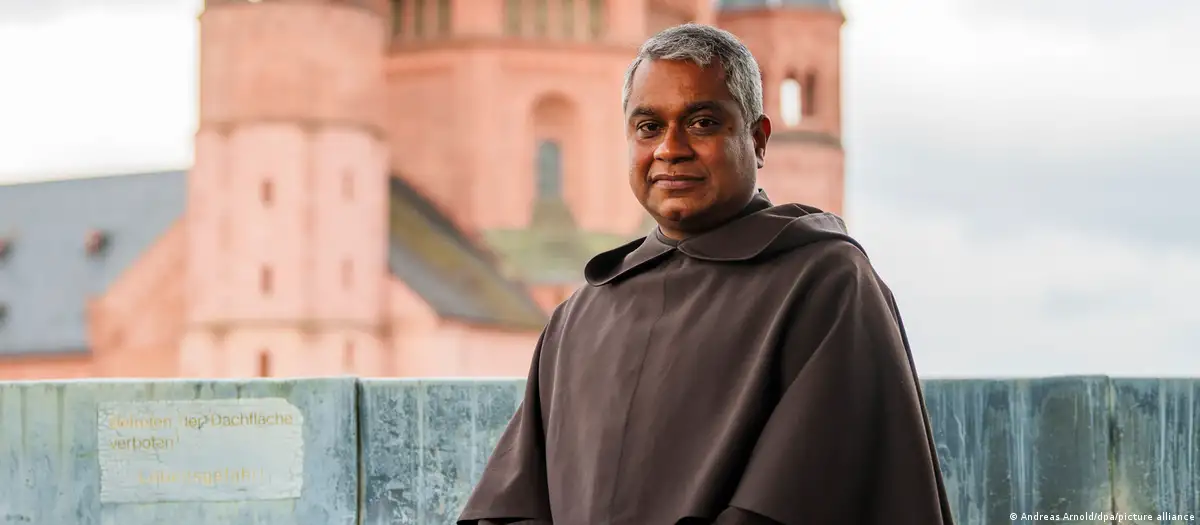
He himself calls it a 'strong signal:' A man with non‑European roots serving as a Catholic bishop in Germany. This Sunday, the Carmelite Father Joshy Pottackal, originally from India, is to be consecrated as a bishop in Mainz Cathedral, and will serve as an auxiliary bishop in the Diocese of Mainz in the west of the country.
Since his appointment in November 2025, he has often heard people of immigrant background exclaim, "At last!"
Pottackal, now 48, told DW that he believes they mean that "now it's acknowledged that they, too, belong to the Catholic Church in Germany." For him, that is a "wonderful motivation," especially given how many Christians in Germany have a migration history.
For the Diocese of Mainz in southwestern Germany, his consecration marks the long‑awaited appointment of an auxiliary bishop who can help lighten the diocesan bishop's workload. The English term "auxiliary bishop" is easier to grasp than the German Weihbischof: It simply means a bishop who assists. Until March 1, Pottackal served as a personnel officer in the diocese. In the future, he will also visit parishes, administer confirmation and represent the church.
For the Catholic Church in Germany, this marks a historic step — almost a sensation. Until now, those who became Catholic bishops in Germany typically came from a conventional German middle‑class background. Pottackal is the first bishop in Germany to have been born outside Europe.
Millions of Catholics come from families with migration histories
Among Catholics in Germany, the picture has long looked very different. According to the German Bishops' Conference, around 3.4 million Catholics in the country hold at least one foreign citizenship — out of a total of just under 20 million.
Many dioceses also estimate how many of their faithful speak a language other than German at home. The Archdiocese of Cologne puts the share at about one-fifth, while the dioceses of Fulda and Mainz each estimate around 25%. In Limburg, the figure is nearly 35%.
As the number of young men in Germany who feel called to the priesthood continues to fall, more clergy and members of religious orders are either invited by German dioceses or arrive on their own. Several hundred come from India, with a similar number from various African countries. Just a few weeks ago, a group of Indian religious sisters even founded a new convent in the Diocese of Münster.
Pottackal explains that the Indian province of the Carmelite Order was originally founded by the German Carmelites. Now he, like other Indian members of the order, has found himself serving in Germany. He even refers to Germany as a "mission country."
Father Joshy in Germany — a country shaped by immigration
Pottackal has lived in Germany for more than 20 years. To many people in the diocese, he is simply Father Joshy. He has held a German passport for years and knows the social climate well.
"At a time when society is polarized and people with a migration background often face headwinds, this is a strong signal," he says of his appointment. The church is showing that diversity matters, Pottackal adds — and that it, too, reflects Germany as a country shaped by immigration.
Peter Kohlgraf, the bishop of Mainz who had recommended Pottackal for the role of auxiliary bishop, called his appointment "a strong and important sign for our times," when he introduced him in November 2025. The Catholic Church, he emphasized, is a global Church.
"There are no strangers in this Church," Kohlgraf said.
In the same spirit, Pope Leo XIV — himself an American priest with many years of pastoral work in Peru — has already appointed several bishops with migration backgrounds since his election in May 2025.
What can parishes in Germany learn from a bishop with migration experience? Joshy Pottackal, who laughs easily and radiates warmth, answers without hesitation. "Flexibility," he says.
He points to the typical preparations for a parish festival in Germany: "You plan six months ahead, everything is written down, and carried out precisely."
In India, he explains, such long‑term planning is uncommon; things are handled more loosely, "with calmness and trust in God."
Father Joshy also talks about the parish festivals in the communities along the Neckar, where he served as pastor for several years: "One stand offered Polish food, another Indian food."
Even in rural parishes, he says, the international character of the Church is now unmistakable. There, too, integration is no longer an issue in church life. Within the Church environment in Germany, he has never felt excluded. However, in everyday situations — in shops, for example — he admits he has occasionally felt a bit uncertain.
Pottackal also thinks back to his experiences in mission areas in India. There, people are grateful simply to have a tent in which to celebrate Mass.
He tells DW, "No one asks how many steps a sanctuary should have, or whether the altar is made of wood or stone."
"Those are typically German questions," Joshy says.
For people who are not even sure what they will eat the next evening, such details simply don't matter. Faith, he insists, is not about outward appearances; it means "living together as a community and celebrating God."
His own bishop's staff is made of wood, rather than a more precious material. Wood is also incorporated into his pectoral cross and bishop's ring.
The new bishop is not moving: he will continue to live in the monastery
On his office door hangs a bishop's vestment, still wrapped in protective film — black with violet accents, the official color for Catholic bishops.
"I don't have to wear it all the time," he says, "only on festive occasions."
It sounds a little as though he is reassuring himself, as well.
Even as an auxiliary bishop, Pottackal will remain a Carmelite and continue living in the Carmelite monastery in downtown Mainz. In the end, he says, the order is his home — ever since he joined it at the age of 15.
For him, the monastery is "the family." Eight fellow brothers currently live and pray there. "I can't even imagine living alone in a bishop's residence," Pottackal says.
He is deeply grateful that the bishop and the diocese immediately understood his wish to remain in the monastery, "that is where I feel at home."
This article was originally written in German.
While you're here: Every Tuesday, DW editors round up what is happening in German politics and society. You can sign up here for the weekly email newsletter, Berlin Briefing.