Why have US-South Africa relations soured?
April 4, 2026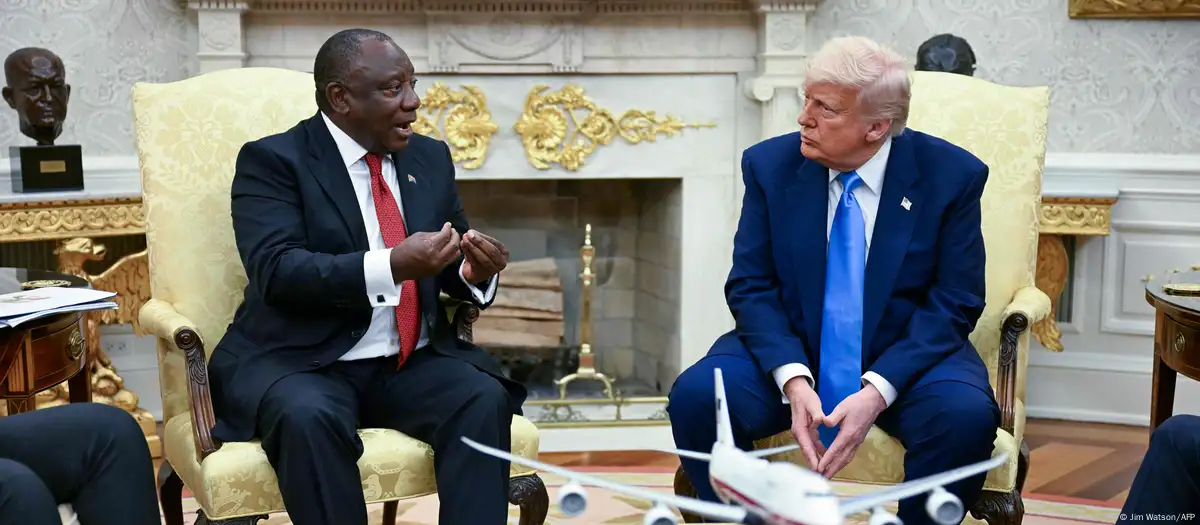
When South African President Cyril Ramaphosa recently lambasted "vicious global right-wing forces" at an ANC party conference, everyone knew he was referring to US President Donald Trump. His outspoken criticism comes as no surprise, as relations between South Africa and the US have deteriorated considerably since Trump returned to the White House in 2025.
Trump says South Africa's white minority is experiencing a genocide without, however, providing any real evidence to back up his claim. Ramaphosa's government vehemently rejects Trump's accusation. President Trump subsequently boycotted last year's G20 meetings and summit, all of which were hosted by South Africa. Various media outlets are now reporting that the US pressured France to disinvite South Africa from the G7 summit in Evian this June.
When did ties fray?
Relations began to sour well before the start of Trump's second term in office, says Daniel Silke, who heads the Cape Town-based Political Futures Consultancy. "This has been a long time coming," Silke told DW. "South Africa over the cause of the last ten years has shifted its foreign policy orientation away from the US and the West for that matter." The country has instead turned towards the BRICS states, an association of emerging economies established as a counterweight to the western-centric G7 alliance.
Ramaphosa even worked to maintain good relations with BRICS member state Russia after it launched its full-scale invasion of Ukraine. This comes as no surprise given the ANC party's strong links to Moscow dating back to the 1970s and 1980s, when the Soviet Union supported its anti-apartheid struggle. In recent years, South Africa has also forged closer ties with China, another BRICS country.
The US has been following this geopolitical shift and the BRICS agenda, which aims to weaken the US dollar as the leading currency in global trade, said Silke.
According to him, the ANC has always been suspicious of the US. This distrust dates back to the 1980s, when international pressure on the South African apartheid government mounted, yet US President Ronald Reagan showed no interest in imposing comprehensive economic sanctions against the regime, Silke explains.
US relations with South Africa shifted after US President Bill Clinton took office and apartheid ended in 1994. Today, the US has become South Africa's second-most important trading partner after China, according to Germany Trade and Invest data.
Washington's latest ideological shift to the right has, however, put it on a collision course with the ANC, said Silke. The Trump administration has not shied away from confrontation, which has made matters even worse, he added.
Trump accuses South Africa of allowing "white genocide"
Powerful tech entrepreneurs close to Trump's MAGA movement have used their influence to make the Republican Party more racist than ever before, said Noor Nieftagodien, who heads the History Workshop at the University of the Witwatersrand in Johannesburg. Trump's inner circle includes people like Elon Musk and Peter Thiel, Nieftagodien said. Tesla boss Musk, who previously headed the US Department of Government Efficiency (DOGE), is a native South African, while Paypal founder Thiel lived in Namibia during his childhood.
"They have connected themselves to ultra right-wing and racist organizations in South Africa, who have perpetrated the falsity, the complete lie, that there is a white genocide in South Africa," Nieftagodien told DW. "And Trump has latched onto this."
DW's Johannesburg correspondent Dianne Hawker said that "since the start of Donald Trump's presidency, South Africa was in his crosshairs." About two weeks after his inauguration, Trump announced that the US would cut all aid ties with South Africa, blaming this on its alleged human rights violations, she added. The cuts have hit aid programes across South Africa, with potentially life‑threatening consequences for people living with HIV.
The rift deepened when the US government began granting asylum to white South Africans, while simultaneously reducing overall refugee admissions.
Ties were strained further when South Africa accused Israel of committing genocide against Gazans before the International Court of Justice in The Hague in December 2023. The US government formally lodged a complaint against the allegation in March 2026, siding with Israel, which rejects the genocide accusation.
What is South Africa's stance on the Iran war?
The ANC has a favorable view of Iran's regime, which stopped supplying oil to the South African apartheid regime following the 1979 Islamic Revolution. That partly explains why South Africa has not distanced itself from Iran as the US continues attacking the country. This refusal to abandon Iran angers Trump, said Nieftagodien. "They won't tolerate any dissenting voices to their own view of the world and their desire to impose their will on the rest of the world."
Trump wants to punish South Africa for its unwavering, independent foreign policy, he added. He does not expect ties to improve while Trump remains in the White House.
This article was originally written in German.