What's behind Israel's attacks along Lebanon's Litani River?
April 15, 2026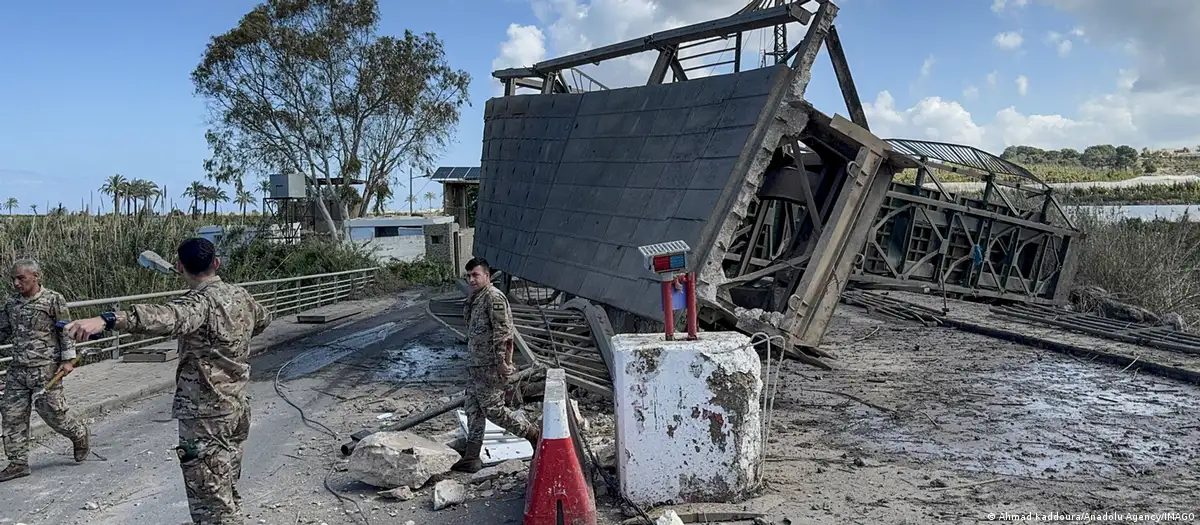
A small river has become a flashpoint in a broader regional conflict: The course of the 145-kilometer (90-mile) Litani River in Lebanon mirrors the front lines of the conflict between Hezbollah and Israel.
The Litani River also highlights the current fragility of international law. Despite the growing escalation in Lebanon between Israel and Hezbollah, the mandate of the long-standing UN mission UNIFIL — which has stationed international peacekeeping forces in the border region since 1978 — is set to expire at the end of the year.
Israeli evacuation orders
In Lebanon, the Iran-backed Hezbollah is fighting against the Israeli army amid the US-Israel war with Iran. Hezbollah is designated as a terrorist organization by the United States, Germany, and other countries.
Hezbollah had fired numerous drones and rockets at Israel in early March. According to the militia’s official statement, the airstrikes were intended as retaliation for the killing of Iran's Supreme Leader Ali Khamenei. Just a few days earlier, on February 28, Israel and the US had launched airstrikes against Iran.
Hezbollah responded with drone and rocket attacks, which Israel countered with airstrikes. According to Lebanese health authorities, the strikes have killed almost 2,000 people and displaced around 1.2 million. The Israeli Defense Forces (IDF) also urged the population in the south of the country to leave the area and seek safety north of the Litani River.
According to the Israeli military, numerous bridges were destroyed to cut off Hezbollah's supply routes.
Israeli government officials emphasized repeatedly that they sought to end the threat to the Israeli population in the north of the country posed by Hezbollah's drone and rocket fire.
'Litani must be the new border'
Israeli Defense Minister Israel Katz said on March 24 that Israeli forces would "control the remaining bridges and the security zone up to the Litani." The river is about 30 kilometers north of Israel's border.
Katz said that Israel plans to create a defensive buffer and, in a warning to the civilian population, posted on X that there could be no homes or residents in areas where there was "terror and rockets," an apparent reference to Hezbollah.
In addition, he said the IDF was tasked with "accelerating the destruction of Lebanese homes in border villages to ward off threats to Israeli settlements — following the model of Beit Hanun and Rafah in Gaza."
According to Israeli media reports, the two locations in the Gaza Strip mentioned by Katz have suffered massive destruction as a result of Israeli military operations.
Israeli Finance Minister Bezalel Smotrich told the Israeli online newspaper The Times of Israel that Israel should move its border with Lebanon forward to the Litani River. "The Litani must be our new border with the state of Lebanon," he said on March 24.
A recent analysis by the NGO International Crisis Group said that "Israeli officials hint that once a full go-ahead comes, they intend to capture at least the 30km-deep strip north of the border."
It said the country is holding back on the offensive only to avoid angering the Trump administration. The administration would prefer Israel to continue working with the US against Iran rather than getting tied up in Lebanon.
Disputed history
Historically, the Litani River has played a significant role in the Israeli-Lebanese conflict. The events during the Israeli military’s "Operation Litani" in March 1978 were particularly tragic.
As part of this military operation, the Israeli army invaded Lebanon with 25,000 soldiers and occupied the area south of the Litani River. Between 1,000 and 2,000 people were killed, and according to estimates by the Lebanese government, around 280,000 people, mostly Shiites, were displaced. A large number later returned to the border region.
This invasion was in retaliation for an attack by the Fatah faction on March 11, 1978. At that time, the Palestinian party operated primarily as an armed wing of the Palestine Liberation Organization (PLO) and used southern Lebanon as a base for attacks on northern Israel. In the attack on a coastal road in northern Israel, 37 people were killed and 76 others were wounded.
The escalation led to the establishment of the UN peacekeeping mission UNIFIL, which was launched by the UN Security Council that same month. The mission, headquartered in Lebanon's Nakura, was intended to help establish a buffer zone between the Litani River and the border with Israel.
After the 2006 Lebanon war, the UNIFIL mandate was expanded by the UN Security Council Resolution 1701. According to the UN resolution, Hezbollah was to withdraw behind the Litani River. However, Israel and the US repeatedly accused the peacekeepers of failing to push Hezbollah back far enough.
The drastic cuts to US funding for the UN and humanitarian aid announced in 2025 also led to a reduction in contributions to UNIFIL. Combined with political pressure from the US and Israel, this resulted in the UN mission not being extended by the Security Council and therefore set to expire at the end of 2026.
Many people in Lebanon now fear that the withdrawal of UN peacekeeping forces could lead to further displacement and ultimately a shift in the border.
Instead of UN peacekeeping forces, Israeli forces could control the security zone up to the Litani River, in keeping with the pledges of "accelerated" destruction by Israel’s defense minister Katz.
This article was originally written in German.