US rebuilding WWII Pacific airfields amid China threat
March 27, 2026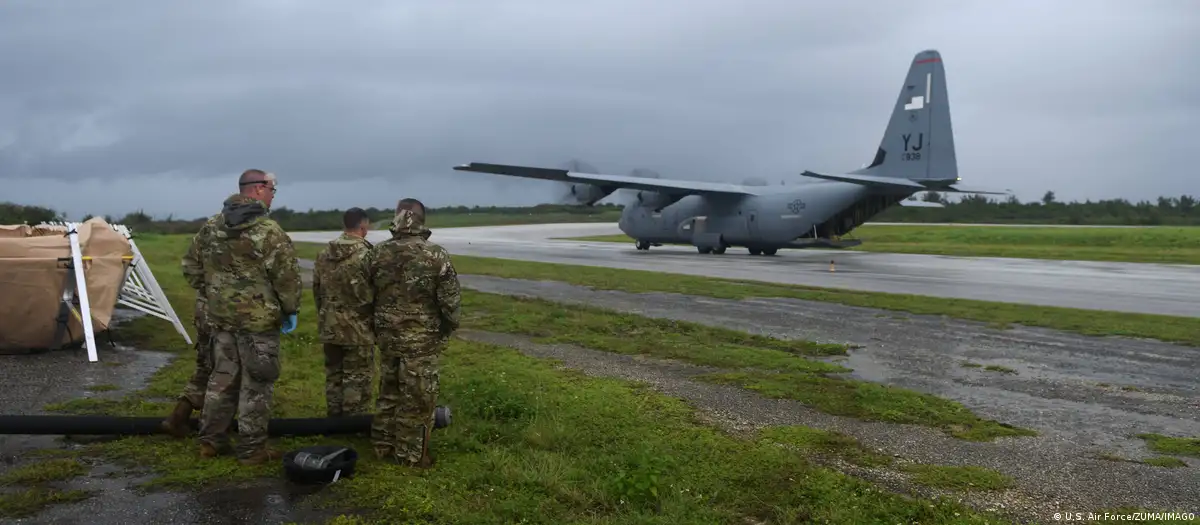
Airstrips that were constructed on remote islands in the Pacific to target Japan in the closing stages of World War II are quietly being repaired and restored as the US builds up its defensive posture amid the growing challenge of China in the region.
Chinese vessels frequently test maritime claims by South Korea and Japan in the northern Pacific. To the south, Beijing carries out frequent large-scale military exercises around Taiwan, which it says will one day be "reunited" with mainland China.
Beijing also claims most of the South China Sea as Chinese territory, despite a 2016 international tribunal rejecting these claims.
"China is, of course, the big concern in the region and this appears to be a response to China building out its own capacity," Dan Pinkston, a professor of international relations at the Seoul campus of Troy University and a former US Air Force officer, told DW.
"They are intent on breaking out beyond the first and second island chains to get unrestricted access to the Pacific and the US returning these airfields to operational status is preparation for further escalation," Pinkston said.
Historic airfields
The details of the work that is taking place at the wartime bases on Tinian and Peleliu are limited.
Analysts believe the intention is to provide the US Air Force an alternative to primary fields, such as Andersen Air Force Base in northern Guam or Kadena Air Base on the Japanese island of Okinawa.
Since 2023, US engineers have been relaying the four 2,400-meter runways that were initially laid down 80 years ago at Tinian Island's North Field, from where the B-29 Superfortress Enola Gay took off to drop the first atomic bomb on the city of Hiroshima on August 6, 1945.
Three days later, another B-29 bomber took off from the airfield, today part of the Northern Marianas Islands, to drop a second bomb on Nagasaki and force Japan's surrender.
Once famous as the busiest air base in the world, the facility was abandoned in 1947 and largely reclaimed by the jungle until 2003, when one runway was cleared for an exercise. More extensive work to clear the base commenced in 2023.
Engineers are also on Peleliu, one of the most southerly islands in the Palau archipelago and the site of fierce fighting during the war. The 1,800-meter runway was completed before the battle to take the island from the Japanese was over, and it supported US operations in the Pacific theater until the end of the war.
The field served as a local airport for islanders, but was only usable by light aircraft until US units arrived in 2024 to clear the facility. In June 2024, a KC-130 tanker aircraft was the first to land at the repaired field.
US looks for a refit
"Ten years ago, the US was very busy reassessing its bases in the Middle East," said Garren Mulloy, a professor of international relations at Daito Bunka University and a specialist in military issues.
"They have realized just how vulnerable their airfields and related infrastructure are to a potential attack," he told DW.
"We also know that China has been escalating in the Indo-Pacific in that time, which I think initially shocked Washington because administrations had previously thought no one would dare to challenge them there," he said.
The basic facilities that the upgraded bases will require are new runway surfaces, taxiing areas and hard stands for aircraft to ensure they do not sink into the muddy ground on islands that are constantly humid and often battered by tropical storms.
Access to power sources and water are other basic needs, while underground fuel tanks and hardened shelters for both aircraft, weapons and other stores would also be desirable.
Positions may also be constructed for radar and defensive weapons systems. The US military told DW in 2024 that surveys were being undertaken for the siting and operation of Patriot anti-missile systems.
Neither radar nor weapons are likely to be in place at present, but the ground is being prepared for their arrival, Mulloy said.
"The number one up-front threat for the US in the region is China, although we can never be sure what North Korea might do and it is sensible to have back-up plans for your forces," said Mulloy, pointing out that Pyongyang announced in 2017 a "careful plan" to use its nuclear-capable Hwasong-12 intermediate-range ballistic missiles to strike "around" Guam.
The weapon is understood to have a range of 4,500 km (around 2,800 miles), putting Andersen Air Force Base within range.
"If a major conflict was to break out on the region, on the Korean Peninsula or over the Taiwan Strait, then Andersen would be an obvious target, so having a range of alternative facilities across the region is good strategy," Mulloy said.
"Also, in the event of an emergency in which the US needs to surge troops and materiel into a theater, these places are strategically located to allow them to do that quickly and effectively," he said.
Edited by: Wesley Rahn