Octopus Under Threat
March 18, 2026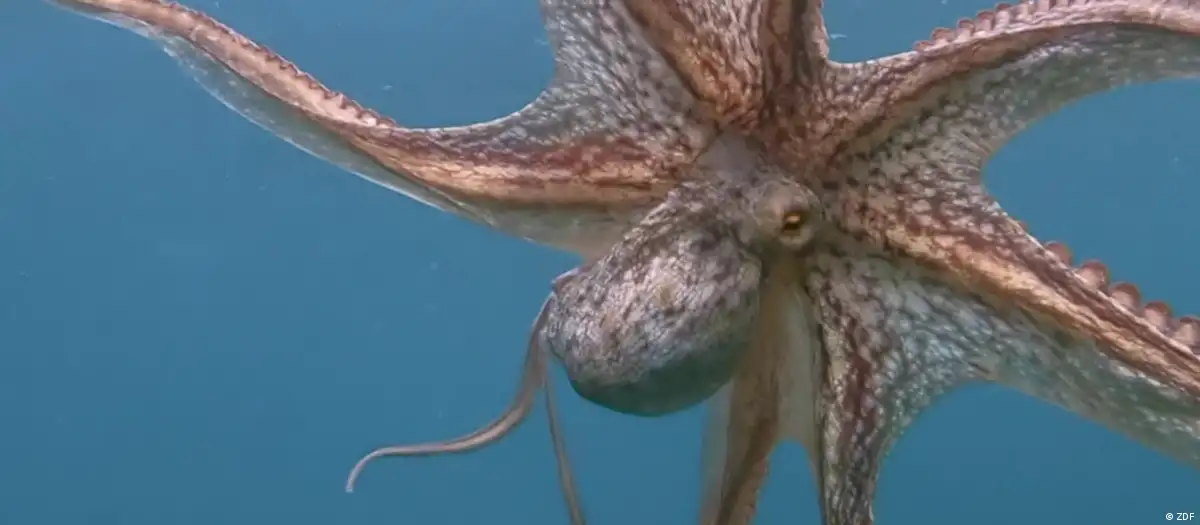
Stocksare shrinking dramatically, especially in the Mediterranean.
In Greece, illegal traps are often used for fishing. Together with the coast guard, the environmental organization Sea Shepherd has removed thousands of these traps from the seabed - part of a mission against environmental crime.
The film crew embarks on an investigative journey along the coasts of Europe and Africa.
In Galicia, northwestern Spain, there are several large fish processing plants that cut up octopuses, freeze them, and prepare them for the international market. Fishing is subject to strict regulations because natural stocks are shrinking rapidly. To meet the high demand, factories are increasingly resorting to imports from African waters.
A corporation is planning to breed octopuses in aquaculture. However, the plan has been met with fierce criticism from environmentalists, and the project has been put on hold for the time being.
The breeding of octopuses is ethically and ecologically questionable: the animals are highly intelligent and sensitive, suffer from stress in captivity, and no humane slaughter methods exist. In addition, their meat-based diet puts strain on marine ecosystems, and thus goes against sustainable aquaculture.
In the Mediterranean, the common octopus (octopus vulgaris) is caught in many places. In Greece, for example, long ropes of plastic traps attached to buoys are placed on the seabed. A local fisherman shows the camera team how the yield is steadily declining - a direct consequence of overfishing.
The ecological consequences of octopus overfishing are already visible: in Italy, the invasive blue crab is spreading uncontrollably. It is one of the octopus's favorite foods - but without natural enemies, it is now destroying mussel farming in the Po Delta and thus posing a threat to livelihoods.
Could the return of octopuses be the solution? An organization from Austria is testing exactly that, off the Croatian island of Krk. There, researchers are investigating whether octopuses can settle in artificial caves, reproduce, and contribute to the long-term stabilization of the ecosystem. The experiments are still in their infancy, but hopes are high: a sustainable model for the entire Mediterranean region could emerge.
Broadcasting Hours:
DW English
THU 26.03.2026 – 01:15 UTC
THU 26.03.2026 – 04:15 UTC
THU 26.03.2026 – 10:15 UTC
FRI 27.03.2026 – 09:15 UTC
FRI 27.03.2026 – 14:15 UTC
FRI 27.03.2026 – 21:15 UTC
SAT 28.03.2026 – 19:15 UTC
SUN 29.03.2026 – 02:15 UTC
MON 30.03.2026 – 07:15 UTC
MON 30.03.2026 – 12:15 UTC
Lagos UTC +1 | Cape Town UTC +2 | Nairobi UTC +3
Delhi UTC +5,5 | Bangkok UTC +7 | Hong Kong UTC +8
London UTC +/-0 | Berlin UTC +1 | Moscow UTC +3
San Francisco UTC -7 | Edmonton UTC -6 | New York UTC -4
From March 29:
London UTC +1 | Berlin UTC +2 | Moscow UTC +3