Merz in Israel: Working toward goal of 'new Middle East'
Published December 6, 2025last updated December 7, 2025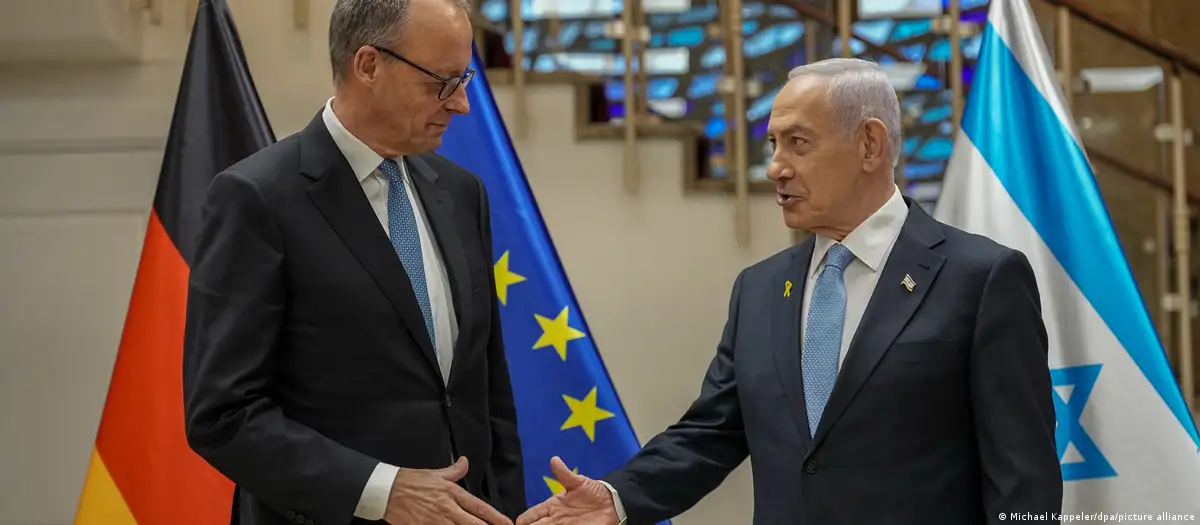
What you need to know
- German Chancellor Friedrich Merz said the best prospect for future peace involved the establishment of a Palestinian state, alongside Israel
- Merz said this could only be achieved at the end of a process of negotiations
- Israel's PM Benjamin Netanyahu spoke of 'opportunities for peace' but rejected a Palestinian state
- Merz's trip comes after a rare rift in German-Israeli relations after Berlin imposed a since-lifted partial arms embargo on Israel over its conduct in Gaza
It was the roundup of the latest developments during the German leader's first official trip to Jordan and Israel on December 6 and December 7. This blog is now closed.
WATCH - Merz visits Yad Vashem, meets Netanyahu
German Chancellor Friedrich Merz visited Yad Vashem in Jerusalem, reaffirming Germany's historic responsibility and commitment to Israel's security. His first trip to Israel came after a Gaza ceasefire and amid strained ties over the war. Merz backed a two-state solution, diverging from Prime Minister Netanyahu's stance, as both countries navigate peace talks and regional tensions.
IDF chief says ceasefire demarcation line in Gaza, 'a new border'
The chief of the Israel Defense Forces (IDF), Eyal Zamir, has called the yellow demarcation line where Israeli forces have withdrawn to in Gaza, a "new border."
"We have operational control over extensive parts of the Gaza Strip and we will remain on those defense lines. The Yellow Line is a new border line — serving as a forward defensive line for our communities and a line of operational activity," Israel's military quoted Zamir as saying to reserve soldiers while on a visit in Gaza.
Under the US-brokered truce between Israel and Hamas and as part of phase one of the three-phase plan, Israeli forces have withdrawn to positions within the Gaza Strip behind the so-called yellow line, while they remain in control of all areas within that yellow line.
The second phase of the ceasefire would involve Israeli troops' withdrawal from Gaza, deploying an international security force, forming a technocratic Palestinian committee within Gaza, and Hamas' disarmament.
Zamir's statements coincided with German Chancellor Friedrich Merz' visit to Israel, his first since becoming chancellor, where he urged the implementation of the truce's next steps.
Netanyahu visit to Germany not on the cards
German Chancellor Friedrich Merz had to handle a delicate question during his joint press conference with Israeli Prime Minister Benjamin Netanyahu.
Asked whether he would reciprocate an invitation for a visit to Germany to Netanyahu, Merz answered:
"There is no reason to discuss this at present. If time allows, I would issue such an invitation, but this is not an issue for either of us at this point in time."
Netanyahu addressed the issue, saying that while he would be "delighted to visit Germany again" and bring the governments together, there was an International Criminal Court arrest warrant for him.
In November 2024, the ICC issued a warrant for the arrest of Netanyahu, his former Defense Minister, Yoav Gallant and Hamas leader Mohammed Deif, who Israel said has been killed.
They are accused of war crimes and crimes against humanity in the Gaza Strip.
Specifically, the ICC has stated there were "reasonable grounds" to believe that Netanyahu and Gallant bore "criminal responsibility" for applying starvation as a method of warfare and for crimes against humanity in the form of murder, persecution and other inhumane acts. Netanyahu rejects the accusations.
Israel is not a signatory to the Rome Statute, which is the founding treaty of the ICC. Germany is a signatory.
Earlier in March, before he officially became chancellor, Merz said he had promised Netanyahu "we will find ways and means for him to visit Germany and also to be able to leave again without being arrested in Germany."
A unique friendship: German-Israeli relations through history
Germany, the country of the perpetrators of the Holocaust, became a diplomatic partner for Israel soon after 1948. The relationship was marked by both critical phases and tensions.
From the horror of the Holocaust to Willy Brandt's first state visit to Israel in 1973, DW takes a closer look at what has marked this unique relationship over the years in this article.
WATCH — German Chancellor Merz reaffirms support for Israel
In his first visit to Israel as chancellor, Friedrich Merz walks a diplomatic tightrope: affirming Germany's support while addressing civilian suffering in Gaza.
Netanyahu expects phase two of ceasefire 'very shortly'
Israeli Prime Minister Benjamin Netanyahu said he expected the second phase of the US-sponsored ceasefire plan for Gaza to begin soon.
Speaking at a joint press conference with German Chancellor Friedrich Merz, Netanyahu said Israel and Hamas are "very shortly expected to move into the second phase of the ceasefire," after the Palestinian militant group returns the remains of the last hostage being held in Gaza.
Hamas says not all remains have been reached because they are buried under rubble left by Israel's two-year offensive in Gaza.
Phase one of the truce came into effect on October 10 and largely halted the war that began after Hamas's deadly attack on Israel on October 7, 2023.
It involved the return of living and dead hostages held in Gaza.
The second stage of the Gaza ceasefire plan deals with disarming Hamas, establishing a transitional authority and deploying an international stabilization force.
"As I mentioned to the chancellor, there's a third phase, and that is to deradicalize Gaza, something that also people believed was impossible. But it was done in Germany, it was done in Japan, it was done in the Gulf States. It can be done in Gaza, too, but of course Hamas has to be dismantled," Netanyahu said.
Germany's Merz says prospective Palestinian state the 'best prospect' for future
German Chancellor Friedrich Merz said that work was taking place "toward the goal of a new Middle East" that involved the recognition of Israel.
Merz also said that the possible establishment of a Palestinian state perhaps offered the best chance for such a future.
"Our conviction is that the prospective establishment of a Palestinian state alongside Israel presumably offers the best prospect for this future," Merz said.
Merz said that any two-state solution would only take place at the end of a process of negotiations, not the beginning, reiterating once again that Germany will not recognize Palestinian statehood just yet.
Israel's Prime Minister Benjamin Netanyahu, however, has continued to reject an independent Palestinian state.
"We believe there's a path to advance a broader peace with the Arab states and a path also to establish a workable peace with our Palestinian neighbors," Netanyahu said.
"But we're not going to create a state that will be committed to our destruction at our doorstep."
Merz: 'A lasting peace is possible' in Gaza
German Chancellor Friedrich Merz said on Sunday that he believed that a "lasting peace is possible" in Gaza despite isolated violations of the ceasefire currently in place under a US-brokered peace plan.
Speaking at a joint press conference with Israeli Prime Minister Benjamin Netanyahu in Jerusalem, Merz said Germany was providing humanitarian aid to Gaza residents and would help rebuild the Palestinian enclave.
Merz also said there could be "no role for Hamas," the Palestinian militant group that has held power in Gaza since 2007, in the political future of the Palestinian territory.
The German leader also reiterated his country's support for Israel, referring to its historical obligation in view of the Holocaust perpetrated by Nazi Germany.
He said this support had been maintained after the October 7, 2023, Hamas-led attacks on Israel that triggered the current Gaza conflict. Hamas is designated as a terrorist group by Israel, Germany and several other countries
However, Merz called on Israel to adhere to international law in its military response to those attacks, in which more than 1,200 people were killed in Israel, mostly civilians, and 251 hostages taken.
Merz also said Israel should desist from taking any steps toward annexing the occupied West Bank, the other main Palestinian territory.
Israeli-German ties have recently been under strain amid difference of opinion over the proportionality of Israel's retaliatory offensive in Gaza, in which more than 70,000 Palestinians have been killed.
Among other things, Germany in August imposed a partial embargo on its arms exports to Israel over its conduct in Gaza, but lifted it in November when a ceasefire was established under the US-brokered peace plan.
Netanyahu: Political annexation of West Bank under discussion
Israeli Prime Minister Benjamin Netanyahu said on Sunday that he expected the status quo regarding the occupied West Bank to remain for the foreseeable future, but that the political annexation of the Palestinian territory was a subject of discussion.
His remarks were made in response to a question during a joint press conference with visiting German Chancellor Friedrich Merz, who in his statement called on Israel to refrain from taking steps toward annexing the territory.
Netanyahu says he'll meet with Trump this month
Netanyahu said he would meet with US President Donald Trump later this month to discuss the implementation of further phases of the Washington-brokered peace plan.
The first phase has involved a ceasefire, along with the exchange of hostages, both alive and dead, held by Palestinian militants in the Gaza Strip for Palestinian prisoners held in Israeli jails.
That exchange is almost at an end, with Netanyahu saying that the remains of one last deceased hostage were expected to be returned soon.
The next phases of the plan foresee the establishment of a technocratic committee to administer the Gaza Strip, the disarmament of Hamas and the deployment of an international "stabilization force" to monitor security in the Palestinian enclave.
Netanyahu says a 'workable peace' with Palestinian neighbors is possible
Israeli Prime Minister Benjamin Netanyahu has told a press conference that Israel believes "there is a path to a workable peace with our Palestinian neighbors," though he reiterated that he did not support any two-state solution.
Speaking at a joint news conference with visiting German Chancellor Friedrich Merz, Netanyahu said Israel believed that any Palestinian state would pose a risk to Israel's security.
He said the sovereign power of security from the Jordan River to the Mediterranean would always remain in Israel's hand.
Netanyahu also said there was a path to advance a broader peace with the Arab states.
Merz and Netanyahu holding 'expanded meeting' — Netanyahu's office
German Chancellor Friedrich Merz and Israeli Prime Minister Benjamin Netanyahu are currently in talks at an "expanded meeting" with other leading Israeli and German officials, the prime minister's office has said.
It named other participants as the Israeli defense and foreign affairs ministers, the acting director of the National Security Council, the director-general of the Defense Ministry, the secretaries of the prime minister and defense minister, the Israeli ambassador to Germany and the German ambassador to Israel.
"After the meeting, the two leaders will issue joint statements at 13:00 (1100 GMT)," the statement said.
IN PICTURES: Merz at Yad Vashem
German chancellors typically visit Israel in the first months in office. Why did Merz wait?
DW political correspondent Bernd Riegert said the German chancellor took office when the war in Gaza was in "full swing."
That Friedrich Merz waited until now didn't have to do with concerns in German-Israeli ties or the "special relationship" between the two countries.
The German foreign minister and president have made visits to Israel since May, Reigert said.
Relations between Germany and Israel were strained this summer after Germany partially suspended German arms exports to Israel, but that has since been resolved.
"It's a routine visit, under extraordinary circumstances," Riegert said.
Merz is meeting with Israeli prime minister
German Chancellor Friedrich Merz is meeting with the Israeli prime minister, Benjamin Netanyahu, this morning. The two leaders are scheduled to hold a press conference together later this afternoon.
Background: The German chancellor is holding talks with regional leaders in the Middle East on consolidating the ceasefire in Gaza this weekend.