Merz hails 'new era' for German military at brigade launch
Published May 22, 2025last updated May 22, 2025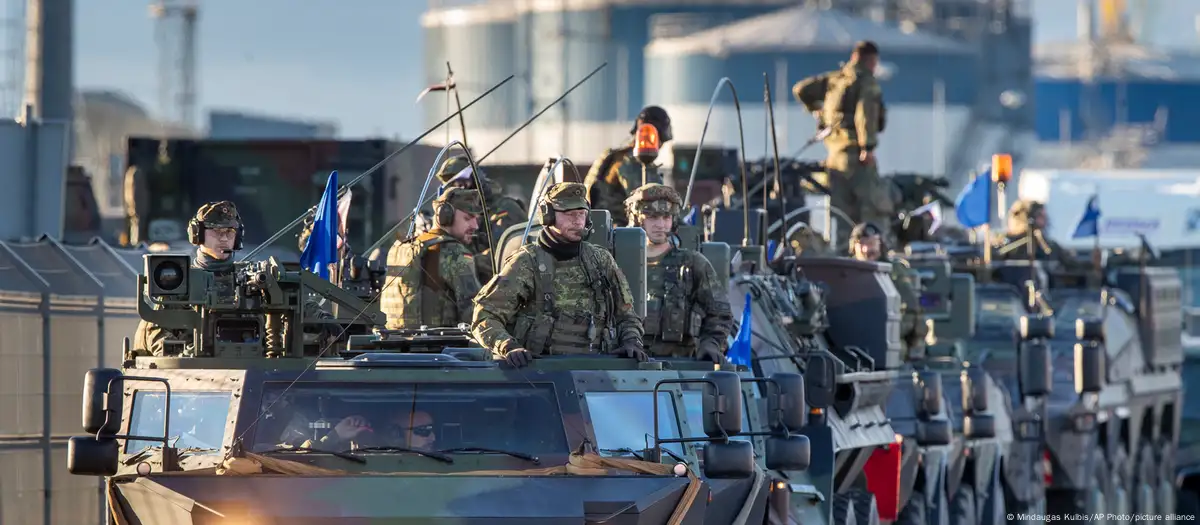
What you need to know
German Chancellor Friedrich Merz and Defense Minister Boris Pistorius are in Lithuania's capital, Vilnius, on Thursday to take part in a ceremony to mark the launch of a new armored brigade aimed at protecting NATO’s eastern flank.
Meanwhile, Foreign Minister Johann Wadephul held talks with Nigerian Foreign Minister Yusuf Maitama Tuggar.
These live updates have been closed. Thank you for reading. Below, you can read a roundup of top news stories from Germany on Thursday, May 22:
WATCH: Germany stations troops in Lithuania
Germany has begun its first permanent military deployment in another country, on NATO's eastern flank in Lithuania. The new German chancellor Friedrich Merz reviewed troops on parade in the capital Vilnius. The 5,000-strong armored brigade aims to deter potential Russian aggression in the Baltics.
German finance minister says 'investment booster' will revive economy
German Finance Minister Lars Klingbeil has said the new coalition government in Berlin will revive the country's economy.
Klingbeil made the remarks on the sidelines of a G7 meeting in Canada on Thursday.
The German government — a coalition between the conservative Christian Democratic Union (CDU) and Social Democratic Party (SPD) — is expected to meet next week to adopt an economic agenda that will outline its policy priorities, Klingbeil said.
One of the main ways the government is hoping to boost the German economy is a so-called "investment booster."
He said it would allow companies to write off up to 30% of investments, which will encourage private investment and boost public spending, German news agency dpa reported.
"I am sure that companies will also immediately get involved, that hesitation about investing will be abandoned, and that we will then also see progress in Germany," Klingbeil said.
During the remarks, Klingbeil also said he was confident of reaching a solution on the international tariff dispute with the US after the G7 talks in the mountain resort of Banff.
"We need movement in the negotiations now," he said, referring to talks between the European Commission and the United States.
Germany arrests alleged Yemeni Houthi fighter
German authorities have arrested a Yemeni man suspected of being a member of the country's Houthi rebels.
A statement by federal prosecutors said Bavarian state police had arrested the man, named as Hussein H., in the town of Dachau, just outside the southern city of Munich.
The man is a "suspected member of the foreign terrorist organization 'Houthi Movement,'" the statement said.
"The accused is strongly suspected of having been a member of a terrorist organization abroad as a young adult" in October 2022.
The arrest warrant accuses the suspect of having "participated in ideological training, followed by three months of military training."
He also allegedly briefly fought for the Houthis in Yemen.
The Iran-backed Houthis have fought an insurgency in Yemen, which has been devastated by war since 2015 when a Saudi-led coalition failed to defeat the rebels.
The Houthis have regularly attacked Israel since the outbreak of war in the Gaza Strip in 2023, and have targeted shipping concerns in the Gulf of Aden.
In the statement, German prosecutors said the militant Islamist organization's "stated goal is to strengthen and expand its power in Yemen and destroy Israel."
"To this end, it carries out military attacks within Yemen, Saudi Arabia, Israel, and the Red Sea," the statement said.
On Monday, the rebels warned they would impose a naval blockade on Haifa, a port in Israel, in response to the intensified Israeli military campaign in the Gaza Strip.
Merz backs NATO defense spending hike
German Chancellor Friedrich Merz said Thursday that he supports higher military spending, amid growing pressure on NATO members to boost their defense budgets in light of the threat seen to come from Russia.
NATO Secretary-General Mark Rutte has proposed that members of the alliance should spend 3.5% of their gross domestic product (GDP) on defense and an additional 1.5% on defense-related infrastructure, such as roads and railways, in the coming years.
US President Donald Trump had led the calls for NATO members — in particular European nations — to increase spending to 5% of GDP. Data from the US Department of Defense put US defense spending in 2024 at 2.7%.
The new spending target is expected to be adopted at an upcoming June NATO summit in The Hague.
These figures "seem reasonable to us, they also seem achievable to us, at least in the specified timeframe up to 2032," Merz said.
The chancellor, who was confirmed this month after federal elections in February, made modernizing Germany's armed forces one of his main campaign pledges.
In March, Germany eased a so-called "debt brake" — a fiscal rule that limits government borrowing — to fund an increase in defense spending.
German Foreign Minister Johann Wadephul has also backed Trump's demand to boost NATO defence spending to 5% of GDP.
Last year, Germany's defense spending was 2.12% of its GDP, up from 1.19% in 2014, according to NATO estimates.
Lithuania has also announced plans to increase defense spending to over 5% from next year.
The Baltic country, which, along with Estonia and Latvia, is considered among the most vulnerable to a potential Russian attack, is expected to spend over 3% of its GDP on defense in 2025.
"My country is ready to play its part. Next year we will reach 5% of GDP for defence," Lithuanian President Gitanas Nauseda said.
German Defence Minister Boris Pistorius, who joined Merz in Vilnius on Thursday to mark the overseas deployment of a German tank brigade, said that "deterrence and defence are Germany's top priorities."
Merz hails 'new era' for German military
German Chancellor Friedrich Merz said the German military had entered a "new era" on Thursday, after its first permanent overseas deployment was officially unveiled in Vilnius.
Merz was in the Lithuanian capital for a ceremony to mark the creation of an overseas tank brigade that will be permanently stationed in the Baltic country.
It is the first such foreign deployment by the German army since World War II, and comes in response to Russia's invasion of Ukraine as part of NATO efforts to strengthen its eastern flank.
The deployment is "a step into a new era" for the German military, Merz said. "Never before have we permanently stationed a large military unit abroad."
"Lithuania has asked for support — and Germany stands ready," Merz said during the ceremony, which Lithuanian President Gitanas Nauseda also attended.
"Anyone who challenges NATO must know that we are prepared. Anyone who threatens an ally must know that the entire alliance will jointly defend every inch of NATO territory," the German chancellor said.
Nauseda said the deployment was a "historic moment" for the two countries and a "landmark event for the security architecture of NATO and the whole of Europe."
Merz said the ceremony was a sign of the "solidarity" and "friendship" between Berlin and Vilnius. The chancellor said he was "all the more grateful" given the "suffering that Nazi Germany brought" to Lithuania.
Two men on trial for bomb threat campaign across Germany
Two young men are on trial in the southern German city of Stuttgart, accused of making bomb threats against schools, authorities and religious communities throughout the country.
According to prosecutors, one 20-year-old defendant is alleged to have sent a total of 51 threatening emails in autumn 2023, while his 21-year-old accomplice is said to have encouraged him via the messenger service Discord.
They are charged with disturbing the public peace by threatening to commit criminal offenses. Bomb threats were made against schools, government offices, universities, and religious communities in eight of Germany's sixteen federal states.
In addition to the bomb threats, the prosecution accuses the older defendant of attempted incitement to murder for an incident that occurred two years ago, when he allegedly paid two people to kill someone. The murder was not carried out.
Germany defends shift on nuclear energy in EU climate policy
German Economy Minister Katherina Reiche defended the government's decision to drop its opposition to nuclear energy being deemed sustainable.
"Every ton of CO2 we can save is a good thing. We have to be open to technology here," Reiche told journalists in Brussels.
She noted that, in the European Union's taxonomy for sustainable economic activities, technologies that emit no or low levels of carbon dioxide should be prioritized.
The taxonomy lists areas in which investments can be made to combat climate change. Certain investments in gas or nuclear power plants are categorized as climate-friendly.
This has been the subject of fierce opposition by Germany's previous government, but the new leadership in Berlin under conservative Chancellor Friedrich Merz has embraced a different stance.
However, Reiche said Germany has no plans to return to nuclear energy.
One in two Germans in favor of banning the AfD, survey says
Half of Germans surveyed support taking consistent action against the Alternative for Germany (AfD) party after the Office for the Protection of the Constitution classified the party as right-wing "extremist."
The non-governmental organization Campact, which commissioned the survey, announced that 60% of eligible voters consider the AfD to be the greatest threat to democracy since the founding of the Federal Republic of Germany.
Half of eligible voters are in favor of banning the party at the federal level, while 41% oppose it, and 9% have no opinion, according to the survey.
However, a majority of respondents (54%) believe that a ban would be unsuccessful. Only a third believe that a ban would be successful.
One of the Washington, D.C. shooting victims was German
The two victims of a shooting outside the Israeli embassy in Washington had been identified as Yaron Lischinsky and Sarah Lynn Milgrim.
German diplomatic sources told Reuters that Lischinsky held German citizenship. According to the German-Israeli Society (DIG), he was originally from Germany and grew up partly in Bavaria.
Lischinsky had been a founding member of the Israel-Germany Youth Forum and took a post at the Israeli embassy in Washington in 2022, the DIG said.
Israel's ambassador to the US said the two victims had been a couple.
German chancellor says NATO allies determined to defend territory
Chancellor Friedrich Merz has warned that Russia threatens European security. "There is a threat to us all from Russia," he told a press conference in Vilnius, adding: "We are protecting ourselves against this threat — and that is why we are here today."
Merz is visiting the Lithuanian capital to attend a ceremony to mark the official formation of Germany's first permanent overseas military deployment since World War II.
He also stressed that Germany and its partners are determined to defend NATO's territory.
"Together with our partners, we are determined to defend the alliance territory against any aggression. The security of our Baltic allies is also our security," Merz said.
Over a quarter of people in Germany have immigration history
Roughly 21.2 million people living in Germany in 2024 have a "immigration history," according to figures published by the Federal Statistical Office, Destatis, on Thursday.
That means they either migrated to Germany themselves or were born to two people who moved to the country.
Overall, these people account for just over a quarter, or 25.6%, of the total population of about 83.6 million. It represented a one percentage point increase from the figure in 2023, Destatis said.
Of those with an immigration history, some 16.1 million people immigrated to the country themselves.
And 6.5 million people living in the country have migrated there since 2015, the agency said.
People with a history of immigration are relatively younger compared to the overall population, with an average age of 38.2 years, nine years younger than that of those without an immigration history.
In the age group of 20-39 years, the proportion of people with a history of immigration was as high as 34%. Among the over 65s, it was just 14%.
German business mood improves in May
Sentiment among German companies has improved again in May, with uncertainty easing and expectations brightening, the Ifo Institute reported Thursday.
The leading German economic institute's business climate index rose to 87.5 in May from 86.9 in April. While companies were slightly less satisfied with current conditions — down 0.3 points to 86.1 — expectations rose by 1.5 points to 88.9.
"The German economy is slowly regaining its footing," said Ifo President Clemens Fuest. He noted that the recent sharp rise in corporate uncertainty has declined.
In manufacturing, the index rose significantly. Companies revised their expectations noticeably upward and assessed their current situation as having improved.
German foreign minister receives his Nigerian counterpart
Foreign Minister Johann Wadephul met with Nigerian Foreign Minister Yusuf Maitama Tuggar on Thursday in Berlin.
After their talks, Wadephul said Africa presents "an incredible number of opportunities" for Germany and the European Union, citing the continent's immense natural resources, including rare earth mineral deposits.
The minister said that he would encourage German firms to become more involved in Nigeria.
Tuggar, for his part, emphasized that Nigeria is already Germany’s second-largest trading partner in sub-Saharan Africa.
He called for both sides to intensify trade ties.
Tuggar also announced closer cooperation in the field of renewable energy development.
German chancellor condemns Washington shooting
German Chancellor Friedrich Merz has condemned the shooting of two Israeli embassy staffers outside a Jewish museum in Washington, calling it "a despicable act."
Posting on X, Merz said he condemned the attack "in the strongest terms" and added that "at the moment we must assume there was an antisemitic motive."
The head of the Central Council of Jews in Germany has said his heart was "torn apart" by the killings.
Council president Josef Schuster said the attack confirmed fears shared during a recent visit to Israel.
"Just one day later, this has been confirmed in the most tragic way," Schuster said. "The rise in political and antisemitic violence, even in Western societies, is shocking and threatening."
German interior minister meets Danish integration minister
German Interior Minister Alexander Dobrindt is meeting the Danish minister of immigration and integration, Kaare Dybvad Bek, in Berlin.
Their talks will focus on migration policy at the national and European level, according to the Interior Ministry.
Shortly after taking office earlier this month, Dobrindt tightened Germany’s migration policy, ordering tougher border checks at the country’s borders and allowing officials to turn back undocumented migrants even if they apply for asylum.
The measures are part of the new German government’s effort to curb irregular migration.
Bek has previously suggested that European nations including Germany could emulate his country's success in handling migration.
Denmark's social democratic government has pursued a tough course on migration for years.
While rights activists have criticized the approach, others have seen it as a model that succeeded in reducing the migrant influx.