Merz criticized for selective approach to international law
March 27, 2026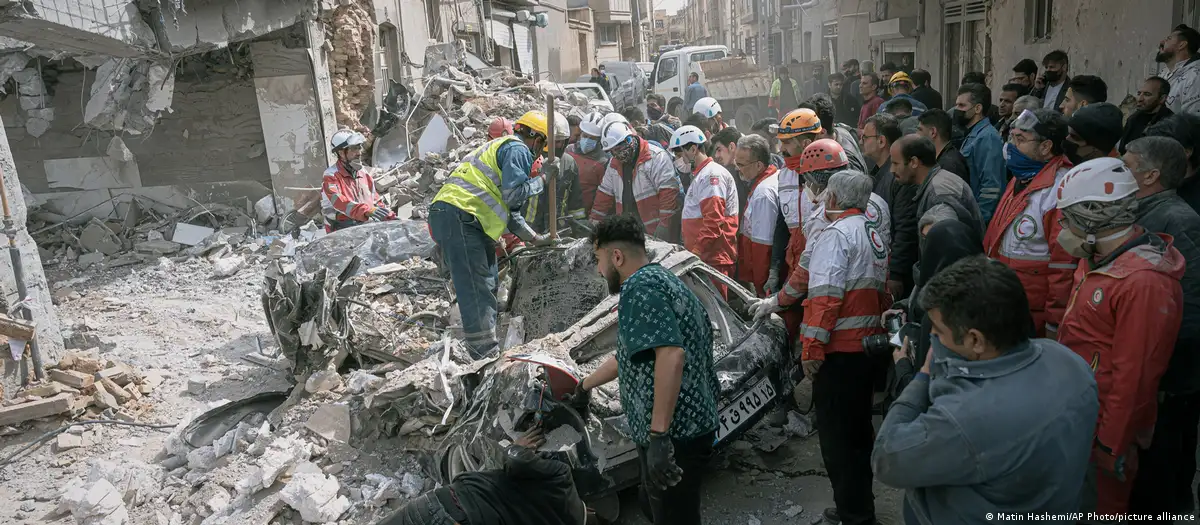
Since the United States and Israel launched a joint attack on Iran in late February, their military forces have killed government officials and more than 1,000 civilians. In early January, US special forces kidnapped Venezuelan President Nicolas Maduro and his wife, and civilians were also killed in that assault.
The vast majority of international law experts consider both the ongoing US-Israel war with Iran and the US intervention in Venezuela to be violations of international law.
German Chancellor Friedrich Merz, of the conservative Christian Democrats, has not unequivocally condemned the US. "We recognize the dilemma that measures and steps taken in accordance with international law against a regime that is developing nuclear weapons and brutally oppressing its own people clearly have no effect," he said following the initial attack on Iran. Prior to this, the chancellor was evasive regarding the legal situation of Maduro's capture, describing it as "complex."
Before his visit to the White House immediately after the first attacks on Iran, Merz also made it clear that he did not intend to "lecture" Donald Trump on international law. Critics in Germany accused Merz of pandering to the US president.
Legal scholars sign open letter to Merz government
In an open letter published on March 17, a number of law scholars and academics criticized the stance of the German government and warned of its potential impact.
"The German federal government's statements to date do not clearly condemn this action [the attack launched by the United States and Israel against the Islamic Republic of Iran on February 28, 2026], which violates international law. This contributes to the further erosion of the rules-based and institutional order in Europe and in the world."
Janina Dill, who teaches law at the University of Oxford in the UK, was one of the signatories. "Right now, it is great power politics — and above all the shift in US policy, the turning away from international law — that is doing incredible harm to the rule of law," she told DW.
Anne Peters, the director of the Max Planck Institute for Comparative Public Law and International Law in Heidelberg, said "unwritten international law can change if violations of international law are not protested. There is a danger that the prohibition of the use of force will be undermined and the rules will change if violations are not criticized."
Critics point out that Merz has downplayed the significance of international law regarding what happened in Venezuela and Iran, but has sharply and unequivocally condemned Russia's violation of international law in Ukraine.
"In reality, the chancellor arguably has a situational relationship with international law," Henning Hoff from the German Council on Foreign Relations told DW.
Experts in and on the Global South have long criticized what they describe as the double standards employed by Western governments when it comes to international law, accusing them of ignoring it when it does not suit their interests.
There is though "no obligation to criticize or sanction other countries in a uniform manner," said Peters. "On the basis of political considerations, Germany is certainly free to criticize one country — [Russian President Vladimir] Putin's Russia, for example — and not others. This is not the case for an international organization that has a mandate to remain neutral. But of course, the credibility of a state — including Germany's — is undermined when similar situations are treated differently."
The legal scholar also said it was important to look at who was making allegations of double standards, which could be a transparent tactic at times. "This accusation — that the West, in particular, applies double standards — is, after all, one that China and Russia repeatedly level. But this is purely opportunistic because these countries do not demand, for example, that sanctions be applied equally, but more that no one speak out at all, criticize at all or impose sanctions."
'Great powers becoming less interested in enforcing the law'
Dill at the University of Oxford highlighted a troubling global trend: "a growing disconnect between actual military and economic power and the will to uphold international law." She pointed out that this applied not only to Russia and China, but increasingly to the US.
"The great powers are, so to speak, becoming less and less interested in enforcing the law," she said.
When asked if weaker states, including Germany, could do anything to counter the trend, she said that in order to do so "all the other states would have to have an even more urgent interest in invoking the law and standing up for it collectively."
Dill added that "the more the great powers act without constraint and unchecked by the law," the more the other states, which are sometimes threatened, "need the norms, institutions and rules of peaceful conflict resolution."
German president indirectly criticizes Merz
So far, Merz has said Germany will not participate in the US-Israel war against Iran but he has not been so clear about his stance on international law. German President Frank-Walter Steinmeier, however, has spoken very clearly and indirectly criticized the chancellor. At an event at the German Foreign Office, Steinmeier said he believed the Iran war was a violation of international law and was "a politically fatal error."
The former foreign minister called on the current government to take a stand. "Our foreign policy does not become more persuasive when we do not designate a violation of international law as such," he said. "International law is not like an old glove that we should remove when others do so. On the contrary, it is vital for all those who cannot count themselves among the great powers."
It is highly unusual for a German president to contradict a chancellor on important foreign policy issues. Merz has not yet responded to Steinmeier's comments, but Jens Spahn, the leader of the CDU/CSU parliamentary group, called on the president to exercise restraint.
"In this case, the assessment of whether it is in accordance with international law is the responsibility of the federal government, and I would expect officials and dignitaries of the German Federal Republic to await the results of this assessment and to respect them," said Spahn.
In January, the German government said it would assess the legal implications of the US military operation in Venezuela but that it would "take its time." No assessment has been issued to date.
This article was originally written in German.