Czechs plan major rally as MPs mull 'foreign agent' law
March 21, 2026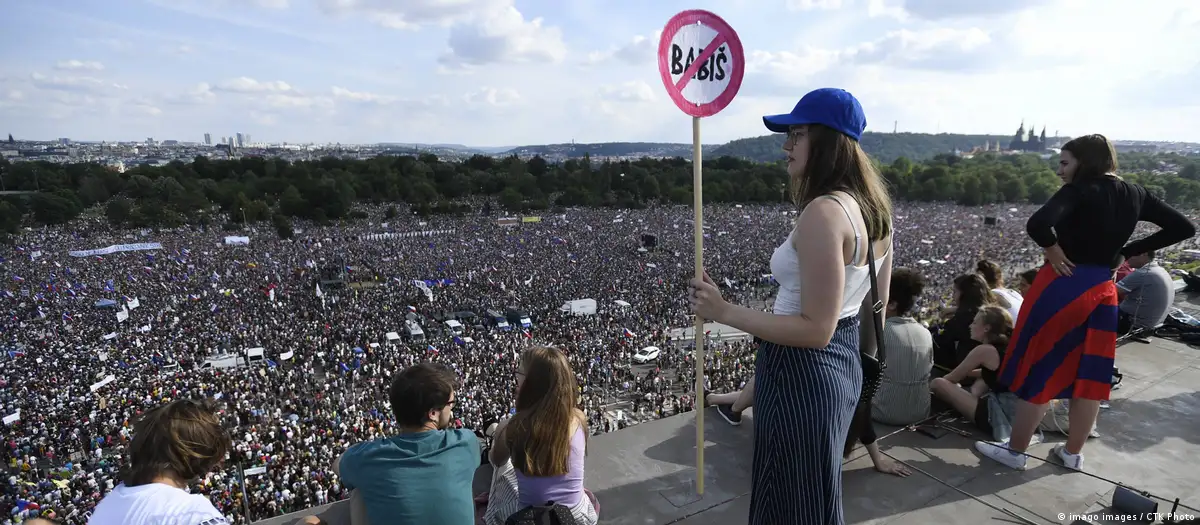
Prague is bracing for what could on Saturday be one of the largest demonstrations in the Czech capital in recent years.
In addition to concerns over public media, state institutions and foreign policy, campaigners are warning against draft legislation they say resembles Russian-style restrictions on civil society.
"The erosion of democracy in the Czech Republic is advancing faster than we thought. We will not stand by silently while oligarchs and extremists threaten the future of our country," read a press release issued by the NGO A Million Moments for Democracy, which is organizing Saturday's rally in Prague.
Site of other major demonstrations in Prague
Letna Plain, where Saturday's demonstration is due to be held, was the site of the biggest demonstration against the Communist regime in November 1989.
A rally in 2019 against a previous Babis government drew almost 300,000 people, the largest protest gathering since Letna in 1989.
A Million Moments for Democracy has said it hopes to see a similar turnout on Saturday. It has issued a rallying call for Czechs to defend their institutions — including NGOs — from what it calls the spread of illiberalism and authoritarianism in Central Europe.
The latest sign of that, it said, are proposals to draw up a so-called "foreign agent" law in Czechia.
NGOs warn of chilling effect
The country's largest NGO — People in Need — has said the draft proposals would stigmatize legitimate international cooperation, chill civil society activity and give the state sweeping supervisory powers without sufficient judicial safeguards.
"We reject the principle of such a law," said Simon Panek, People in Need's executive director and co-founder.
The organization runs humanitarian, development and human rights programs in more than 40 countries around the world.
"We are living in a free democratic country with existing laws. And this [foreign agent law] is the instrument that authoritarians and dictators use to control society. Not without reason is it called a Russian law," he went on.
"If you make a comparison, about 70% to 80% of the instruments and measures of the first draft [are similar to Russia's foreign agent legislation]," Panek told DW.
New 'foreign agent' law would have wide reach and heavy fines
If passed in its current form, the law would require a wide range of organizations and individuals with either foreign ties or foreign funding to register themselves.
Noncompliance would trigger fines of up to 15 million crowns (€612,000/$701,000), or up to 10% of annual revenue.
Critics have said it is aimed squarely at NGOs involved in human rights and advocacy work, mirroring legislation that the Putin regime has used to undermine civil society in Russia.
They note it also conspicuously ignores foreign media — which they say would allow Russian propaganda to continue unchecked in Czechia.
One of those drawing up the legislation is Babis's "free speech" adviser Natalie Vachatova, who is described by the Czech media as a pro-Russian activist.
'Balancing freedom and transparency'
"This has nothing to do with Russia," Babis told lawmakers last week. "We welcome NGOs that help in the social system. But it's not possible for political NGOs to become involved in political struggle."
The opposition has seized on the proposals, claiming they are so broad they could in theory criminalize beekeepers or anyone who posts on Facebook.
What has been released to the media, said government lawmakers, is merely a draft for discussion rather than a finished bill.
"In today's global world we are vulnerable. We are vulnerable to foreign actors and foreign influence," Radek Vondracek, a lawmaker in Babis' ANO party, told Czech television.
"The greatest strength of democracy is free debate and free exchange of opinions. But if there is foreign funding that effectively puts some pressure group or lobbying group on steroids, then that becomes democracy's weakness," he added.
"We simply want to know who pays for what, where the money comes from. It is in the government's policy program. This is about balancing freedom and transparency."
Critics say new law would undermine NGOs
NGOs from elsewhere in Central Europe see echoes of legislation passed by populist governments there.
"This labelling of civil society organizations is one of the most well-known tools of illiberal and authoritarian regimes," Andras Lederer, head of advocacy at the Hungarian Helsinki Committee, told DW.
"The aim is to undermine credibility and portray civil society organizations as doing something suspicious — potentially not in the interest of citizens, but in the interest of foreign powers and foreign interests," he said.
"Potential sanctions or fines for noncompliance are tied to the fact they receive funding from abroad. So, it's a kind of sword of Damocles," Lederer went on.
The 2017 Hungarian law was repealed and replaced following a verdict by the European Court of Justice which said it violated EU rules on the free movement of capital and services.
The chilling effect, however, remains.
Echoes of Slovakia and Georgia
In Slovakia, a foreign agents-style law introduced by Robert Fico's populist government in June 2025 was struck down in December by the Constitutional Court.
Slovak NGOs are alarmed by the draft of the Czech law they've seen published in the media.
"It is a Russian law," said Katarina Batkova, executive director of Via Iuris, a Slovak NGO that provides legal expertise and advocacy on the rule of law, civic freedoms and environmental protection.
"It is copied from the Russian law, and it is very similar to the Georgian Foreign Agent Act aimed at punishing NGOs," Batkova told DW.
Babis has seemed unhappy in the past about mass demonstrations filling the front pages, and his critics argue the last ones in 2019 sent a powerful message.
Opponents hope a similar mass turnout this weekend will lead the government to think twice before trying to curtail civil society.
Edited by: Aingeal Flanagan