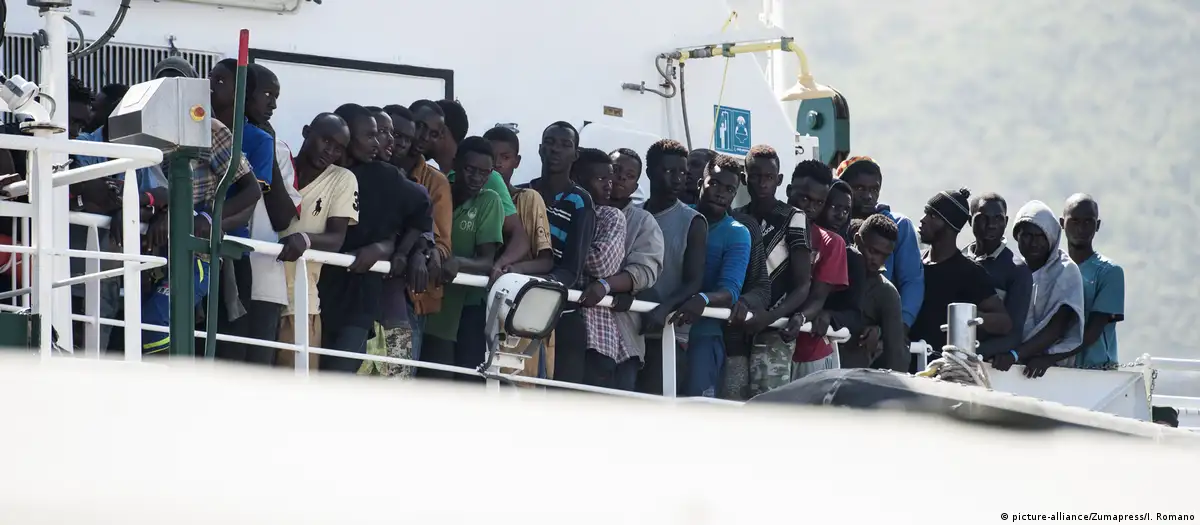
Italy's hardline Interior Minister, Matteo Salvini, vowed on Sunday to stop foreign naval vessels that have saved migrants in the Mediterranean Sea from docking in Italian ports, extending a ban first placed on ships chartered by charities.
Foreign naval ships participating in European Union and NATO-sponsored search-and-rescue missions transfer many migrants to land at Italian ports. On Sunday, Irish navy ship Samuel Beckett landed in Sicily with 106 migrants on board.
Announcing his decision on social media, Salvini said he would inform his counterparts from other European Union countries about the move at an upcoming EU meeting in Austria.
'Migration can't just be an Italian problem'
"Unfortunately, Italian governments over the past five years have signed agreements (in exchange for what?) so that all these ships disembark immigrants in Italy," Salvini wrote. "With our government, the music has changed and will change."
-
Italy's populist government: Key players
Conte: Novice at the helm
Giuseppe Conte, a little-known law professor with no political experience, was picked by the League and 5-Star Movement (M5S) as their candidate for prime minister. He was forced to temporarily give up his leadership bid after the parties' cabinet selection was initially blocked. However, after the two parties struck a deal with President Sergio Mattarella, Conte was eventually sworn in on June 1.
-
Italy's populist government: Key players
Mattarella: President with the final say
President Sergio Mattarella faced calls for his impeachment after he prevented the populist alliance from taking office. He singled out its choice for finance minister, Paolo Savona, warning that an openly euroskeptic minister in that position went against the parties' joint promise to simply "change Europe for the better." After the parties agreed to replace Savona, Mattarella gave the go-ahead.
-
Italy's populist government: Key players
Di Maio: Anti-austerity advocate
M5S chief Luigi Di Maio secured his party 32 percent of the vote in the March election. With the populist M5S-League coalition in power, Di Maio assumed the role of joint deputy prime minister and took over the economic development portfolio. The M5S leader has come under fire for his anti-immigration rhetoric, including calling rescue missions to save migrants from drowning a "sea-taxi service."
-
Italy's populist government: Key players
Salvini: 'The Captain'
Matteo Salvini is the leader of the anti-immigrant, euroskeptic League, which won 17 percent of the vote in the March election. A former MEP, he and his party have no experience in governing. Salvini has taken on the position of interior minister within Conte's Cabinet. Known for his hostile rhetoric toward immigrants and the EU, Salvini once described the euro a "crime against humanity."
-
Italy's populist government: Key players
Savona: Anti-euro radical
Paola Savona, initially tipped to lead the Finance Ministry, has called the euro a "German cage" and said that Italy needs a plan to leave the single currency. The 81-year-old's stance won him the backing of most Italian lawmakers but that wasn't enough to stop his appointment being vetoed. In his place steps Giovanni Tria, an economics professor without any previous government experience.
-
Italy's populist government: Key players
Cottarelli: Temporary caretaker
Carlo Cottarelli was set to become Italy's caretaker prime minster after the M5S-League alliance failed to have its controversial cabinet picks approved. The former IMF economist's time in the spotlight was short-lived, however. Political uncertainty in Italy rocked Europe's financial markets and prompted Mattarella to swiftly renegotiate and approve Salvini and Di Maio's governing coalition.
-
Italy's populist government: Key players
Berlusconi: Vanquished enabler
Silvio Berlusconi (right) and his Forza Italia entered a four-party electoral alliance including League in the March election that secured the bloc 37 percent. Berlusconi is now upset at his right-wing ally Salvini after the League leader moved to work with M5S. Berlusconi has said he would act as a "reasonable and scrutinizing opposition."
Author: Chase Winter
Salvini did not mention any EU or NATO missions by name, but Italian Transport Minister Danilo Toninelli wrote on Twitter that Italy would seek to amend the EU's Operation Sophia operation.
"We respect the rules, but now they will be changed," Toninelli wrote. "Migration can't just be an Italian problem or else the EU is at risk."
Read more: Will Italy's refugee stance bring down the EU?
Migrant arrivals down
Salvini heads the anti-immigrant League Party that has been in a coalition with the populist Five Star Movement since June 1. In an effort to drastically reduce migrant arrivals, he has already blocked charity-run search-and-rescue vessels from docking in Italian ports.
That decision forced France's Aquarius to divert to Spain and Germany's Lifeline to dock in Malta after they both spent days stranded at sea in June.
Migrant arrivals in Italy are down 80 percent in 2018 compared to the same period last year, with some 16,600 arrivals since the beginning of the year.
Mediterranean countries Italy and Greece have taken the brunt of migrant and asylum seeker arrivals to Europe in recent years. Most people seeking refuge arriving in Italy used to continue their journeys to northern Europe. However, the introduction of EU-backed processing centers to ensure migrants are identified at their first entry point in Europe, along with stricter border controls implemented by France, Switzerland and Austria, created barriers along this well-worn route.
The situation has resulted in some 160,000 migrants, who would rather leave Italy, being stuck in the country.
-
World Refugee Day: Iconic images of the refugee crisis
The goal: Survival
A journey combined with misery as well as dangers for the body and the soul: In their escape from war and suffering, hundreds of thousands of people, mostly from Syria, traveled to Greece from Turkey in 2015 and 2016. There are still around 10,000 people stranded on the islands of Lesbos, Chios and Samos. More than 6,000 new arrivals were recorded this year from January to May.
-
World Refugee Day: Iconic images of the refugee crisis
On foot to Europe
In 2015 and 2016, more than a million people tried to reach Western Europe from Greece or Turkey over the Balkan route - through Macedonia, Serbia and Hungary. The stream of refugees stopped only when the route was officially closed and many countries sealed their borders. Today, most refugees opt for the dangerous Mediterranean route from Libya to Europe.
-
World Refugee Day: Iconic images of the refugee crisis
Global dismay
This picture shook the world. The body of three-year-old Aylan Kurdi from Syria washed up on a beach in Turkey in September 2015. The photograph was widely circulated in social networks and became a symbol of the refugee crisis. Europe could not look away anymore.
-
World Refugee Day: Iconic images of the refugee crisis
Chaos and despair
Last-minute rush: Thousands of refugees tried to get into overcrowded buses and trains in Croatia after it became known that the route through Europe would not remain open for long. In October 2015, Hungary closed its borders and installed container camps, where refugees would be kept for the duration of their asylum process.
-
World Refugee Day: Iconic images of the refugee crisis
Unscrupulous reporting
A Hungarian journalist caused uproar in September 2015 after she tripped a Syrian man who was trying to run from the police at Roszke, near the Hungarian border with Serbia. At the peak of the crisis, the tone against refugees became coarser. In Germany, attacks on refugee homes increased.
-
World Refugee Day: Iconic images of the refugee crisis
No open borders
The official closure of the Balkan route in March 2016 led to tumultuous scenes at border crossings. Thousands of refugees were stranded and there were reports of brutal violence. Many tried to circumvent border crossings, like these refugees at the Greek-Macedonian border shortly after borders were closed.
-
World Refugee Day: Iconic images of the refugee crisis
Symbol of horror
A child covered in blood and dust: the photograph of five-year-old Omran shocked the public when it was released in 2016. It became an allegory of the horror of the Syrian civil war and the suffering of the Syrian people. One year later, new pictures of the boy circulated on the internet, showing him much happier. Assad supporters say the picture last year was planted for propaganda purposes.
-
World Refugee Day: Iconic images of the refugee crisis
The unknown new home
A Syrian man carries his daughter in the rain at the Greek-Macedonian border in Idomeni. He hopes for security for his family in Europe. According to the Dublin regulation, asylum can be applied only in the country where the refugee first entered Europe. Many who travel further on are sent back. Above all, Greece and Italy carry the largest burden.
-
World Refugee Day: Iconic images of the refugee crisis
Hope for support
Germany remains the top destination, although the refugee and asylum policy in Germany has become more restrictive following the massive influx. No country in Europe has taken in as many refugees as Germany, which took in 1.2 million since the influx began in 2015. Chancellor Angela Merkel was an icon for many of the newcomers.
-
World Refugee Day: Iconic images of the refugee crisis
Emergency situation in the camps
In France's north, authorities clean up the infamous "jungle" in Calais. The camp caught fire during the evacuation in October 2016. Around 6,500 residents were distributed among other shelters in France. Half a year later, aid organizations reported many minor refugees living as homeless people around Calais.
-
World Refugee Day: Iconic images of the refugee crisis
Drowning in the Mediterranean
NGO and government rescue ships are constantly on the lookout for migrant boats in distress. Despite extreme danger during their voyage, many refugees, fleeing poverty or conflict in the home countries, expect to find a better future in Europe. The overcrowded boats and rubber dinghies often capsize. In 2017 alone, 1,800 people died in the crossing. In 2016, 5,000 people lost their lives.
-
World Refugee Day: Iconic images of the refugee crisis
No justice in Libya
Hundreds of thousands of refugees from Sub Saharan Africa and the Middle East wait in Libyan detention camps to cross the Mediterranean. Human smugglers and traffickers control the business. The conditions in the camps are reportedly catastrophic, human rights organizations say. Eyewitnesses report of slavery and forced prostitution. Still, the inmates never give up the dream of coming to Europe.
Author: Charlotte Hauswedell
lw, amp/se (AFP, AP)
Each evening at 1830 UTC, DW's editors send out a selection of the day's hard news and quality feature journalism. You can sign up to receive it directly here.