Iran: UK Navy reports cargo vessel hit in Strait of Hormuz
Published June 25, 2026last updated June 25, 2026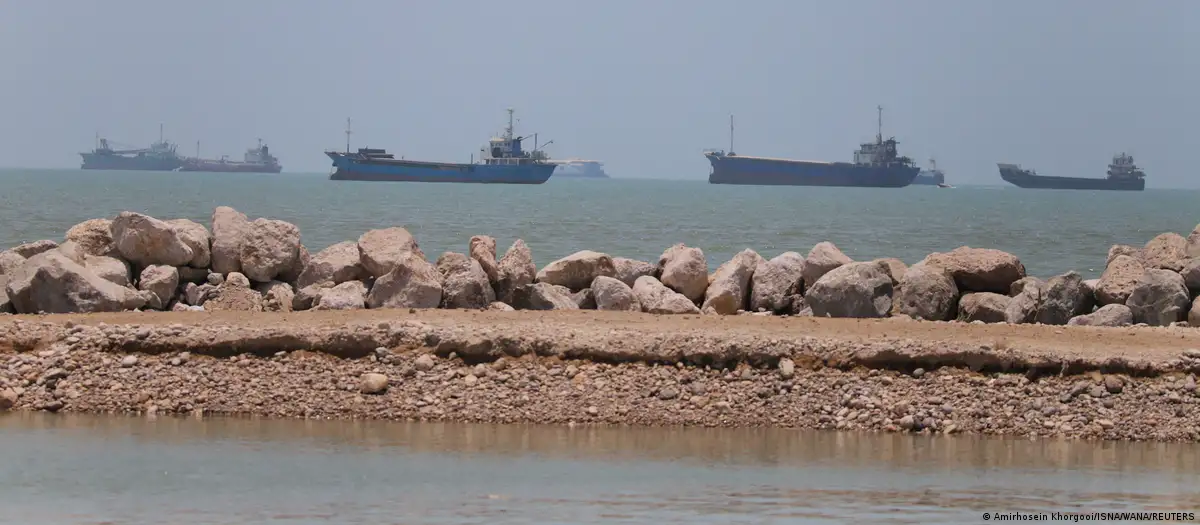
What you need to know
- UK Navy says cargo vessel attacked with projectile in Strait of Hormuz
- In response, UN maritime agency halts its evacuations of sailors stranded in the Gulf
- Iran has said it is 'unacceptable and dangerous' to pass through Hormuz without permission from Tehran
- Rubio is in Bahrain on the last leg of his Middle East tour
- Israel insists Hezbollah disarm before Israeli troops leave Lebanon
Below are the latest developments on the Iran war and the wider Middle East on Thursday, June 25, 2026.
Tired of missing our real-time updates? Click here to add us as a Preferred Source on Google. Then tap the "Star" or "Preferred" to keep DW News at the top of your feed.
British military says cargo ship hit; UN maritime agency pauses evacuation plan
The UK Maritime Trade Operations (UKMTO) said it received a report that a "cargo vessel has been hit on the starboard side by an unknown projectile, causing damage to the bridge."
There have been no casualties or environmental impact reported due to the hit, UKMTO said.
"Authorities are investigating. Vessels are advised to transit with caution and report any suspicious activity to UKMTO," the statement said.
After the attack, the UN International Maritime Organization agency said it paused its evacuation plan of seafarers stranded in the Gulf.
"I have been informed of an attack today in the Gulf of Oman. Seafarer safety remains paramount. To ensure coordinated approach & navigational safety, the IMO evacuation plan will be paused until further clarity," Internatinal Maritime Organization Secretary-General Arsenio Dominguez wrote on X.
Over 11,000 seafarers stuck in the Gulf were expected to be escorted through the Strait of Hormuz during the evacuation plan. Iran, the US, and other coastal states in the region were supposed to cooperate with the initiative.
In addition to the risk of attacks, the Strait of Hormuz also faces security challenges due to Iranian mines in the maritime passageway.
Israel insists Hezbollah disarm before troops leave Lebanon
Israel said on Thursday that it would only withdraw its forces from southern Lebanon after Hezbollah was disarmed, as the two countries engaged in the fifth round of US-mediated negotiations in Washington
"We will not withdraw our forces from southern Lebanon as long as Hezbollah remains a threat, are not disarmed and are not demilitarized," Israeli government spokesperson David Mencer told reporters.
Hezbollah, an Iran-backed military group, has refused to disarm in full and has called on the Lebanese government to give up on its direct talks with Israel.
Four rounds of US-mediated talks between Lebanon and Israel since April have failed to produce a durable ceasefire.
Fighting started in Lebanon after Hezbollah launched rockets at Israel on March 2 in support of Iran and triggered Israeli air and ground attacks.
Iran calls US claim on use of unfrozen assets false
Iran's top negotiator Mohammad Bagher Qalibaf rejected the notion that Tehran will spend its unfrozen assets to buy US farm products.
"America falsely claims our unfrozen assets will buy their agriculture," Qalibaf said in a post on X.
"The US only exports GMO soybeans, broken promises and trash talks," he added.
In a CNBC interview, US Treasury Secretary Scott Bessent said on Wednesday that "a very large percentage" of Iran's unfrozen assets "will go to buy US foodstuffs and medicines," repeating what President Donald Trump had said about how the money will be spent.
The 14-point interim agreement between Washington and Tehran includes a pledge to make Iran's frozen assets "fully available for use."
Rubio hails progress in Israel-Lebanon talks
US Secretary of State Marco Rubio on Thursday hailed progress in talks between Israel and Lebanon in the United States.
"I think we are very close in our hopes of getting a commitment of intent between the two countries," Rubio told reporters during a visit to Bahrain.
"It'll be a process, it'll take some time, it'll take a lot of work, but I can tell you that for the first time in 30 years, the sovereign government of Lebanon is speaking to the government of Israel directly," he added.
Israel launched an air and ground offensive in Lebanon in early March after the armed group Hezbollah, Iran's key ally, carried out strikes against Israel in support of Tehran.
Under US pressure, Lebanese and Israeli officials began direct talks in April in Washington.
2 killed in Israeli drone strike in Lebanon
Two people were killed in an Israeli drone strike on a car in southern Lebanon on Thursday, according to security and medical sources.
It was the second consecutive day such an incident occurred. A similar strike on Wednesday also killed at least two people, with Israel saying it had targeted "two armed Hezbollah terrorists."
The strike comes as Lebanese and Israeli officials meet in Washington for a fifth round of direct negotiations, which began in April.
LebanesePresident Joseph Aoun stressed on Wednesday that ongoing negotiations with Israel are independent from US peace talks with Iran.
Oman rejects Hormuz transit fees in any future arrangement
Oman's Foreign Minister Badr Albusaidi said no transit fees would be imposed in the Strait of Hormuz during a meeting of Gulf foreign ministers in the Bahraini capital Manama with US Secretary Marco Rubio.
The top Omani diplomat said that "future arrangements regarding the Strait do not entail the imposition of any transit fees."
Earlier, Muscat and Tehran announced that they were discussing the "costs" to be charged for services related to the administration of the vital waterway.
Iranian state media, meanwhile, reported that the foreign ministers of Iran and Oman underlined "the importance of continued coordination" during a phone call on Thursday.
Where the US–Iran peace talks stand so far
It's been one week since the US and Iran inked a 14-point memorandum of understanding on June 17 to end their war.
The framework agreement gives both countries 60 days to reach a final agreement.
Here's a recap of the latest developments:
Iran's nuclear program
- What's in the MoU: Iran promised "to maintain the current status quo of its nuclear program" and reaffirmed that it will not "procure or develop nuclear weapons."
- Where things stand: The head of the UN's nuclear agency said that his inspectors will visit Iranian nuclear enrichment sites; An Iranian diplomat countered that any such visit would only come after a final deal.
The Strait of Hormuz
- What's in the MoU: The US agreed to remove its naval blockade of Iranian ports while Iran allowed commercial traffic through Hormuz to be restored; The MoU guarantees "no charge" or toll in Hormuz for 60 days.
- Where things stand: Ships have passed through Hormuz as Iran's Revolutionary Guards warned that any unauthorized crossings would be "dealt with"; US Secretary of State Marco Rubio insisted that Hormuz will remain toll-free.
Fighting in Lebanon
Lebanon was drawn into the war on March 2, when Hezbollah, an Iran-backed Shiite militant group in Lebanon, launched rockets into Israel in retaliation for US-Israeli strikes on Iran.
- What's in the MoU: Washington and Tehran announced an "immediate and permanent termination of military operations on all fronts, including in Lebanon."
- Where things stand: Israel's Defense Minister Israel Katz said that the US has not demanded that Israel withdraw its troops from southern Lebanon; Hezbollah accused Israel of violating the truce after an Israeli strike killed two people while Israel said it targeted "two armed Hezbollah terrorists."
Oil price return pre-Iran war levels
Oil prices have dropped to levels last seen before the war in the Middle East as more oil tankers exited the Strait of Hormuz.
Brent crude sank to below $73 (roughly €64) a barrel for the first time since the Iran war started on February 28.
Oil and energy prices spiked after the war, with crude soaring as high as $120 a barrel at one stage.
The declines follow last week's interim agreement to end the war and the reopening of the Strait of Hormuz.
Last week, Washington and Tehran signed a memorandum of understanding, which has seen the US partially lift sanctions on Iranian oil exports. Both sides have 60 days to iron out sticking points before a final agreement.
Iran's IRGC says Hormuz crossings without authorization 'will be dealt with'
Iran's Revolutionary Guard Corps (IRGC) on Thursday said vessels need to stick to routes designated by Tehran through the Strait of Hormuz.
Any crossing without authorization is "unacceptable and extremely dangerous," IRGC warned. It also said vessels failing to comply with the requirements "will be dealt with."
The statement came a day after Oman announced temporary shipping lanes through the waterway in coordination with the International Maritime Organization.
Before the war, roughly a fifth of global oil and liquefied natural gas supplies passed through the Strait of Hormuz — a major sticking point in talks between Washington and Tehran.
Iran closed the vital waterway to shipping soon after the US-Israeli strikes began.
Rubio warns against charging tolls in Hormuz
US Secretary of State Marco Rubio on Thursday warned that Iranian tolls on ships passing the Strait of Hormuz would risk "total chaos" as it could spread to other waterways.
"International waterways do not belong to any nation-state. This is a foundational principle in the world today, without which the world would be in total chaos," he told a Gulf Cooperation Council meeting in Bahrain.
"If, in fact, we accepted that you can charge money to use an international waterway because it happens to be near your territorial space, well then, this will spread throughout the world like a contagion," he added.
Rubio is on a three-nation tour of Gulf countries — his first regional tour since the US and Iran signed a memorandum of understanding last week to work toward a permanent end to the Middle East war.
Tehran has on more than one occasion floated the idea that the Strait of Hormuz should be controlled by countries in the region, including Gulf nations, who could potentially collect fees from vessels passing through it.
Rubio says US wants a deal with Iran, but 'not at any price'
The top US diplomat also said that Washington wants a peace deal with Tehran but not "at any price."
"While we want a deal, we don't want a deal at any price," he said. "We want a deal that's good, we want a deal that's real, we want a deal that's verifiable, and we want a deal that's adhered to."
Rubio also sought to reassure the Gulf allies that their interests would be taken into account.
"We want to ensure... that there is no part of this deal that's undertaken that in any way undermines the security, the stability, or the prosperity of any of our partners in the Gulf region," he said.
In response to the US-Israeli strikes on Iran, which began on February 28, Tehran launched missiles and drones at Gulf states hosting US military bases, including the United Arab Emirates, Kuwait and Bahrain — all three countries on Rubio's regional tour.
Welcome to our coverage
Thank you for joining DW as we track the latest developments in the Iran war.
Today, we will be following US Secretary of State Marco Rubio as he meets Bahraini officials in Manama, the final stop on his Middle East tour.
Rubio is seeking to reassure US allies in the Gulf states, which were targeted by Tehran's missiles and drones during the conflict, that Washington would protect their interests.
His visit comes as Iran tries to push for what it has framed as regional control over the strategic Strait of Hormuz, which potentially involves charging vessels that use the critical waterway.
Throughout the day, we will bring you the latest updates, video reports and expert analysis on the situation across the Middle East.