EU, India clinch historic free trade deal
Published January 27, 2026last updated January 27, 2026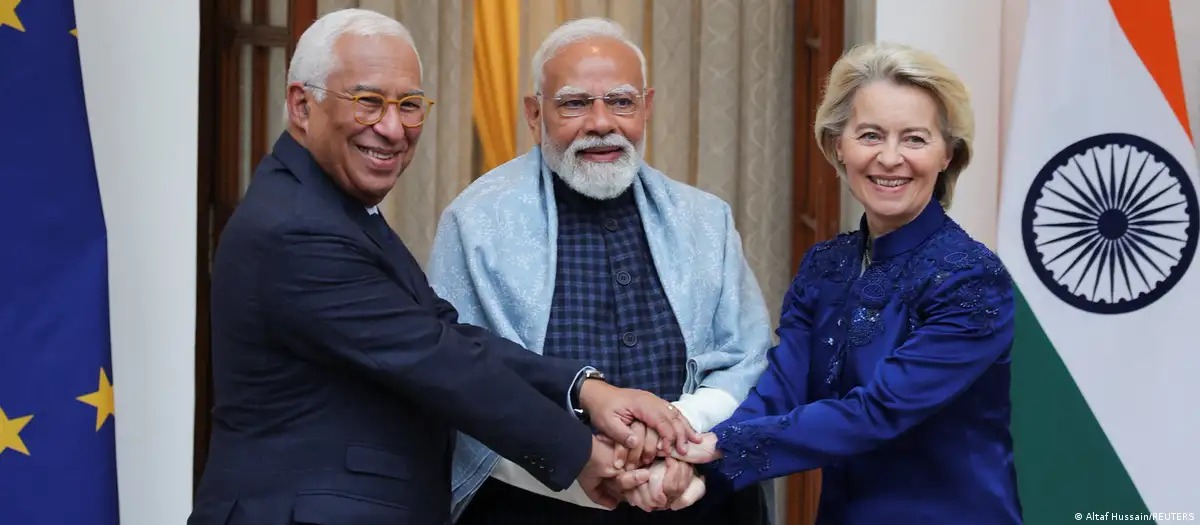
What you need to know
- EU and India have finalized a trade deal after nearly two decades of negotiations
- Top EU officials Antonio Costa and Ursula von der Leyen co-chair an India-EU summit with Prime Minister Narendra Modi in New Delhi
- Trade deal will pave the way for free movement of goods between the bloc of 27 European nations and India
- The agreement covers almost all goods and is set to bring down high import costs for European wines and cars
- EU top diplomat Kaja Kallas signed a security and defense partnership with India
This blog is now closed. Below is a roundup of the major developments during the EU-India summit in New Delhi on Tuesday, January 27, 2026:
Closing summary: EU and India finalize 'mother of all deals'
The world's most populous country, India, and the 27-nation European Union announced on Tuesday that they have reached a free trade agreement to deepen economic and strategic ties.
EU chief Ursula von der Leyen described the deal as the "mother of all deals" that could affect as many as 2 billion people.
The deal is expected to double EU exports to India by 2032 by eliminating or reducing tariffs on 96.6% of EU goods entering the Asian nation, the European Commission said. The accord will bring down especially high import taxes for European wine and cars.
In turn, the EU will cut tariffs on 99.5% of goods imported from India over seven years. Provided that the EU Parliament ratifies the new trade deal, a formal signing of the document is expected later this year.
India, EU finalize trade deal: Social media highlights
Here are some key moments on social media that caught our attention this morning:
When European Council President Antonio Costa said he has Overseas Indian Citizenship:
When European Commission President Ursula von der Leyen announced a new EU office to facilitate mobility for skilled Indian workers and students:
Indian media outlets widely took note of Ursula von der Leyen's Indo-Western outfit at the Republic Day parade yesterday:
India, EU sign new defense trade pact
India and the EU also agreed on a framework for deeper defense and security cooperation, and a separate pact aimed at easing mobility for skilled workers and students, signaling their partnership extends beyond commerce.
EU foreign policy chief Kaja Kallas said that the pact also established an annual security and defense dialogue, with the first meeting to take place this month.
"As the global order shifts, the EU will continue to deepen its diplomatic and economic ties across the world. Strong partnerships multiply our strength," she said.
The negotiations for the India-EU trade deal got a new impetus last year after US President Donald Trump put pressure on both India and the 27-member bloc with a string of ultimatums with the aim of achieving both trade and non-trade objectives.
EU trade deal: Wine, pasta, chocolates to be cheaper in India
The trade deal is expected to double EU goods exports to India by 2032 by eliminating or reducing tariffs on 96.6% of EU goods exports to India, according to a European Commission press release on Tuesday.
Here are some food products that stand to benefit:
DW visual explainer: How the EU stands to benefit from 'mother of all deals'
India and the EU announced they had reached an agreement earlier today, but signing the deal would take place after legal vetting, expected to take about six months. The European Parliament will then ratify the deal.
Here's how the agreement stands to benefit the EU:
Chemistry in the room unmistakable, writes DW correspondent
The friendship between top officials from both the Indian delegation and the EU delegation was apparent even before the bosses — European Commission President Ursula von der Leyen, European Council President Antonio Costa and Indian Prime Minister Narendra Modi — arrived at the Kailash Hall in Hyderabad House.
EU's foreign policy chief Kaja Kallas was seen sharing a moment of laughter with Indian Foreign Minister S. Jaishankar and the familiarity appeared indicative of all the hard work and multiple rounds of negotiations that they have held over the course of the last year, a year where it became clear that there was a need for urgency. The chemistry in the room was unmistakable.
I was struck by Ursula von der Leyen's deep knowledge of Indian culture — evident in her reference to auspicious Hindu festivals such as Makar Sankranti and Uttarayan.
She said, "It is the beginning of Uttarayan, the sun's northward journey. From darkness to light. From stillness to growth. From what was to what can be. That is what makes our Summit so unique and timely. The time is ripe for renewal. For fresh momentum. And for opening a new chapter in EU-India friendship. And this is exactly what we have achieved today, together."
Also noteworthy was von der Leyen's choice of attire as she attended the Republic Day parade. She wore an Indo-Western attire called an achkan, a long buttoned coat, with golden brocade.
Modi invoked Antonio Costa's Indian heritage and told the room full of journalists and delegates that he is famously known as Lisbon's Gandhi. Antonio has Indian roots. His father's family comes from Goa in India. And that would have surely helped when the two sides were negotiating hard to make this deal a reality.
How the India-EU trade deal marks a turning point in relations
Calling the newly announced EU-India free trade agreement a "truly big moment," former Indian ambassador to Switzerland and Liechtenstein, Sanjay Bhattacharyya, said the deal marks a turning point in economic relations between the two sides after years of difficult negotiations.
"The history of talks was long and tough. There was a time when Europe was focused more on China and multilateral trade, and India didn’t have much leverage," he told DW.
"What has changed is the realization on both sides that India is now a large, fast-growing market, and China's economic attraction has clearly dipped."
"For India, market access has always been the missing piece in our relationship with Europe. This agreement finally corrects that."
Trade, investment and technology to surge
Rather than pointing to a single winning sector, Bhattacharyya stressed the deal will create a dynamic economic environment.
"Today it may benefit textiles, pharmaceuticals or agriculture. Tomorrow it could be semiconductors and critical materials," he said.
He added that increased trade will naturally bring a wave of European investment into India. "Investment always follows trade," he said.
Timing of India-EU accord is particularly salient
Bhattacharyya also framed the agreement as part of a broader geopolitical realignment.
"This isn’t just about commerce, it’s about connectivity," he said, pointing to initiatives linking India, the Middle East and Europe, as well as growing EU engagement in the Indo-Pacific.
"When two billion people and nearly a quarter of global GDP come together, it has its own strategic momentum," he said.
A pragmatic response to stalled multilateral trade
With global trade negotiations at the WTO largely frozen, Bhattacharyya said bilateral and regional deals have become essential.
"Multilateralism is in crisis, the WTO is practically in a coma," he said, adding, "So India and the EU have turned to bilateral deals to ensure growth, development and supply-chain resilience."
He argues that Europe’s economic slowdown and India's need for expanding markets make such partnerships increasingly necessary.
European carmakers set for growth, but face tough market
The India-EU accord announced earlier this morning would open up India's vast and highly guarded market, with New Delhi slashing tariffs on cars to 10% over five years from as high as 110%, according to an EU statement.
European carmakers like Volkswagen, Renault, and Stellantis, as well as luxury players Mercedes-Benz and BMW, are set to benefit because they'll be able to sell imported cars for a cheaper price.
But the automakers still face a tough market dominated by homegrown firms and compact Japanese "kei" cars — pint-sized, affordable vehicles smaller than a Mini Cooper.
"It's a start. When we talk about exports from Europe, it's only about premium cars. For the volume sector it is difficult," said Stefan Bratzel of German auto research group CAM, who said Suzuki and Hyundai had better understood the market.
India is the world's third-largest car market by sales after US and China, but its domestic auto industry has been one of the most protected.
New Delhi currently levies tariffs of 70% and 110% on imported cars, a level often criticized by executives, including Tesla chief Elon Musk.
'We have concluded the mother of all deals,' says EU chief
European Commission President Ursula von der Leyen said on social media that India and the EU have "concluded the mother of all deals."
"We have created a free trade zone of two billion people, with both sides set to benefit," she said in New Delhi.
Indian Prime Minister Narendra Modi said the agreement would strengthen India's manufacturing and services sector and boost investor confidence in the country.
Trade deal to create opportunities for growth and jobs, says Germany
Germany's finance minister said on Tuesday that the trade deal reached by the European Union and India could accelerate economic growth and deepen strategic ties.
"This agreement creates new opportunities for growth and good jobs — in Europe and India alike — while deepening the strategic partnership with the world's largest democracy," Vice Chancellor and Finance Minister Lars Klingbeil said in a statement.
Trade deal expected to double European exports to India by 2032
The European Union (EU) and India have agreed upon a landmark free trade agreement which will cut or eliminate tariffs on almost 97 percent of European exports, saving up to 4 billion euros ($4.75 billion) annually in duties, the 27-nation bloc said.
Under the agreement, India will grant the EU tariff reductions no other trading partner has received. It also addressed climate action, environmental protection, labor rights and women’s empowerment.
Here are some more details of the deal, which is expected to be formally signed later this year after legal vetting:
- The agreement is set to double European exports to India by 2032
- Duties on cars will fall from as high as 110% to as low as 10% over time, while tariffs on car parts will be abolished within 5-10 years
- Levies on machinery, chemicals and pharmaceuticals to be largely eliminated
- Sharp cuts to agri-food tariffs, currently averaging more than 36%
- Indian duties on wine will drop from 150% to 75% initially and eventually to around 20%
- Olive oil tariffs will fall to zero within five years
- Levies on processed foods such as bread and confectionery will be removed
- All imports to the EU to continue to meet strict EU food safety standards
- A new EU-India climate cooperation platform to be launched in 2026
- A €500-million EU fund over two years is expected help India cut emissions and increase sustainable industrial transformation
- The EU will cut tariffs on 99.5% of goods traded over seven years
- Tariffs on Indian marine goods, leather products, chemicals, rubber, base metals and gems and jewelry to be cut to zero
WATCH: EU chief moves to seal 'mother of all deals' with India
As global geopolitics shift rapidly, the EU is looking beyond traditional partners, with Commission President Ursula von der Leyen set to sign a landmark trade deal with India's Prime Minister Narendra Modi on Tuesday.
India-EU summit aimed at restoring stability amid global trade disruption, expert says
The partnership between India and the European Union (EU) is increasingly driven by global trade uncertainty, linked to US tariff policies, and shifting power dynamics, an expert told DW.
Biswajit Dhar, Distinguished Professor at the Council for Social Development in New Delhi, said the past year of disruption in international commerce has underscored the need for predictable and stable trading partners.
"Global trade rules have been thrown up into the air," Dhar said, adding, "in this scenario it became important for India and the EU to turn to each other, not only to safeguard bilateral trade, but to expand it."
He urged New Delhi and Brussels to take a leadership role in reviving multilateral institutions such as the World Trade Organization.
Further, emphasizing cooperation with other like-minded countries, he said, "the multilateral system still offers the best long-term guarantee for fair and predictable trade".
The EU is already India's largest trading partner and offers a more consistent policy environment than Washington, where shifting tariff decisions have raised costs and risks.
"Pressure from the US has effectively pushed countries into these kinds of agreements, Dhar explained. "Trading with the US has become unpredictable and difficult, which is why India and the EU finally moved faster after years of stalled negotiations."
The two sides had been in talks for nearly two decades before recent progress.
And despite the political differences, especially India’s relationship with Russia, Dhar says, "India and EU have not targeted each other and tried to extract short-term benefits. In fact, these geopolitical issues are a matter of long-term strategy of different countries."
He said that Europe understands where India is coming from. And so, the EU would ultimately want India to decrease its dependence on Russia. But India would need time to do that, if at all.
Dhar finds that the EU has adopted a tolerant approach to all these issues compared to the US, which, according to him, "has been actually hammering away all the time".
While optimistic about the agreement’s potential, Dhar cautioned that future disagreements could emerge over environmental standards and EU’s carbon border tax (CBAM), which may affect some Indian industries.
"Market access will improve on both sides," he said, "but how measures on carbon emissions, labor standards and sustainability are implemented will determine how smoothly this partnership develops."
Modi announces India-EU free trade agreement
Indian Prime Minster Narendra Modi announced the finalization of a landmark free trade agreement on Tuesday with the EU, saying it will being major opportunities to billions of people in India.
"Yesterday, a big agreement was signed between the European Union and India," Modi said. "People around the world are calling this the mother of all deals. This agreement will bring major opportunities for the 1.4 billion people of India and the millions of people in Europe," he said.
The free trade agreement came after nearly two decades of negotiations as both sides seek to hedge against rising global trade tensions.
Modi and European Commission President Ursula von der Leyen are expected to make a joint announcement along with the details of the deal, later on Tuesday.
The deal is expected to be formally signed later this year by other EU bodies.
India-EU trade pact sends signal amid fractured global economy, expert tells DW
After nearly two decades of stalled negotiations, the India-EU free trade agreement has gained fresh momentum, driven as much by shifting geopolitics as by policy compromises on both sides, according to Gulshan Sachdeva, professor and Jean Monnet Chair at the Centre for European Studies at Jawaharlal Nehru University.
"The sudden geopolitical circumstances have clearly facilitated the push to conclude the deal now," Sachdeva said.
Talks began in 2007, stalled in 2013 over differing ambitions, and did not resume until 2022. The EU pushed for a deep, comprehensive agreement, while India preferred a gradual approach, he said.
Sachdeva said recent trade deals India signed with countries such as the UK and Australia created templates that made compromise easier, particularly on sensitive issues such as labor standards, sustainability, and environmental clauses.
"Earlier India was quite allergic to these issues," Sachdeva said. "Now they've learned how to accommodate them without taking strict legal commitments."
He added that the timing carries strong political symbolism as global trade norms come under strain, especially with the US pushing for a different kind of trading regime around the world.
"When the global trading system is almost in serious trouble, a deal between the EU and a large growing economy like India sends a message that there are still countries that believe in rules-based trade," he said. "It also signals there are alternatives beyond the US."
On domestic concerns in India, Sachdeva said there may be some worry about opening the automobile sector. At the same time, he noted that Indian companies want more opportunities in the financial sector and IT services, which would support mobility and other areas. "So overall, I think it has to be balanced," Sachdeva told DW.