Germany news: Surf's up again in Munich!
Published May 9, 2026last updated May 9, 2026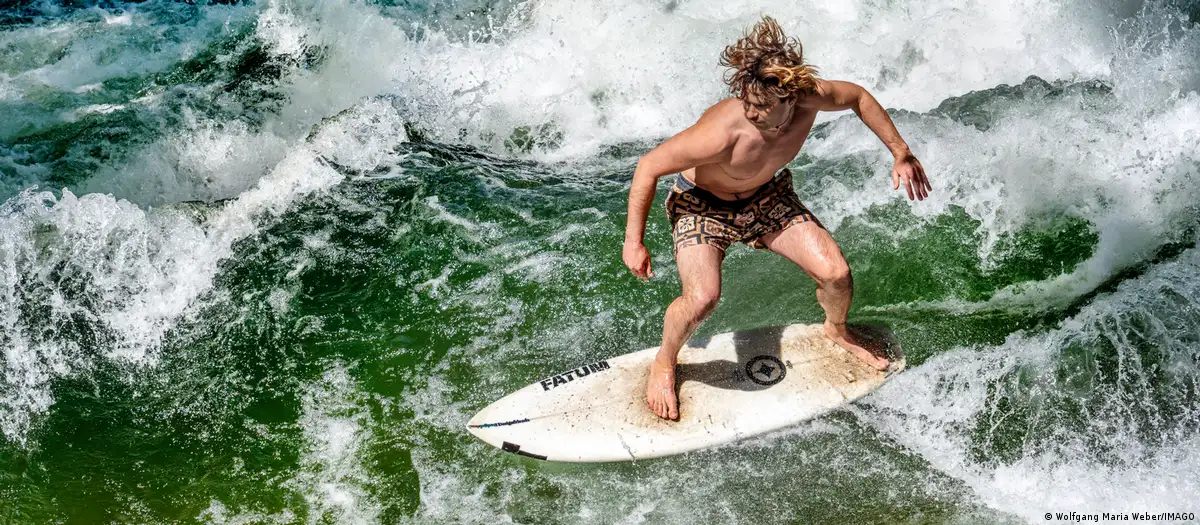
What you need to know
- Surfing has resumed in Munich's English Garden after the city's new mayor lifted a ban with a new city decree
- Only experienced surfers are allowed on the wave until 10 p.m. with new safety rules introduced following a fatal accident last year
- Germany reaches its 2026 Earth Overshoot Day on May 10
- Environmental group BUND blames a heavy reliance on fossil fuels and energy-intensive sectors
- Chancellor Friedrich Merz defends NATO unity during a visit to Stockholm
Here are the latest developments from and about Germany on Saturday May 9, 2026.
Pull out of Bundestag construction project: German lawmakers
Amid the current pressure on public spending, two senior lawmakers want to pull out of plans for a major construction project around Germany's parliament, the Bundestag.
The Luisenblock Ost II project, which was first mooted in 2009, would provide additional office space for lawmakers in Berlin's government district.
Bundestag President Julia Klöckner told Germany's Spiegel magazine that "when budgets are tight, we must not push ahead with expensive parliamentary expansions that we do not strictly need."
Bundestag Vice President Omid Nouripour said it was important to "focus on what is essential."
According to Spiegel, the goal is to save at least €600 million ($707 million) in construction costs alone, which will help the federal government’s tight budget situation.
Luisenblock Ost is divided into two parts. The first will house new Bundestag offices and secure meeting rooms and has been approved. Construction is due to begin within the next year.
The second, Luisenblock Ost II, is the larger of the two projects. If it proceeds, the second will provide housing and stores as well as its parliamentary function.
Nouripour plans to call a special meeting of the Bundestag’s Building and Space Commission at the end of the month to formally recommend dropping the project.
Merz says NATO unity remains strong
German Chancellor Friedrich Merz has said he remains confident in NATO unity despite rising tensions with Washington and plans to reduce US troop numbers in Germany.
Speaking during a visit to Stockholm, Merz said NATO's strength depends on goals rather than troop levels. He said the alliance's unity remained intact.
"NATO's strength depends not solely on troop numbers, but on shared objectives — and that unity still prevails," Merz said at a press conference in Stockholm. "I have no doubt that the United States has a strong interest in having a robust European pillar of NATO by its side — and vice versa."
The comments came after the Pentagon announced plans to withdraw about 5,000 US troops from Germany. Around 39,000 American soldiers are currently stationed in the country.
Relations between Merz and US President Donald Trump have become strained over the conflict in the Gulf.
Pope urges sustainability after Augustiner visit
Employees of Munich's Augustiner-Bräu brewery brought beer gifts to Pope Leo XIV during an audience at the Vatican, where the pontiff thanked them for their "thoughtful gesture of solidarity."
The pope recalled his own connection to the brewery through the Order of Saint Augustine, whose members brewed the beer until the early 19th century. He noted that food and drink were part of God’s creation and quoted from predecessor Pope Francis' environmental writings, saying “everything is a caress of God.”
Leo XIV urged his Bavarian visitors to use resources wisely and promote justice as a condition for peace. He encouraged them to continue contributing professionally and personally to protecting creation “for the common good” after returning home.
Augustiner-Bräu says it is the Bavarian capital’s oldest still-operating brewery. It was founded by Augustinian hermits in the early 14th century and later supplied nobility. After the monastery was dissolved in 1803, the brewery survived and was eventually taken over by the Wagner brewing family in 1829. Today, the Edith-Haberland-Wagner Foundation holds just over half of the company.
German football bosses in talks over World Cup player bonuses
The German Football Association (DFB) has been negotiating bonus payments with the national team ahead of the FIFA World Cup.
DFB President Bernd Neuendorf said no agreement had yet been reached, though discussions with the players' council were ongoing and constructive.
Talks come weeks before the tournament kicks off across Canada, Mexico and the US, with the German Football Association aiming to finalize terms in time.
Germany’s 2014 World Cup winners each received €300,000 ($354,000), while a title at Euro 2024 would have earned €400,000 per player. More recently, players took home €100,000 each after reaching the quarterfinals at Euro 2024.
Former Germany captain Philipp Lahm has said reaching at least the semifinals should remain the benchmark, with coach Julian Nagelsmann expected to lead a renewed push after recent World Cup disappointments.
Neuendorf has said Germany belongs among the wider group of contenders, alongside teams such as England, France, Brazil and Argentina.
Germany hits 2026 resource limit
Germany has already used up all of the natural resources that should last for the entire year.
The date, known as Earth Overshoot Day, is calculated annually by the Global Footprint Network for individual countries and for the planet as a whole.
If everyone on Earth consumed as many natural resources and produced as much carbon dioxide as people in Germany, the planet's annual biocapacity would already be exhausted within the first third of the year.
According to the German Federation for the Environment and Nature (BUND), Germany consumes far too many resources, mainly because of its heavy reliance on fossil fuels. The main contributors are energy-intensive industries, the building sector, road transport and industrial livestock farming.
As a result, the consequences are already being felt through droughts, heavy rainfall and increasing heat in cities.
"Our current way of living and doing business is not sustainable," BUND chairman Olaf Bandt said. "Instead of switching to renewables, we are continuing to rely on coal, oil and gas."
Electricity from solar and wind power, along with heat pumps and lightweight, small and efficient electric cars, would instead provide independence, planning certainty and climate protection, Bandt said.
In 2025, Germany's Earth Overshoot Day fell on May 3. The fact that the date shifted back by a week in 2026 was not the result of a more environmentally friendly lifestyle, but updated data and changes in calculation methods.
Munich reopens Eisbach wave to surfers
Surfing has resumed at Munich's Eisbach wave, in the city's famous English Garden after officials lifted a previous ban.
Green Party Mayor Dominik Krause approved the move by issuing a revised general decree shortly after a new city coalition was formed.
"Surfing on the Eisbach is an integral part of the Munich way of life; the Eisbach wave is a landmark of the city of Munich," Krause declared.
From the very beginning, he noted, his goal had been "to open the wave as soon as possible." To take this step, he worked closely with representatives of the Munich surfing community, who have organized themselves into two associations.
Only experienced river surfers are allowed to use the wave, and only until 10 p.m., with new safety rules including quick-release leashes to reduce risks in the strong current.
The site had been closed after a fatal accident in April last year, when a surfer was pulled underwater after her leash became trapped.
Welcome to our coverage
Guten Tag from the DW newsroom in Bonn.
You join us as we learn that one of the world's strangest surfing venues, in the capital of landlocked Bavaria, is once again allowing tourists to catch a wave.
Meanwhile, Germany has already consumed its share of the Earth's resources for the year.
Stay with us for more on the latest stories from and about Germany.