Germany news: Power back in Berlin after arson attack
Published January 7, 2026last updated January 7, 2026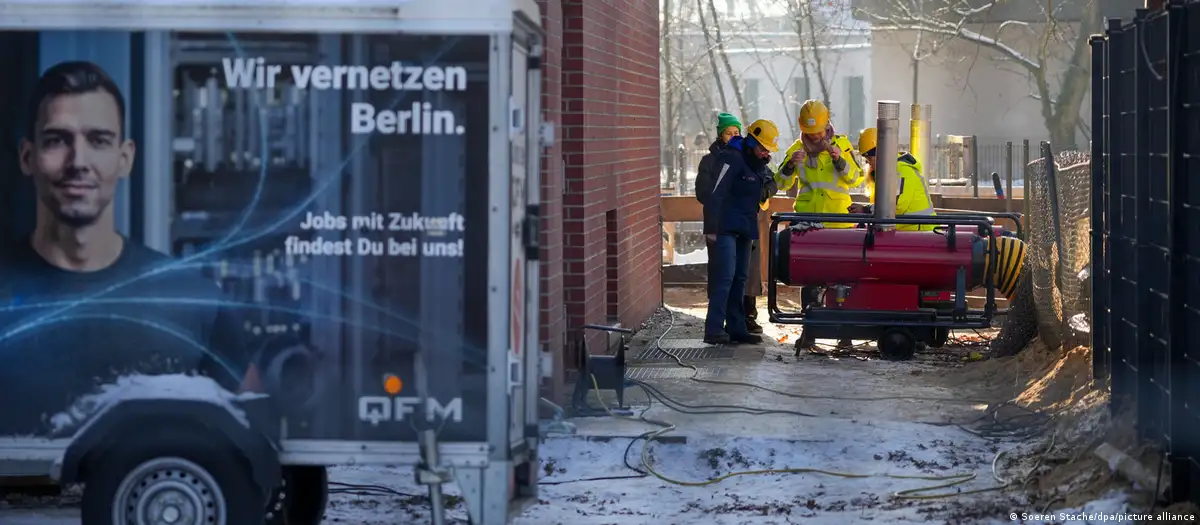
What you need to know
- Power has been fully restored in southwestern Berlin on Wednesday
- Federal prosecutors have taken over the investigation of an arson attack that led to a major power outage in Berln
- A group claiming responsibility has said its action did not target people but infrastructure it claims destroys the environment
- Germany's DAX stock index hits record high
- A Bavarian parliamentarian from the far-right AfD is going on trial on charges of incitement to hatred
- The unemployment rate in 2025 was the highest since 2013, new figures show
This blog is now closed. Here are the top stories from and about Germany on Wednesday, January 7, 2026
German government to continue tough migration policy, Interior Minister Dobrindt tells DW
The German government intends to continue pursuing its tough migration policy in 2026, Interior Minister Alexander Dobrindt confirmed to DW. Last year, the number of asylum seekers in Germany more than halved to around 113,000.
Dobrindt hopes that the introduction of the new European asylum system will lead to a further reduction in migration to Germany. He said that in addition, Germany was working with a group of European countries to set up repatriation centers known as "return hubs" in third countries.
Dobrindt said Germany didn't want to leave the matter to the European Commission, but rather to work it out with "like-minded countries."
"This group will agree in the coming weeks which country outside the EU to enter into talks with first," the interior minister said, but emphasized that this is “still a lengthy process.” He declined to say which countries were under consideration as "return hubs."
In his interview with DW, Dobrindt acknowledged that the global political situation could lead to a renewed rise in migration, especially when it comes to Ukraine.
In recent months, young Ukrainian men have been coming to Germany in greater numbers than ever before. The federal government wants to limit that movement.
"We have initially reduced the pull factor by canceling welfare payments for Ukrainian refugees and by replacing it with asylum seeker benefits," Dobrindt explained. "This has a significant impact, for example on protected assets, which are reduced to €200 ($233).” He said, German authorities are required to take those assets into account.
In addition, the German government expects Ukraine to change its laws and make it more difficult for young men to emigrate to the European Union. “We know that Ukraine is taking our request very seriously and that it is also being discussed. But there is no result yet,” said Dobrindt.
At the same time, he emphasized, “There are prospects in Germany for people who want to integrate here, take up work and earn their own living.” Conversely, he added, people who do not integrate must “be aware that their prospects then lie in their home countries.”
Power restored to Berlin after biggest outage since WWII
The electricity supply to southwest Berlin has been restored, officials said Wednesday evening, after tens of thousands of residents were left without power for days.
The outage, which Mayor Kai Wegner has described as an act of terrorism, is the longest in Berlin's postwar history.
All households in the affected areas were reconnected to the power grid by mid-afternoon on Wednesday, Berlin's senator for economic affairs, Franziska Giffey, said.
Power had been cut to some 45,000 households and over 2,200 businesses in several districts in Berlin's southwest since Saturday.
Electricity had been gradually restored in the days since, with the last 19,900 households and 850 businesses back on the grid on Wednesday.
Left-wing extremists from the Vulkangruppe (Volcano Group) had claimed responsibility for the power outage, claiming in a statement on Sunday that it had "successfully sabotaged" a power station.
In the statement, the group said its main target was the fossil fuel industry, pointing out that the action "resulted in power outages in the more affluent districts of Wannsee, Zehlendorf and Nikolassee."
"We apologize to the less affluent residents of southwest Berlin," the group added.
Police warn of scams after Gelsenkirchen heist
Police have warned of scams connected to a break-in at a bank in Gelsenkirchen in western Germany.
According to the report, the perpetrators of the fraud attempts allegedly impersonated police officers and bank employees over the phone and inquired about valuables and cash after having mentioned the bank heist.
In some cases, they also asked for personal information.
Police advised caution, stressing that police officers and bank employees would not come to a customer's home to check or collect valuable items or cash.
What happened in the Gelsenkirchen heist?
The police warning comes after robbers drilled a hole into the vault of a bank in Gelsenkirchen, which lies between Essen and Dortmund in North Rhine-Westphalia state, late in December.
More than 3,000 safe-deposit boxes in the vault were forced open, containing cash, jewelry, and gold.
Investigators estimated some €30 million (almost $36 million) was stolen in the heist, which was described as highly professional.
Highway closed in western Germany due to broken wind turbine
Parts of a highway in western Germany were closed off after one of the blades of a wind turbine snapped on Wednesday, with authorities expressing concern it could come tumbling down.
The affected area is the A44 highway between the Jackerath and Holz intersections in the state of North Rhine-Westphalia in an area southwest of the state capital, Düsseldorf.
"The highway was completely closed for safety reasons, because we cannot rule out the possibility that the motorway could be endangered by parts or all of the wind turbine," a police spokesperson was cited by the Bild tabloid newspaper as saying.
Bild reported that the area was closed to traffic at 10:30 a.m. local time (0930 UTC).
Fire brigade commander Guido Garbe told the DPA news agency that an area of 400 meters (1312 feet) was closed to traffic.
He said that firefighters did not know how long operations would last.
There was no evidence of sabotage, according to police.
German Red Cross demands more investment in civilian protection after Berlin blackout
The German Red Cross (DRK) has criticized a lack of investment in civilian protection measure by the federal government after an arson attack triggered a major five-day power outage in Berlin during a cold spell.
The blackout showed "how vulnerable critical infrastructure is and how important it is to protect the population," DRK President Hermann Gröhe said in remarks to newspapers from the Redaktionsnetzwerk Deutschland corporate newsroom.
Protection against catastrophes was a central element of social resilience and a vital public obligation of the state, Gröhe said.
He said it had become clear after the arson incident "how important it is to have fallback procedures and a sufficient supply of materials to cope with such situations."
He gave the example of mobile care units that could each provide necessary supplies and aid to 5,000 people.
According to Gröhe, at least 10 of these units were required across Germany and that this had been agreed with the government.
However, he said, so far only 1 1/2 of the units had been financed, with no money earmarked for more of them in the current budget.
The German Hospital Federation (DKG) also called for billions to be invested in hospital infrastructure to make it more resilient.
Pointing to the use of emergency generators by hospitals during the blackout, federation head Gerald Gass told the daily Augsburger Allgemeine that this can allow basic operations only for a limited amount of time, and that a major blackout has a direct impact on medical care.
He said some €2.7 billion ($3.2 billion) was needed to protect hospitals from cyberattacks and sabotage, while preparing them for possible wartime conditions could even require €14-15 billion.
2025 warmest year on record for North Sea — German maritime agency
The North Sea in 2025 reached its highest average temperature since records began, Germany's national agency for maritime affairs and hydrology (BSH) said Wednesday.
"In 2025, the North Sea reached an average temperature of 11.6 C (52.9 F), the highest value in the BSH data series since 1969," Tim Kruschke, head of the BSH's climate team, said in a statement.
According to the agency, the Baltic Sea also came near record temperatures in 2025, experiencing its second-warmest year since the BSH has recorded its data.
The agency said the average surface temperature in the sea was 9.7C (49.5 F), surpassed only by that in 2020.
The warmest region was the southwestern part of the Baltic, including waters belonging to Germany, along with the Gulf of Finland, the BSH said.
Sea temperatures are rising globally as the Earth warms, owing largely to the human use of fossil fuels.
The rate of ocean warming has more than doubled since 1993, according to the UN's IPCC climate expert panel.
BSH President Helge Heegewaldt warned that action to combat climate change is vital.
"Even if we immediately stop emitting greenhouse gases worldwide, sea leverls will probably continue rising for centuries," he said.
"That is dangerous particularly for our coast. It is thus important to do more for climate protection. We will be able to win time to prepare better for the consequences of climate change and improve protection of our coasts and thus the people living there," he added.
Trial postponed in case of girl isolated from world for 7 years
The trial of the mother and grandparents of a girl who was allegedly locked away in isolation from the outside world for seven years began on Wednesday but was suspended after 30 minutes due to the absence of the grandfather.
According to his lawyer, the man was released from hospital on Tuesday and is bedridden.
But Judge Sabine Metz-Horst said that since no medical certificate had been provided, the grandfather had an unexcused absence, meaning the indictment could not be read out.
She postponed the session to January 12.
The 49-year-old mother is facing charges of unlawful detention, mistreatment of a dependent and physical injury in the trial to be held in the western city of Siegen.
The grandparents are also accused of being accessories to the crimes.
The now 12-year-old girl was freed by police from her home in the town of Attendorn in the Sauerland region in September 2022 after authorities received several tip-offs. She was 8 years old at the time and was believed to have been locked away since 2015.
According to the court, the girl, who is now in the care of a foster family, has suffered considerable delay in her development because of her isolation. At the time of her liberation, she was reportedly so underdeveloped that she was not able to climb stairs or make her way across uneven ground.
Child welfare authorities were long told by the grandparents that the girl was staying in Italy with her mother.
The motivation for the alleged actions of the mother and grandparents is still unclear.
Power to be restored gradually in southwest Berlin on Wednesday — energy provider
The electricity supply to areas of southwest Berlin affected by a major power outage is to be restored gradually over the course of Wednesday, according to the energy provider Stromnetz Berlin.
Initially, the provider had predicted a complete restoration of power by Thursday.
The power outage has lasted for five days, with 20,000 households still affected early on Wednesday.
Federal prosecutors are conducting a terror probe into the arson attack on a cable bridge over the Teltow Canal that led to the blackout.
Authorities believe that left-wing extremists were behind the attack.
Germany met 2025 CO2 emissions target, but progess slowing — think tank
Germany met its climate target in 2025, but greenhouse gas emissions fell more slowly than the year before, raising concerns about a goal of 65% reduction of emissions compared with 1990 levels by 2030, a study has shown.
The 2025 figure represents a 1.5% decline from 2024 and a 49% drop since 1990, the calculations showed.
The research by think tank Agora Energiewende calculated that Germany will now need to annually quadruple the reductions achieved in 2025 to meet the goal in five years' time.
While meeting its national goals, Germany however missed EU targets by around 30 million tons of greenhouse gases, the calculations showed.
If that trend persists, the government might have to buy additional emissions rights from other countries, potentially costing up to €34 billion by 2030 ($39.8 billion).
Greenhouse gases include mainly CO2 and methane, along with other gases that contribute to retaining heat within the Earth's atmosphere.
Germany's 2025 unemployment numbers rise to highest level since 2013
Altogether 2.9 million people in Germany were without work at the end of last year, figures from the Federal Employment Agency (BA) showed on Wednesday.
The agency said the number of unemployed grew by 3,000 in December in seasonally adjusted terms, a smaller number than expected.
"The labor market continues to lack economic momentum," said BA head Andrea Nahles. "The weak trend is therefore continuing at the end of the year."
The labor market has shown a negative trend throughout 2025, with 2.948 million unemployed people registered on average, 161,000 more than the year before.
The average unemployment rate rose by 0.3 percentage points to 6.3%.
Bavarian far-right parliamentarian Halemba due to go on trial on hate charges
Daniel Halemba, a member of Bavaria's state parliament who belongs to the far-right Alternative for Germany (AfD) party, is due to go on trial on Wednesday, where he will face charges including incitement to hatred and money laundering.
The trial in Würzburg has been scheduled to run for eight days.
Among other things, Halemba, 24, is alleged to have overseen the playing of a song by the neo-Nazi rock band Landser — which has been classified as a criminal organization — at his birthday party in July 22.
Prosecutors say the lyrics of the song that was played incite hatred against people of Turkish background living in Germany.
Halemba has denied the charge, saying he was not even present at the party at the time in question.
He is also facing money laundering charges connected with money he transferred from his private account to an account in the Baltic states that is believed to come from fraud committed by third parties.
Halemba is alleged to have received a commission for the transfer.
The lawmaker has denied all the charges and said he expects to be acquitted.
Germany's DAX index hits record high of 25,000 points
The blue-chip DAX stock index has climbed about 25,000 points for the first time in its history, rising by 0.6% on Wednesday to a record high of 25,029.64.
The record comes as investor sentiment is being bolstered by hopes pinned on the artificial intelligence boom.
There has also been a run on stocks from armaments companies such as Rheinmetall, particularly following the US military operation in Venezuela over the weekend.
Lights to go back on in Berlin's southwest on Wednesday, authorities say
Berlin authorities have told the dpa news agency that energy supplier Berlin Stromnetz will be gradually restoring power in areas affected by a major blackout in the course of Wednesday.
"We will be working on restoration of supply today over the day," a Berlin Stromnetz spokesman said.
The mass-circulation daily Bild earlier reported that power would be returned from 11 a.m. local time (10:00 a.m. UTC ).
Federal prosecutors take over investigation into Berlin power outage
The top German prosecutors' office, the "Bundesanwaltschaft," has taken over the probe into an arson attack on the power supply in Berlin on Saturday that has caused the longest blackout in Berlin's postwar history.
The prosecutors are investigating the incident as involving unconstitutional sabotage, membership in a terrorist group, arson and the disruption of public facilities.
The arson attack is believed to have been carried out by left-wing extremists, with a letter sent to authorities by a group calling itself the "Vulkangruppe, "or Volcano Group, deemed as "credible" by police.
Some 20,000 households remained without power on Wednesday, with energy supplier Berlin Stromnetz saying it will take until Thursday for electricity to be fully restored to affected areas.
The Vulkangruppe was reported by the mass-circulation Bild newspaper on Wednesday to have issued another statement regarding its alleged actions.
In the statement, the group said its attack was not directed "at people" but at infrastructure that is destroying the environment.
At the same time, it said that it was not "by chance" that vulnerable groups such as the aged, children and the ills were affected.
The statement is said to have also dismissed speculation that Russia could be behind the attack, saying this was an "attempt to conceal" authorities' own helplessness by "constructing an external enemy."
Germany's domestic intelligence agency, the BfV, says the Vulkangruppe has been behind a number of arson attacks on important public infrastructure since 2011, mostly in Berlin and the surrounding state of Brandenburg.
Berlin's governing Mayor Kai Wegner said Tuesday the sabotage of power lines was an act of "left wing extremist terror."
"Suspected left-wing extremists knowingly put lives at risk, especially those of patients in hospitals, as well as the elderly, children and families," Wegner said.
Welcome to our coverage
The DW newsroom in Bonn wishes a warm Guten Tag on a very cold day to our readers across the world as it brings you another look at the top stories in Germany.
We will be reporting on the continuing power outage in parts of Berlin following a fire on a cable bridge believed to have been lit by a left-wing extremist group.
With some 20,000 households still without electricity amid freezing temperatures, federal prosecutors have taken over investigations, an indication of how seriously the disaster is being seen by Germany's authorities.
Other news on Wednesday includes the high-profile trial of controversial Bavarian AfD parliamentarian Daniel Halemba on charges of inciting hatred and money laundering, and another trial of the parents and grandparents of a young girl segregated from the outside world since her infancy.
Keep reading for more news on what is happening in Germany on Wednesday, January 7.