Germany news: Coalition frictions open on military service
Published October 14, 2025last updated October 14, 2025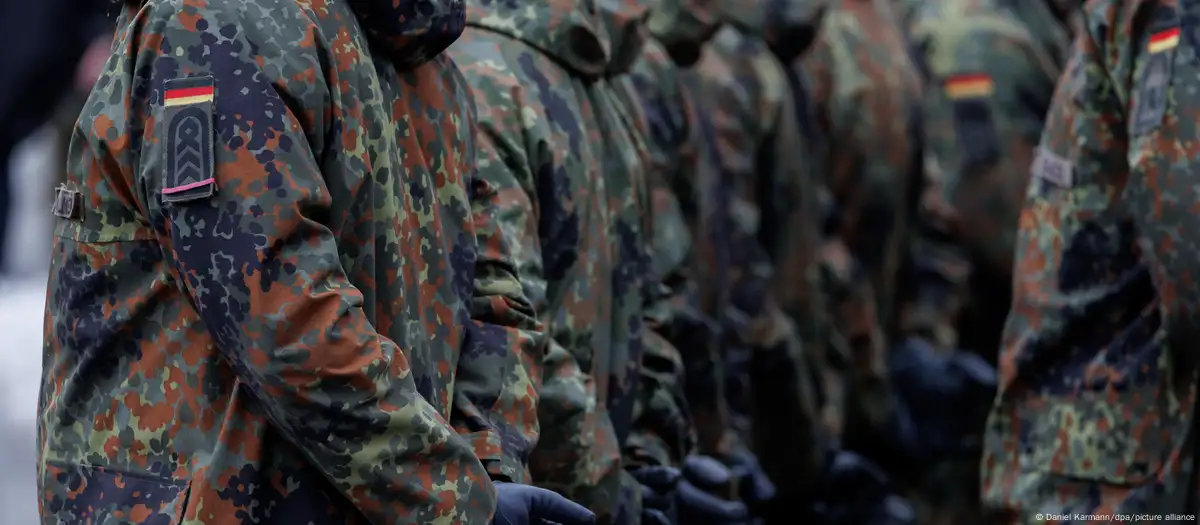
What you need to know
Germany's coalition government called, and then hastily canceled, a press conference on Tuesday evening to present what it hoped was a breakthrough on stalled plans to reintroduce military service.
The CDU has resisted a proposal put forward in August by the defense minister, envisioning purely voluntary recruitment, saying it was concerned too few would volunteer.
Its proposed solution was a lottery among young men who did not volunteer, if it is needed to bolster the ranks in a given year.
Reportedly, this proposal met fierce resistance among SPD members, with political reporters in Berlin implying that Defense Minster Boris Pistorius, a Social Democrat, had made clear to the party members that the new idea was not his.
In other news, inflation has risen again as previous energy price dips become less pronounced.
This blog is now closed. Here is a roundup of headlines from Germany on Wednesday, October 10:
Coalition still split on military service as 'lottery' plan stalls
The government's impasse on reintroducing some form of military service briefly appeared to be solved on Tuesday, until the conservative Christian Democrats (CDU) and center-left Social Democrats (SPD) called off a press conference scheduled to present their new compromise at the last minute.
The story had been leaked out to German media including ARD, Spiegel and others, saying that top defense politicians from both parties had agreed on a plan for a lottery system similar to Denmark's, in the event that too few people volunteered in a given year.
But the Berlin presentation of the plan was abruptly canceled on Tuesday evening, seemingly after the plans proved unacceptable to more junior SPD members of the Bundestag.
The SPD in particular has objected to the notion of mandatory national service.
Tip-toeing around the word 'mandatory'
The plan put forward in August by Defense Minister Boris Pistorius (SPD) would involve a mandatory questionnaire going to all male school leavers, asking about their availability and encouraging them to sign up voluntarily. Young women would also be sent the survey, but would be under no obligation to respond.
CDU members had been warning that too few people might volunteer, calling for a more codified system in the event of a shortfall.
Tuesday's short-lived new agreement was for a lottery among men who declined to join, if one was needed to make up the difference. But then those chosen in the lottery would supposedly be encouraged to join of their own volition. Quite how that last part works, or whether honoring the lottery would be obligatory at all or subject to any penalty, was not made particularly clear by Tuesday's reports.
For now, though, both ruling parties will have to return to boot camp and see if they can cobble another compromise together.
In a further sign of this issue's ability to divide politicians in Germany, with its catastrophic 20th century military history, the opposition AfD on Tuesday also abandoned its plans to submit an alternative military service bill in parliament until further notice, conceding it could not reach an internal consensus.
German far-right politician criticized over scheduled trip to Moscow
A planned visit to Moscow by a top far-right German politician was criticized as "treason."
Michael Frohnmaier, the deputy floor leader for far-right Alternative for Germany (AfD) members in the Bundestag, recently announced a trip to Russiadue to what he said was the need to keep dialogue open for the time after the war with Ukraine.
In response to Frohnmaier's intention to visit Russia, Christian Social Union (CSU) member Martin Huber said the party must stop the trip.
"Anything else is treason," he said, while blaming the far-right politician for traveling to Russia for a "pilgrimage to the Kremlin" and being a "vassal" of Russian leader Vladimir Putin.
Huber also said the trip posed a "high risk" due to the chances of Frohnmaier potentially passing on secret information to Moscow, thus "massively jeopardizing the security of Germany and Europe."
Germans still embracing heating systems despite high costs, study says
Heating costs in Germany jumped a whopping 82% between 2021 and 2024, according to a new report by the Germany-based energy management company Techem, but higher prices have not prompted consumers to dial down thermostats.
Techem analyzed heating and energy consumption data from 2022 (the most recent available) and found that roughly half of all homes in Germany were heated with gas, a quarter with heating oil, and about seven percent with district heating — the latter being the most expensive option.
Techem used data compiled from 100,000 houses and over one million apartments in its analysis.
The company says its latest study highlights a divergence from past trends, namely an increase in heating consumption despite higher unit prices.
Those prices rose most sharply in early 2022, when Russia launched its invasion of neighboring Ukraine — leading first to a sharp drop in heating consumption by Germans and then to a spike.
Consumption, says Techem, has remained steady since then, despite continued price increases, signaling what the study calls, "a greatly reduced propensity to save."
Chocolate prices spike in Germany
Products and services in Germany became more expensive by 2.4% in September 2025 in comparison to the same month last year, the highest rate since December 2024, according to the German Federal Statistics Office.
Among the products whose price became more expensive are sugar and jam (6.5% more expensive) and fruits (5.1%), while the prices of milk-based products and eggs also went up (3.6%).
Chocolate prices went up by a staggering 21.2%.
But products that became cheaper in comparison to October 2024 include oil (down by 3.2%) and vegetables (down by 2.1%).
Number of book retailers falls by nearly a quarter over five years
The number of book retailers in Germany slumped by nearly 24% over five years, with just over 2,980 businesses operating in 2023, according to the Federal Statistical Office.
In 2018, there were about 3,930 bookstores. Destatis presented the figures ahead of the Frankfurt Book Fair, which runs from October 15 to 19.
Analysts attribute the decline to rising rents and staffing costs, as well as changing consumer habits. The number of employees in the sector also fell by 19% over the same period, from 28,000 in 2018 to 22,620 in 2023.
Despite the contraction, sales have risen 9% since 2018. Book retailers generated just under €4 billion in 2023, up from about €3.6 billion five years earlier.
Training in the book trade remains female-dominated. In 2024, nearly 490 people began apprenticeships as booksellers, down slightly from 500 in 2023. Women accounted for 87% of new trainees — the highest proportion in a decade.
Body of missing 8-year-old Fabian likely found
Police searching for an eight-year-old boy who went missing from Güstrow south of Rostock, have found a child's body in a nearby forest.
Authorities said the body is believed to be that of the missing boy Fabian, though a forensic examination is still needed to confirm his identity.
Local broadcaster Ostseewelle first reported the discovery.
Germany's inflation edges up to 2.4% in September
Germany's inflation rate rose to 2.4% in September 2025, up from 2.2% in August and 2% in July and June, according to the country's Federal Statistical Office, Destatis.
Consumer prices also increased by 0.2% compared with August.
"After declining inflation since the beginning of the year, the inflation rate has now risen for the second month in a row," said Destatis President Ruth Brand. She noted that service prices continued to climb at an above-average pace, while falling energy prices had a smaller dampening effect than earlier in the year.
Energy prices were 0.7% lower in September than a year earlier, marking the fifth straight month of a slowing decline. The drop was smaller than in August, when energy prices were down 2.4% year-on-year.
Fuel prices rose 1.1% — the first annual increase since May 2024 — while household energy costs fell 1.9%.
Few German workers fear job loss from AI, survey finds
Only about 5% of employees in Germany are worried that artificial intelligence could threaten their jobs within the next five years, according to a new survey by the health insurer AOK's Scientific Institute (WIdO).
Two-thirds of respondents said they were "not at all concerned," while another 23% were "rather unconcerned" about AI's impact on their job security.
The survey also revealed limited knowledge about AI. Even in companies where it is already in use, just under 40% of employees said they had received any related training. Nearly half of respondents said they "roughly" understood what AI means, while 47% believed they could explain it fairly well. Only 5% considered themselves experts.
WIdO director Helmut Schröder said he was surprised by the widespread lack of concern, noting that studies by the Institute for Employment Research (IAB) suggest that roughly 38% of jobs in Germany involve tasks that could be largely automated. He warned that AI systems could also take over more complex professional roles.
According to the survey, 42% of respondents said AI is already being used in their workplace, while 8.5% reported concrete plans to introduce it and 15% said it was being discussed. Only 22% said AI was not yet an issue in their work environment, and just 12% believed it would never be relevant to their field.
The survey was conducted in April among 2,490 employees.
Majority of Germans back reintroduction of military conscription
Most Germans favor reinstating compulsory military service, according to a new Forsa poll for Germany's Stern news magazine.
The survey found that 54% support mandatory service in the Bundeswehr, while 41% oppose it and 5% expressed no opinion.
Support is strongest among conservative voters, with 74% of CDU/CSU supporters in favor. Among the center-left Social Democrats (SPD), 58% back a return to conscription, while 80% of Left Party voters oppose it.
The poll revealed a clear generational divide: 61% of those aged 60 and older support conscription, compared to just 37% among 18- to 29-year-olds, who would be most directly affected.
Since Russia's full-scale invasion of Ukraine in February 2022, Forsa has tracked fluctuating public opinion on the issue, but since March 2024, support for reinstating conscription has clearly prevailed. The draft was suspended, not abolished, in 2011.
Defense Minister Boris Pistorius of the SPD has proposed a new military service law aimed at recruiting tens of thousands of new soldiers annually, initially on a voluntary basis. Mandatory service would be introduced only if recruitment goals are not met or if the security situation deteriorates.
Welcome to our coverage
Guten Tag from DW's newsroom in Bonn.
You join us as figures show that a large majority of Germans are not worried about artificial intelligence taking their jobs.
The survey also showed that there was limited knowledge about AI, with very few workers saying they understood it well.
Meanwhile, figures show that inflation remains stubbornly above target in Germany.
Follow DW for more news about this and other stories from Germany here in our blog.