Germany updates: Finance minister defends 2026 budget plans
Published September 23, 2025last updated September 23, 2025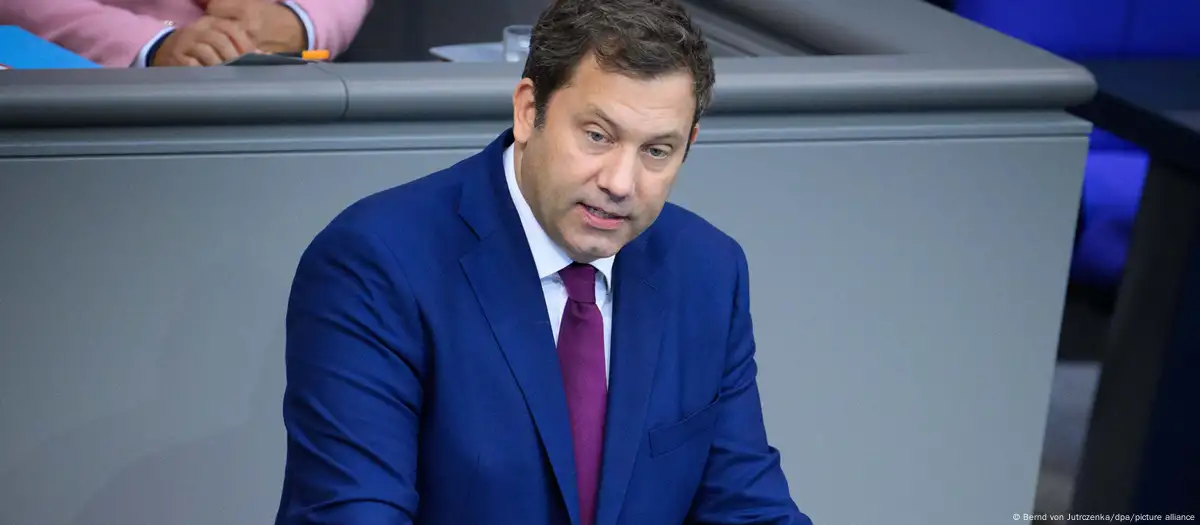
What you need to know
German Finance Minister Lars Klingbeil has been pushing back on claims that his budget would just fill gaps, saying Germany will invest €126.7 billion (about $150 billion) in infrastructure, schools and hospitals in 2026.
Klingbeil told the Bundestag that special funds would be used to secure jobs and boost growth rather than bankroll pet projects.
Opposition parties have accused the coalition of piling up debt for tax breaks and pensions instead of real investment.
Meanwhile, the leader of the opposition Green Party has condemned Chancellor Merz for not attending the UN General Assembly.
This blog is now closed. Read below for DW's coverage of news stories from Germany from Tuesday, September 23.
DHL resumes package delivery to US, after tariff-related pause
Germany's DHL carrier said it has resumed delivering packages to the United States on behalf of corporate customers.
The announcement comes after a four-week pause in August, after Washington imposed new customs duties, scrapping a duty-free threshold for goods worth up to $800 (€677).
Logistics companies were disrupted by the move, with the Geneva-based Universal Postal Union (UPU) saying the sending of mail came "to a near halt after the implementation of the new rules on 29 August 2025."
DHL now says businesses can once again begin sending shipments across the Atlantic starting Thursday, using the new "Postal Delivered Duty Paid" service for goods valued up to $800.
Businesses must "provide complete and accurate customs data, particularly the customs tariff number and country of origin for each individual item," DHL said.
Private customers can continue to send goods declared as gifts with a value of up to $100 without facing additional duties.
But DHL warned that "these shipments will be monitored even more closely than before to prevent the misuse of private gift shipments for shipping commercial goods."
Cannabis use among young German adults rises
Young adults in Germany are using more cannabis than 10 years ago, according to a recent survey from the Federal Institute of Public Health.
Cannabis was partially legalized in Germany in 2024.
Some 31.6% of 18- to 25-year-old men said they have used the drug at least once in the last 12 months, compared to 20.6% in 2015, the survey found.
A similar rise was seen among young women 18 to 25 years old, with some 18.5% in 2025 saying they used cannabis, compared to 9.7% in 2015.
Among adolescents aged 12 to 17 years old, the survey found only a minimal change in consumption levels, with 4.6% of girls and 7.2% of boys reporting cannabis use in the past year, compared to 6.3% and 8.1% respectively in 2015.
"Our data shows that consumption among adolescents has not increased," said Johannes Niessen, the institute's acting director.
"Among young adults, however, consumption has risen slightly, especially among men between the ages of 18 and 25," Niessen said, adding, "We need to monitor this development very closely."
The institute's director explained that "cannabis is particularly harmful to the health of young people," highlighting how cannabis "consumption can impair brain development, lead to concentration and memory problems and jeopardize long-term health."
Hamburg to host referendum for Olympics bid
Hamburg has called for a referendum on May 31, 2026 to approve the northern city's bid to host the Olympic games.
It comes as Germany is aiming to host the Games in 2036, 2040 or 2044.
"Hamburg is focusing on dialogue, participation, and the approval of Hamburg's citizens in its bid for the Olympic and Paralympic Games," interior senator Andy Grote said in a statement.
"Our aim is to develop a balanced, sustainable concept that has the support of the city's residents," Grote added.
Organizers have promised an Olympic games that would blend into the existing city, with short distances and experiences throughout the city.
"The Games should benefit as many people in the city as possible — far beyond the events themselves," explained Steffen Rülke, head of Hamburg's bid for the Olympic and Paralympic Games.
Other cities that are said to be vying to host the Olympics are Berlin and Munich, as well as the densely populated Rhine-Ruhr region, which is home to cities such as Cologne and Düsseldorf.
Germany says Palestinian state recognition 'a question of when'
Foreign Minister Johann Wadephul spoke to DW's chief political editor, Michaela Küfner, at the UN summit in New York, where he said Germany's recognizing Palestinian statehood was "a question of when."
Wadephul said EU member states "are all united in the goal of a two-state solution" and "only the question of when to recognize the state of Palestine is dividing us."
When asked about how effective the UN could be at this moment, Wadephul said: "There is no alternative to the United Nations" and "although we have a lot of crises, the future for the UN is bright."
Steakhouse heiress faces fierce courtroom clash in Hamburg abduction trial
Heated exchanges marked the 12th day of the Hamburg trial over the alleged abduction of two children by their own mother, steakhouse heiress Christina Block.
Prosecutors say Block, 52, a daughter of Block House steakhouse founder Eugen Block, hired an Israeli security team to abduct her 10-year-old son and 13-year-old daughter from Denmark.
Defense lawyers grilled father Stephan Hensel for hours about the long custody battle with his ex-wife Block.
Defense attorney Ingo Bott pressed Hensel on past family disputes, prompting objections from the judge and accusations of "airing dirty laundry" from Hensel's lawyer.
"I feel a bit like I’m on a quiz show," Hensel said after repeated questions. Bott said he aimed to test Hensel's credibility, noting Hensel has made accusations against Block that she denies.
Six co-defendants, including Block's partner, former sports broadcaster Gerhard Delling, are also on trial.
An Israeli suspect has admitted involvement, and Hamburg prosecutors are seeking six more suspects believed to be in Israel. The children, now 15 and 12, are slated to testify, though the circumstances remain undecided.
Söder says EU sanctions on Israel may create 'pogrom atmosphere'
Bavarian State Premier Markus Söder said EU sanctions on Israel might create a "pogrom atmosphere."
"First of all, I can say quite clearly that I think the European Commission's approach is generally wrong," Söder said at a party retreat for his Christian Social Union (CSU), the Bavarian sister party of Chancellor Friedrich Merz's Christian Democratic Union (CDU).
The raft of measures proposed by European Commission President Ursula von der Leyen last week includes sanctions on far-right ministers and ends some special trade concessions for Israel.
The announcement came amid mounting international outcry over what has been called a genocide by leading scholars and international bodies such as a UN commission of inquiry in Gaza, as well as rising settler violence and expanding settlements in the occupied West Bank.
Greens slam Merz for skipping UN General Assembly
The Green Party has criticized Chancellor Friedrich Merz for staying in Germany as the UN General Assembly opens in New York, where about 150 world leaders are gathering this week.
"The US president, the Chinese premier, heads of state and prime ministers from all over the world — they have all traveled to the UN, not because of a protocol, but because the world is in upheaval," said Agnieszka Brugger, who is deputy parliamentary leader of the Greens, who are part of the opposition in the Bundestag.
"It is currently being decided who will play along and who will become a pawn," Brugger said.
Foreign Minister Johann Wadephul is representing Germany as Merz focuses on the federal budget week and a key constitutional court election in the Bundestag.
Brugger warned that his absence could hurt Germany’s security, prosperity and bid for a non-permanent UN Security Council seat next year, saying the country "cannot afford" such disengagement in serious times.
Baerbock rules out UN secretary-general bid
UN General Assembly President Annalena Baerbock said she would not be running for the position of secretary-general, but believes that it would be "wonderful" and "overdue after 80 years" for a woman to hold the post.
In an interview published Tuesday on the website of Stern magazine, the former German foreign minister said leading the selection process for the next secretary-general — part of her current job — was challenging enough in the current global climate.
Incumbent Secretary-General Antonio Guterres will step down at the end of next year after two terms.
Baerbock, who served as Germany’s top diplomat from 2021 to 2025, began her one-year presidency of the General Assembly this month and is overseeing the General Debate opening Tuesday with more than 140 leaders expected in New York.
Baerbock says it remains "completely open" whether she will return to Germany after finishing her position at the UN.
"In Germany, it wasn't always so easy, especially for the children, for their mother to be recognized everywhere," Baerbock said.
"Here, I'm completely lost, I can go out without people checking every time to see if I've really stopped when the traffic lights suddenly turn red," she added.
OECD trims German growth outlook, lifts eurozone forecast
The Organization for Economic Cooperation and Development (OECD) has cut its economic outlook for Germany while slightly raising its forecast for the wider eurozone.
Germany's GDP is now expected to grow 0.3% in 2025 and 1.1% in 2026, each 0.1 percentage point lower than earlier projections. The country has struggled to recover from two years of economic contraction, pressured by weak global demand, high energy costs and declining industrial output.
The OECD now projects 1% growth for the eurozone next year, down from 1.2%, but anticipates 1.2% growth in 2025, which is 0.2 percentage points higher than previously forecast. The report states that easier credit conditions have partly offset trade frictions and geopolitical uncertainty.
Despite this, Germany, the eurozone's largest economy, was the main driver of growth in the single currency area in September, posting a solid increase in output that offset continued weakness in France.
The S&P Global's purchasing managers' index for the eurozone came in at 51.2, up from 51 in August. Any reading above 50 signals growth.
Evelyn Palla confirmed as new Deutsche Bahn chief
The supervisory board of Deutsche Bahn has confirmed Evelyn Palla as the company's new chief executive effective from October 1, the rail operator said on Tuesday.
Supervisory board chair Werner Gatzer said Palla could lead a successful restart and quickly implement the transport ministry’s agenda for improved customer service.
Transport Minister Patrick Schnieder introduced Palla as his pick on Monday, winning praise from the Greens, the passenger group Pro Bahn and the train drivers' union GDL.
Palla, who will be Deutsche Bahn's first female CEO, currently heads up the group's commuter and short-distance train unit DB Regio.
However, the railway workers' union EVG opposed her appointment in a protest vote against Schnieder's choice of Dirk Rompf to head infrastructure unit Infrago.
EVG chief Martin Burkert said Rompf, a former DB Netz board member, bears responsibility for cost-cutting that hurt operations and "is no fresh start."
Schnieder told German broadcaster ARD on Tuesday that he understood not everyone supports the plan but stressed there can be no "business as usual." He described both Palla and Rompf as excellent choices.
Klingbeil defends budget plan against opposition criticism
German Finance Minister Lars Klingbeil has rejected opposition claims that his budget proposal plugs gaps instead of funding real investment.
Opposition parties have argued that the ruling coalition is using large loans to finance pet projects such as the parent pensions and restaurant tax breaks rather than driving economic expansion.
However, speaking in the Bundestag budget debate, the SPD co-leader said special-fund spending would be aimed at securing jobs and boosting growth.
Klingbeil said the federal government would invest €126.7 billion (about $150 billion) next year from the core budget and debt-financed special funds in roads, rail, public transport, schools, kindergartens and hospitals.
"We all know that reforms are overdue, in bureaucracy, in the welfare state, in the economy," said the minister, who is also the vice chancellor in the government led by Chancellor Friedrich Merz. "Anyone who thinks we can simply carry on as before is mistaken."
"With the investments from the special fund, we will not plug budget holes, but rather we will rehabilitate what has been neglected for years," Klingbeil said.
"We are ensuring more growth, we are ensuring greater competitiveness, and above all, we are ensuring that jobs in this country are secure and that we create more employment," he added.
Welcome to our coverage
Guten Tag from the DW newsroom in Bonn.
You join us as Germany's finance minister promises lawmakers far-reaching reforms and investment.
Speaking to the German parliament, Lars Klingbeil rejected criticism of his draft budget from the opposition.
Klingbeil said investments in infrastructure would ultimately serve to secure jobs and help the economy grow.
Meanwhile, the supervisory board of Deutsche Bahn on Tuesday voted to appoint Evelyn Palla as the German state-owned rail operator's new boss.
Stay tuned for more throughout the day!