Ukraine: Trump says Putin agreed not to hit Kyiv for 1 week
Published January 29, 2026last updated January 29, 2026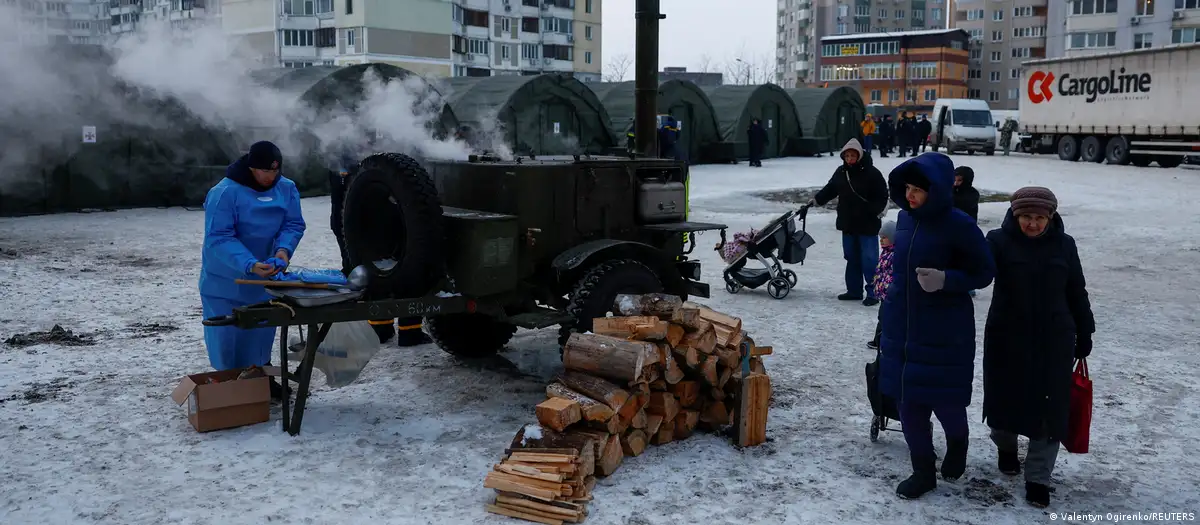
What you need to know
- US President Trump says Russia's Putin agrees not to strike Kyiv for 1 week
- EU will provide Ukraine with €153 million in emergency aid
- German Chancellor Friedrich Merz denounced Russia's “daily war crimes” against Ukraine's civilian population.
- Ukraine is working with SpaceX to stop Russian drones from using Starlink
- Russia and Ukraine report exchanging bodies of war dead
This blog is now closed. Thanks for reading our roundup of the latest developments regarding Russia's ongoing invasion of Ukraine on Thursday, January 29.
Zelenskyy praises Germany's Merz for his leadership
Ukrainian President Volodymyr Zelenskyy has praised German Chancellor Friedrich Merz for displaying leadership strength and supporting Ukraine in its fight against Russia's full-scale invasion.
"Friedrich demonstrates true leadership strength, and I greatly appreciate our coordination," he wrote on Telegram on Thursday evening.
Zelenskyy had earlier in the day held a phone call with Merz.
Germany has been one of the most important partners of Ukraine since the war began. The Ukrainian president appreciated Berlin's support for his country.
He also underscored the importance of German deliveries of Patriot and IRIS-T air-defense systems for defending Ukrainian airspace.
Zelenskyy says he expects a week without attacks on Kyiv
Ukrainian President Volodymyr Zelenskyy said he expects a promise by Russia not to attack Kyiv and other Ukrainian cities for a week because of winter weather, as announced by US President Donald Trump, to go into effect.
"Our teams discussed this in the United Arab Emirates. We expect the agreements to be implemented," the Ukrainian leaders posted on X. "De-escalation steps contribute to real progress toward ending the war."
Zelenskyy also thanked Trump, calling the supply of power a "foundation of life."
Kyiv mayor: Heating still out in 450 apartment blocks
Kyiv Mayor Vitali Klitschko has said heating is still not working in some 450 apartment blocks in the Ukrainian capital following Russian attacks this month.
Most of the unheated houses are still located in this north-eastern district of the city.
Russia intensified its airstrikes on Kyiv since the beginning of the year with major attacks on January 9 and January 13.
Russian attacks have also targeted Ukrainian energy infrastructure, leaving thousands without heat as temperatures drop below freezing.
Klitschko had already urged residents to leave Kyiv temporarily if possible.
Trump says Putin agreed not to strike Kyiv for 1 week amid extreme cold
US President Donald Trump said during a Cabinet meeting in Washington on Thursday that he had asked Russia's Vladimir Putin not to strike the Ukrainian capital for one week amid the extreme cold weather.
The call for a pause comes amid Russia's longstanding tactic of targeting Ukraine's energy infrastructure, particularly during the cold winters, in the nearly four-year war.
"I personally asked President Putin not to fire on Kyiv and the cities and towns for a week, and he agreed to that," Trump said during the meeting, attributing his request to the "extraordinary cold."
Russia has not commented on any ceasefire or pause in attacks, and Trump's comments did not make clear which "cities and towns" might also be covered in any potential amnesty.
"A lot of people said, 'Don't waste the call. You're not going to get that,'" Trump said. "And he did it. And we're very happy that they did it."
Already-low temperatures in the Kyiv area are forecast to dip sharply for a sustained period starting on Friday, with overnight lows below -20 degrees Celsius (-4 degrees Fahrenheit) forecast for four consecutive days starting on Saturday.
EU to provide Ukraine with €153 million in emergency aid
The European Commission has announced €153 million ($182 million) in emergency aid for Ukraine and Ukrainian refugees in neighboring Moldova. This announcement comes amid ongoing Russian attacks on Ukrainian infrastructure and power outages in the face of freezing temperatures.
Approximately €145 million is earmarked for humanitarian aid, including food, shelter, access to water, and health services in Ukraine. An additional €8 million will support Moldova in hosting refugees.
Additionally, the European Commission and the European Investment Bank are providing €50 million to Ukraine's energy sector. These funds will be given to the Ukrainian state-owned company Naftogaz to help secure heat and energy supplies for households, important institutions and businesses.
Ukraine is working with SpaceX to stop Russian drones from using Starlink
Ukraine is working with the US satellite firm SpaceX to address the issue of Russian drones using the Starlink satellite internet system, Ukrainian Defense Minister Mykhaylo Fedorov said after recent reports of Starlink devices being found on Russian long-range UAVs in Ukraine.
"We are grateful to SpaceX President Gwynne Shotwell and personally to Elon Musk for the quick response and the start of work on resolving the situation," Fedorov wrote on X.
Ukraine uses thousands of Starlink terminals for battlefield communication and for piloting drones. They are favored for their stable connection on the battlefield and for their resistance to enemy signal jamming.
SpaceX activated the Starlink service in Ukraine in 2022 after Kyiv pleaded for help in the days following Russia's full-scale invasion. SpaceX does not provide Starlink service in Russia.
Germany's Merz denounces Russia's 'daily war crimes' in Ukraine
German Chancellor Friedrich Merz denounced Russia's "daily war crimes" against Ukraine's civilian population.
"We are witnessing the ruthless bombing of Ukraine's entire civilian infrastructure, particularly its energy infrastructure," Merz said following a meeting with Lithuanian Prime Minister Inga Ruginiene in Berlin.
"These are daily war crimes committed by the Russian side against Ukraine and its people," he added.
Merz expressed skepticism that Russia was truly prepared for a ceasefire, followed by a peace agreement. "That's why we have to keep up the pressure and maintain the sanctions," he said.
The German chancellor also said he still sees "no need to open additional channels of communication" with Russian President Vladimir Putin because Europeans are well-informed about the details of thetalks between Ukraine, the US, and Russia.
However, Merz emphasized that the German government is open to any format and talks.
"We can only say that we are doing everything we can to end this war diplomatically, humanitarily, and militarily. However, the key to ending the war has been in Moscow for four years," he stressed.
Germany sends power units to help Ukraine through winter
Germany has sent two mobile heat and power plants to Ukraine as Russian attacks continue to damage energy systems during the freezing winter weather.
The German Development Ministry announced that Berlin will provide an additional €15 million ($18 million) in aid, on top of the €70 million given in December for local heating and power supplies.
The units delivered in Kyiv are the first under this support package. The delivery of additional mobile heating units, generators, boiler systems, pallet heating, and battery systems is planned.
German Development Minister Reem Alabali Radovan condemned Russia’s ongoing strikes, which have left thousands of apartment buildings without heat and limited many households' access to electricity and water.
“We believe in the resilience of the Ukrainian people and stand by their side," she said.
Zelenskyy says Ukraine has 'significantly diversified' its gas supplies
Following Russian strikes on Ukrainian oil and gas infrastructure, Ukraine has "significantly diversified" its supply of natural gas, according to President Volodymyr Zelenskyy.
"We are ensuring a reliable gas supply for Ukrainians despite all challenges," he wrote on X. "We continue to import sufficient volumes. Supply routes have been significantly diversified."
Ukraine said that Russian strikes had inflicted massive damage on its energy infrastructure, including gas facilities.
Russia says issue of territory is not the only one holding up peace deal
Kremlin foreign policy aide Yuri Ushakov said the issue of territorial control was not the only point holding up a potential deal to end the fighting in Ukraine.
Russia wants Ukrainian forces to withdraw from roughly 20% of the Donetsk region that the Russian army does not control. Kyiv has said it does not want to give Moscow territory.
When asked if he agreed that the territorial question was the only outstanding issue, Ushakov said: "I don't think so." He did not name the other issues yet to be resolved.
On Wednesday, US Secretary of State Marco Rubio described the disagreement as a key remaining issue that was "very difficult" to resolve.
Putin meets UAE president ahead of Ukraine talks in Abu Dhabi
Ahead of a second round of talks on the Ukraine war, Russian President Vladimir Putin met his Emirati counterpart, Mohamed bin Zayed Al Nahyan, in Moscow.
During a televised meeting with Al Nahyan, Putin said: "I would like to commend the Emirati side's efforts in the context of the Ukrainian crisis, their contribution to prisoner exchanges, and assistance in organising contacts in the United Arab Emirates."
The UAE has emerged as a key mediator in the Russia-Ukraine war, brokering prisoner exchanges and, most recently, hosting talks between US, Russian, and Ukrainian officials on a US-drafted plan to end the fighting.
A follow-up meeting is planned for Sunday in Abu Dhabi, though it is unclear if US officials will attend.
Meanwhile, Kremlin spokesman Dmitry Peskov told Interfax that Russia had renewed its invitation to Ukrainian President Volodymyr Zelenskyy to come to Moscow for peace talks, but had not yet received a response.
Last year, Zelenskyy rejected a similar invitation, suggesting that Putin come to Kyiv instead.
Extreme frost expected in Ukraine next week: Crops are in danger
Ukraine is bracing for very cold weather, with temperatures expected to fall as low as minus 30 degrees Celsius (minus 22 degrees Fahrenheit) early next week.
"We consider the current cold spell to be extremely dangerous for winter crops across a significant part of Ukraine," consultancy firm Barva Invest wrote on Telegram.
Winter wheat, which makes up 95% of Ukraine’s wheat production, is particularly vulnerable to the extreme cold. It is sown in autumn and harvested in summer of the following year.
The biggest risk comes from the mix of hard frost and little or no snow to protect the plants. The central, northeastern and eastern regions of Ukraine are at the greatest risk, while southern areas also face danger because they lack snow cover.
The cold spell is expected to begin on 1 February and ease slightly by 4 February, but it could have a significant impact on crops.
Lavrov says Russia is unaware of US guarantees for Ukraine
Russian Foreign Minister Sergei Lavrov said that he did not know what security guarantees the US and Ukraine had agreed on, but questioned their viability.
Lavrov was quoted by Russian state media as saying that any guarantees that attempted to preserve the existing "regime" in Kyiv were unlikely to ensure a reliable peace.
As part of a deal to end the war, Ukraine is seeking guarantees of its future protection in its talks with the US.
Russia's Lukoil to sell foreign assets to US firm Carlyle
Lukoil, a Russian oil company that was sanctioned by Washington over the war in Ukraine, announced the sale of its foreign assets to the US investment firm Carlyle.
Lukoil revealed that it had signed an agreement with Carlyle to sell LUKOIL International GmbH but did not disclose the deal's value.
The Russian oil giant said the deal excludes assets in Kazakhstan and still requires US Treasury approval. Negotiations were still being held with other potential buyers, Lukoil added.
Meanwhile, Carlyle said that the agreement "has been structured to be fully compliant" with US Treasury policies and that it was "conditional upon Carlyle's due diligence and regulatory approvals."
In late October 2025, the United States added Moscow's two largest oil producers, Lukoil and Rosneft, to its blacklist of sanctioned entities in an effort to pressure Russia's state finances.
The US Treasury had given Lukoil until February 28 to sell its global portfolio.
Estonia wants to prevent Russian combatants from entering Schengen area
Estonia's Foreign Minister Margus Tsahkna called on EU countries to impose a coordinated Schengen visa ban on Russians who have fought in Ukraine.
"They are really bad people, and we need to put together the blacklist of these people," he said.
"I cannot imagine how our leaders can explain if peace comes and these hundreds of thousands of ex-combatants are coming to Europe," the minister told reporters. "They're going to do many bad things."
Hundreds of fighters from specific Russian military units have already been blacklisted by Estonia, which has taken the first step.