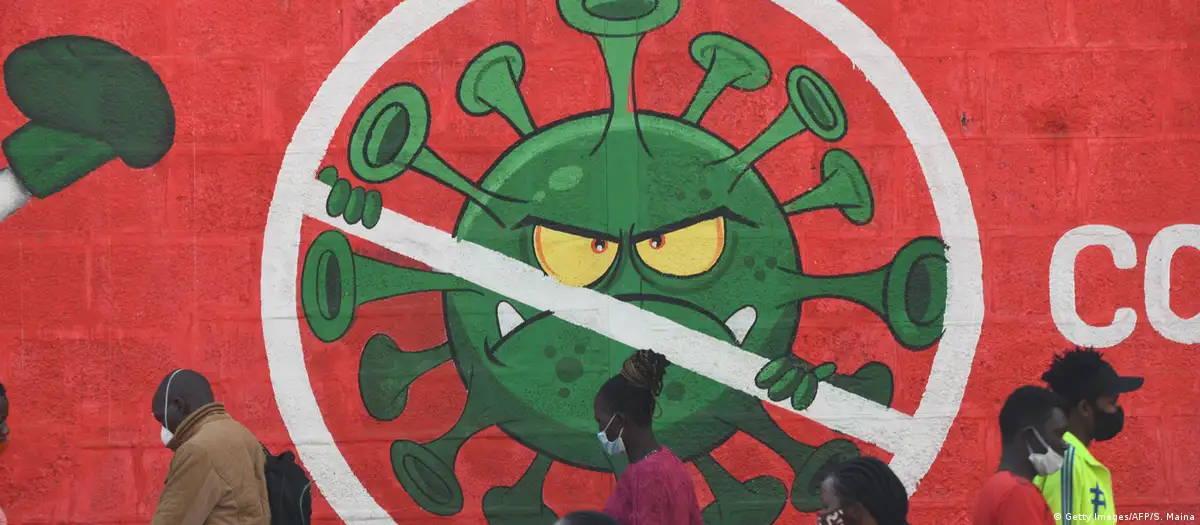
Hundreds of thousands or even millions of deaths and serious infections causing the collapse of already shaky health care systems —this is how experts imagined the effect of the coronavirus pandemic in most African countries.
But, more than four months later, one can say that this horror scenario has not materialized.
While rates of infection and death on other continents have sometimes exploded in recent months, Africa has been spared a high COVID-19 mortality rate — and this despite the fact that people in cities like Dakar and Lagos live under very crowded conditions, with many suffering from poverty and a lack of basic hygienic facilities.
Scientists have been examining the possible reasons for the mild course of the pandemic on the continent.
In an analysis for the journal Science in August, one group of researchers surmised that early action by authorities may have played a role. "Measures such as travel restrictions, curfews and school closures were implemented early in Africa compared with other continents, often before an African country had detected a case," they wrote.
The authors attributed this readiness to take early action to the experiences of many African countries with other infectious diseases such as Ebola and Lassa fever. The rapid response most likely led to a slower spread of the infection, they said.
'The measures are working'
"We know that the measures are working," says Edward Chu, emergency medicine adviser at Doctors Without Borders. "However, strict measures are difficult to maintain over a long period of time. We can therefore assume that with further relaxation, the number of infections will also increase."
Nevertheless, according to the authors of the Science article, there must be other reasons why the worst-case scenario has not occurred, because "[m]ost people work in the informal business sector, such as in traditional markets, making strict lockdown measures impossible to implement."
Young continent
Age, for example, could be one reason. On average, the population of the African continent is 19.7 years old — only half as old as people in the US. Although the novel coronavirus also infects the young, it is mainly the elderly who come to hospitals with severe cases of the disease and die from the infection.
The low recorded infection rates could also be related to this low average age on the continent. That is because young people are more often asymptomatic. Because they do not become noticeably ill, they are less likely to be tested and examined, says Chu — especially when the country's health care system is shaky anyway and testing capacity is low.
"The lack of testing capacity makes it extremely difficult to say how much the pandemic will actually affect the populations of African countries," says Chu.
Parasitic boost to immune system?
The analysis published in Science says immune systems influenced by African environments could be another reason for the comparatively mild course of the pandemic. "It is increasingly recognized that the immune system is shaped not only by genetics but also by environmental factors, such as exposure to microorganisms and parasites. This educates the immune system to protect against invading pathogens not only specifically but also nonspecifically," the researchers write.
This could decisively mitigate the severity of an infectious disease and be another reason why the expected high number of victims in Africa has so far failed to materialize.
The immunologist and parasitologist Achim Hörauf is researching this hypothesis at the University Hospital in Bonn. He is especially interested in worms, which live more or less harmoniously as parasites in the bodies of people in many African countries.
This harmony is possible only because in many cases the worms do not trigger a strong immune response. They avoid it by signaling to the immune system with certain secretions that there is no reason for it to get het up. "It could be that the COVID-19 infection is better tolerated this way," says Hörauf. An excessively violent response from the immune system can lead to severe courses of COVID-19.
While parasites may make a milder course of infection more likely, non-infectious conditions such as cardiovascular illnesses, obesity and type 2 diabetes often cause big problems. And these are typical diseases above all in Western industrialized countries. At least, for now: In the urban regions of African states, these lifestyle diseases have already found their way into the population.
Collateral damage
But although the expected complete catastrophe has not yet occurred, SARS-CoV-2 has still had devastating consequences for Africa. "The virus indirectly has enormous effects on many people in the African states. The collateral damage caused by the pandemic measures could be much more acute in many countries than the direct damage caused by the virus," says physician Chu. The youngest ones are hit the hardest here, Chu says, adding that food and medication shortages often have fatal consequences for children in particular.
The organization UNAIDS, for example, reported back in May that there were bottlenecks in the supply of antiretroviral drugs, which are essential for the treatment of HIV. The closure of national borders and the temporary suspension of air traffic opened up a supply gap that was exacerbated by the fact that HIV drugs were used to treat COVID-19 patients as well.
UNAIDS and the World Health Organization (WHO) have predicted that this situation could lead to an additional 500,000 AIDS deaths. The aid organization Oxfam warned in July that measures imposed to stem the spread of the pandemic could result in 12,000 starvation deaths per day around the globe by the end of the year.
Six of the 10 "worst hunger hotspots" named by Oxfam are in Africa.
-
Former child soldiers join the fight against coronavirus
Coronavirus: A new enemy
A crew of former child soldiers and street kids dig a well for an impoverished suburb in CAR's capital, Bangui. These youngsters are helping to improve hygiene in overcrowded communities as part of a UNICEF project. They have already installed wells for around 25,000 people. The project began before coronavirus took hold, but it's now helping CAR fight the pandemic.
-
Former child soldiers join the fight against coronavirus
Drilling for peace
A young worker stands on top of a drill as his teammates manually turn it to create a well. The project is also a form of social rehabilitation, offering these teenagers new skills and paid work as they escape their violent past. It also encourages the community to accept them. The program was set up in 2015, and is now integrated into CAR’s coronavirus response plan.
-
Former child soldiers join the fight against coronavirus
A dirty job
A pair of former child soldiers squat down to dredge out the earth by hand. There are more than 3,900 confirmed cases of coronavirus in CAR , although limited testing means that the true number is likely higher. The well-digging taskforce is now racing to install new pipes and boreholes nationwide. Almost 80% of households in CAR lack hand-washing facilities.
-
Former child soldiers join the fight against coronavirus
Winning hearts and minds
A crowd of children gather to watch the well diggers. Former child soldiers often face stigma and rejection, which can increase their chances of being recruited again. Interventions that promote acceptance are crucial. As one former child solider explained: "This work could change my life. I finally have some money. And I'm helping these communities and my country."
-
Former child soldiers join the fight against coronavirus
A scarred land
Unmarked graves on the outskirts of Bossangoa in north-west CAR hold the remains of civilians who were massacred in the conflict. After decades of instability, war broke out in 2013 when a mainly Muslim rebel coalition known as the Séléka swept across the country and toppled the president. In response, Christian and animist communities mobilised to form 'Anti-Balaka' militias.
-
Former child soldiers join the fight against coronavirus
A fraying peace deal
A rebel soldier from the powerful 'FPRC' faction stands guard at a checkpoint in CAR’s lawless north. Rebels control much of the country and, despite the signing of a peace deal last February between the government and 14 armed groups, instability persists. Unrest has been particularly bad in recent months in this region, where rival factions are clashing over control of the mineral-rich area.
-
Former child soldiers join the fight against coronavirus
'Children, not soldiers'
A UNICEF roadside sign in Bossangoa advocates against recruiting children in armed conflict. Between 2014 and 2019, more than 14,500 child soldiers were released from CAR's militias. However, an estimated 5,550 children remain trapped in armed groups nationwide, wiht many subject to violence and sexual abuse. Some are combatants, while others serve as cooks, guards or messengers.
-
Former child soldiers join the fight against coronavirus
Education against the odds
Children gather inside a makeshift classroom under tarpaulins in a sprawling camp for families displaced by the conflict in rebel-held Kaga Bandoro. More than 1.3 million people have been uprooted from their homes. On average, one in five children do not attend school. But in the worst-affected areas, the number is as high as four out of every five.
-
Former child soldiers join the fight against coronavirus
Civilians under siege
A UN peacekeeper heads out on patrol through a displacement camp in the eastern, rebel-held town of Bria. A sign at the entrance warns militants against bringing in weapons. The cramped and unsanitary conditions of camps like these also increase the risk of coronavirus spreading.
-
Former child soldiers join the fight against coronavirus
Resilience in the face of war
Civilians sit in the back of a pick-up truck while driving through territory held by the FPRC faction in north-eastern CAR. The UN warns that the country is very poorly prepared to cope with a coronavirus outbreak. The complex, sectarian conflict has ravaged CAR's weak healthcare system and forced medical personnel to flee. Today, half of the population depends on humanitarian support.
-
Former child soldiers join the fight against coronavirus
An uphill struggle
A child carrying water passes a peacekeeper near a displacement camp in rebel-held Bria. UNHCR is installing more water points in camps and explainign the importance of handwashing to residents. However, the sheer number of people are overwhelming and senior aid officials have warned that there are too few resources to meet the population's needs.
-
Former child soldiers join the fight against coronavirus
Trying to keep the peace
Women walk past a UN armoured vehicle in rebel-held Kaga Bandoro. There are fears that COVID-19 could undermine security and exacerbate tensions between communities by creating price increases and stalling aid supplies. With the presidential election set for December, this is a critical year for CAR. But observers fear hostilities will increase in the run-up to the vote.
-
Former child soldiers join the fight against coronavirus
Tackling the violators
Teenage boys play football in the dust in Kaga Bandoro’s displacement camp. While the real numbers are almost certainly far higher, more than 500 grave violations of child rights were reported last year. Efforts are underway to bring warlords to justice but widespread corruption makes it more difficult.
-
Former child soldiers join the fight against coronavirus
A glimmer of hope
A team of former child soldiers finish drilling their new well in Bangui. Therapy is out of reach for many here. But projects like this help them deal with feelings of shame and guilt and create a sense of normality. While not a perfect solution by any means, grassroots initiatives like this offer the children of CAR a glimmer of hope.
Author: Jack Losh