Trump warns Venezuela's interim leader to 'do what's right'
Published January 4, 2026last updated January 5, 2026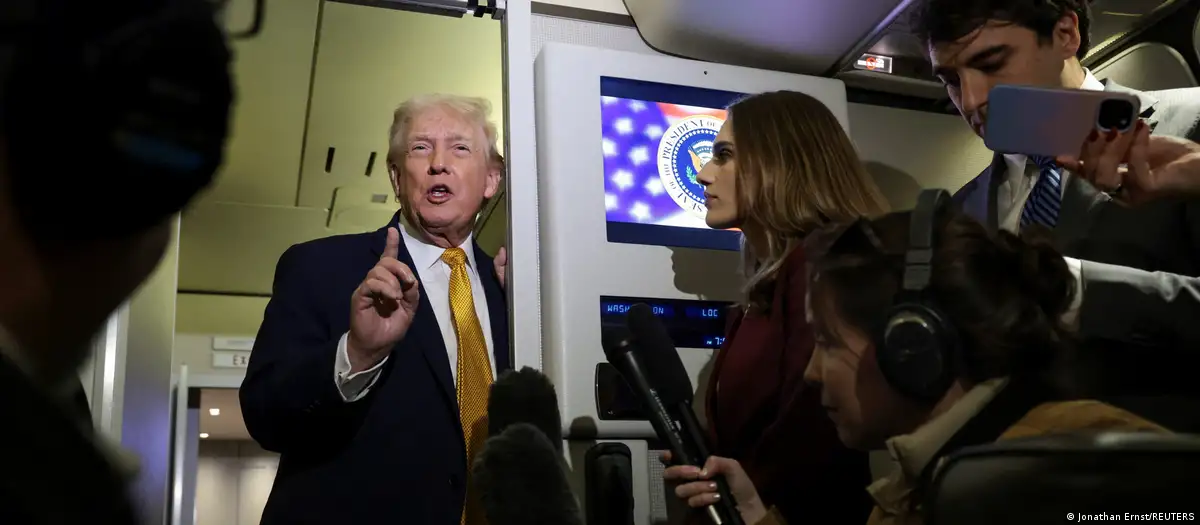
What you need to know
- Nicolas Maduro's second-in-command Delcy Rodriguez has assumed power in Venezuela, a day after his ouster
- Donald Trump again says US is now 'in charge' of the oil-rich South American nation
- Trump has warned that Rodriguez could face tougher measures than the ousted leader 'if she doesn't do what's right'
- Maduro is being held in US federal prison in New York, set to make court appearance on Monday
- Secretary of State Marco Rubio said US fighting drug trafficking networks, not at war with Venezuela
- EU calls for respect of the people's will to restore democracy in Venezuela
These updates are closed. Click here for the latest developments on the US attack on Venezuela and capture of President Maduro
Rodriguez appoints commission to seek Maduro's release
Interim Venezuelan President Delcy Rodriguez has formed a commission to seek the release of President Nicolas Maduro and his wife, Cilia Flores, who were captured by US forces and flown to the United States.
Rodriguez appointed her brother, Jorge Rodriguez, the president of the National Assembly, and Foreign Minister Yvan Gil to co-chair the commission. Information Minister Freddy Nandez will also serve on the commission.
Accused of drug trafficking, terrorism and other crimes, Maduro is due to appear before a federal judge in Manhattan, New York, on Monday at 12 p.m. (5 p.m. UTC) to be formally notified of the charges against him.
What happened on Sunday?
Here are some of the key points related to the fallout on Sunday from the US attack on Venezuela and capture of President Nicolas Maduro:
- US President Donald Trump has said that American oil companies are prepared to enter Venezuela and invest to restore production in the South American country
- US Secretary of State Marco Rubio has insisted that the US is at war with drug traffickers, not Venezuela
- Venezuela's military has endorsed Maduro's vice president Delcy Rodriguez as the country's interim leader
- Rodriguez has appealed for a 'balanced, 'respectful' relationship with the US
- Trump has warned Rodriguez that she could face tougher measures than Maduro 'if she doesn't do what's right'
- Trump repeated his stance that the US is 'in charge' of Venezuela
-
Edmundo Gonzalez Urrutia, Venezuela's opposition leader, has welcomed the removal of Nicolas Maduro
-
But Gonzalez warned that more needs to be done to return the crisis-stricken nation to normal
Delcy Rodriguez calls for 'balanced, respectful' relationship with US
Venezuela's interim president, Delcy Rodriguez, on Sunday called for a "balanced and respectful" relationship with the United States, a day after US forces captured President Nicolas Maduro.
"We consider it a priority to move toward a balanced and respectful relationship between the US and Venezuela," Rodriguez, Maduro's former vice president, posted on Telegram.
"We extend an invitation to the US government to work together on an agenda for cooperation that is aimed toward shared development," she said.
While Trump said Sunday that Rodriguez was "cooperating" with the US, he said he wanted broad US access to Venezuela's oil facilities and infrastructure, adding that she will "face a situation probably worse than Maduro" if she "doesn't do what's right."
Havana says 32 Cubans killed in US attack on Venezuela
The Cuban government has said that 32 of its citizens were killed during the US raid on Venezuela that resulted in the capture of President Nicolas Maduro.
The ousted leader has since been brought to the United States for prosecution on drug trafficking charges.
Havana has declared Monday and Tuesday as days of mourning in honor of the deceased.
In a statement broadcast on Cuban state TV Sunday night, the Cuban government said 32 officers had been killed during the US operation in Venezuela.
The statement added that the Cubans were military and police officers on a mission in Venezuela at the request of the Caracas government.
"Faithful to their responsibilities for security and defense, our compatriots fulfilled their duty with dignity and heroism and fell after fierce resistance in direct combat against the attackers or as a result of the bombings of the facilities," the Cuban government statement said.
While it is unclear what exactly the Cuban officers' mission in Venezuela consisted of, Havana and Caracas are close allies and have for years cooperated in military and policing operations.
Earlier on Sunday, Secretary of State Marco Rubio said on NBC's "Meet the Press" that Cuban officers were with Maduro in Venezuela ahead of his capture.
"He was not guarded by Venezuelan bodyguards. He had Cuban bodyguards," Rubio said.
US President Donald Trump also mentioned that many Cuban guards tasked with protecting Maduro were killed in the operation.
US military action against Colombia 'sounds good', Trump says
US President Donald Trump on Sunday suggested the US could be considering attacking Colombia.
Colombia, Venezuela's neighbor, has boosted security at its border since the US attacks on Saturday morning that resulted in Nicolas Maduro's capture.
In the wake of the US attack on Venezuela, Colombia's leftist President Gustavo Petro, a vocal Trump critic, condemned the strikes as an "assault on the sovereignty" of Latin America.
In an apparent reference to Petro, Trump told reporters on Air Force One on Sunday that: "Colombia is very sick, too, run by a sick man, who likes making cocaine and selling it to the United States, and he's not going to be doing it very long."
Asked whether Washington would pursue military action against Colombia, Trump replied, "It sounds good to me."
Cuba 'ready to fall,' Trump says
US President Donald Trump said on Sunday that US military action in Cuba was unlikely as the country appeared "ready to fall" without involving Washington.
Speaking to reporters aboard Air Force One, Trump said Havana would struggle to hold out without heavily subsidized oil from Venezuela, following the US operation that seized Venezuelan leader Nicolas Maduro.
Trump has said US companies will take over control of Venezuela's oil infrastructure.
"I don't think we need any action. It looks like it's going down," he said, referring to the socialist regime in Havana.
Trump also added that a large number of Cuban security personnel were killed during the operation in Venezuela, saying there had been "a lot of death on the other side, unfortunately."
Trump says US 'in charge' of Venezuela
US President Donald Trump said on Sunday that the United States is "in charge" of Venezuela following the capture of President Nicolas Maduro.
Maduro's vice president Delcy Rodriguez has been named interim president by Venezuela's top court.
Speaking to reporters on Sunday evening on board Air Force One, Trump said, "We're dealing with the people who just got sworn in. Don't ask me who's in charge because I'll give you an answer and it'll be very controversial."
When reporters pressed the US leader on what he meant, Trump replied: "It means we're in charge."
Venezuela opposition leader says removing Maduro is 'not enough'
Edmundo Gonzalez Urrutia, Venezuela's opposition leader, has welcomed the ousting of Nicolas Maduro, by US forces as "an important step."
But he warned that more needs to be done to return the crisis-stricken nation to normal.
"This moment represents an important step, but it is not enough," Urrutia said in an Instagram video post from Spain, where he has lived in exile since fleeing Venezuela in the wake of the 2024 election.
Venezuela's opposition, as well as most Western nations, said Gonzalez had won the election by a landslide, and dismissed Maduro's claims of victory as fraudulent.
Gonzalez added that the country could only return to normal when "all Venezuelans who have been deprived of their freedom for political reasons are released" and when the results of the 2024 election are respected.
Maduro set to appear in US court on Monday
Venezuela's deposed president, Nicolas Maduro, is scheduled to appear before a US federal judge in Manhattan, New York at 12 p.m. (5 p.m. GMT) on Monday to be formally notified of the charges against him.
According to US Attorney General Pamela Bondi, Maduro and his wife Cilia Flores have been charged with:
- Narco-Terrorism Conspiracy
- Cocaine Importation Conspiracy
- Possession of Machineguns and Destructive Devices
- Conspiracy to Possess Machineguns and Destructive Devices against the United States
What does the indictment say?
- The indictment accuses Maduro of leading a 'a corrupt, illegitimate government that, for decades, has leveraged government power to protect and promote illegal activity, including drug trafficking'
- It also says Maduro has been the 'de fact but illegitimate ruler' of Venezuela, where he 'remained in power despite losses in recent elections'
Trump threatens Venezuela's interim president in interview — report
US President Donald Trump has warned Nicolas Maduro's former deputy Delcy Rodriguez that she could face tougher measures than the ousted leader "if she doesn't do what's right."
Rodriguez, who served as Maduro's vice president, has been named interim president by Venezuela's highest court after US forces captured Maduro on Saturday.
"If she doesn't do what's right, she is going to pay a very big price, probably bigger than [President Nicolas] Maduro," Trump said in a phone call with The Atlantic magazine.
The publication did not say what question Trump was responding to with those remarks, nor did it say whether Trump clarified what he meant by "right."
Early Saturday morning, US forces bombed military targets in Caracas and flew Maduro and his wife out of the country.
The Trump administration has said that it is willing to work with the rest of Maduro's government as long as its goals are met.
WATCH: How are people in the US reacting to Maduro's capture?
While Republicans mostly support the operation, there have also been "concerns about legality and precedent," says DW's Washington Bureau Chief Ines Pohl.
Reactions within the Latin American community are also "mixed."
EU calls for peaceful resolution to Venezuela crisis
The European Union on Sunday urged calm and restraint from all parties involved in Venezuela's deepening crisis.
In a statement by High Representative for Foreign Affairs Kaja Kallas, endorsed by all EU member states except Hungary, the bloc said it was important to "avoid escalation and to ensure a peaceful solution to the crisis."
Without mentioning the United States directly, the EU stressed that the principles of international law and the United Nations Charter must be upheld under all circumstances.
"Members of the United Nations Security Council have a particular responsibility to uphold those principles, as a pillar of the international security architecture," the statement said.
The EU reiterated that it does not recognize Nicolas Maduro as Venezuela's legitimate leader but added that "the right of the Venezuelan people to determine their future must be respected."
Brussels said it remains in close contact with the United States and other regional and international partners to facilitate dialogue among all stakeholders. The goal, according to the EU, is "a negotiated, democratic, inclusive and peaceful solution to the crisis, led by Venezuelans."
The bloc also highlighted the shared global priority of combating transnational organized crime and drug trafficking, which the United States has cited as one of the objectives of its military operation in Venezuela.
"These challenges must be addressed through sustained cooperation in full respect of international law and the principles of territorial integrity and sovereignty," the statement said.
The EU called for the unconditional release of all political prisoners currently detained in Venezuela.
Concerns raised over legality of Maduro's seizure
US forces have captured Venezuelan President Nicolas Maduro and flown him to New York on drug and weapons charges.
The Trump administration's "Operation Absolute Resolve" has drawn mixed reactions, while many experts view Maduro's removal, after a disputed 2024 election and political repression, as positive, questions remain over the legality of the US action.
Read more about what the experts had to say by clicking here.
Greenland slams 'disrespectful' pic posted by Trump aide's spouse after Venezuela operation
Greenland and Denmark have pushed back against a controversial social media post by Katie Miller, wife of President Donald Trump’s deputy chief of staff, Stephen Miller.
She shared an image, shortly after a US military operation in Venezuela, of Greenland painted in US flag colors with the word "Soon."
Greenland's Prime Minister Jens-Frederik Nielsen called the post "disrespectful."
"Relations between nations and peoples are built on mutual respect and international law — not on symbolic gestures that disregard our status and our rights," he said.
Denmark's ambassador to Washington also demanded "full respect for the territorial integrity" of Denmark.
While Greenland is part of the Kingdom of Denmark, it has its own government and parliament.
Since returning to the White House for his second term, Trump has repeatedly said he wants the US to annex Greenland, despite firm objections from Greenland, Denmark, and the European Union.
Questions loom over US Venezuela strategy, expert says
The United States military’s capture of Venezuelan leader Nicolas Maduro, executed with what former US ambassador to Panama John Feeley described as "precision, power, and professionalism," has raised questions about Washington’s intentions.
While the raid achieved its immediate objectives, Feeley told DW the political aftermath appears uncertain.
"The power and the professionalism of the US military members who conducted that raid stood in high, high contrast to the imprecision, sort of chaos and uncertainty that the President [Donald Trump] and Secretary [Marco] Rubio presented as the geopolitical future of Venezuela," Feeley said.
Trump suggested the US would temporarily "run" Venezuela, fueling speculation about what happens next.
"I, and no one else, really has a good understanding of what is going to transpire in Venezuela right now."
He said the question should be what Trump wants, and the president has focused heavily on oil, wealth, and domestic politics, signaling that economic interests may drive US strategy.
Feeley added, "Trump sees the [Western] hemisphere as his turf."
"So the implications for the region are very, very serious. I don't think that we're going to see any further attacks, but I do think we're going to see all kinds of pressure."