Oil for cash? Ukraine-Hungary tension continues to escalate
March 13, 2026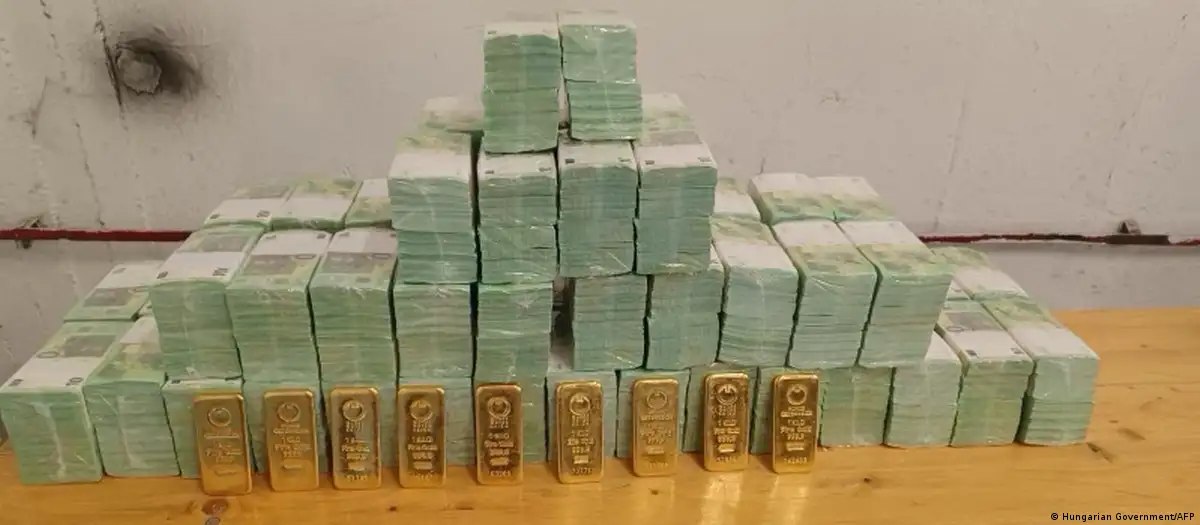
As Hungary enters the final month of its election campaign, the tension between it and Ukraine seems to reach new heights every day.
Hungary's ruling Fidesz party has made anti-Ukraine messages a core pillar of its campaign, claiming Ukraine could meddle in the election and even attack Hungary.
Ukrainian President Volodymyr Zelenskyy, on the other hand, has accused Hungarian Prime Minister Viktor Orban of supporting Russia by all means at his disposal, short of "attacking with missiles or drones."
While Russian oil transfers to Hungary via Ukraine remain interrupted, Hungary is blocking much-needed EU aid for its neighbor. And Budapest is piling on the pressure.
The Hungarian job: law enforcement or 'banditry'?
On March 5, Hungarian special forces stopped two security vans belonging to Ukraine's Oschadbank that were transporting cash and gold from Vienna to Ukraine via Hungary. They also temporarily detained seven Ukrainian citizens.
Hungarian authorities say they acted on suspicion of money laundering.
The Ukrainian bank and its Austrian business partner maintain this was a legal, regular cash transport, prompting Ukraine's President Zelenskyy to accuse Hungary of "banditry."
Millions in cash and gold seized
The detained Ukrainians have since been released and expelled from Hungary.
While the vans were returned to Oschadbank, its precious cargo — cash to the tune of around $80 million (€70 million) in euro and dollar banknotes and 9 kilograms (20 pounds) of gold — remain in the hands of the Hungarian authorities and are unlikely to be returned anytime soon.
A government decree issued on March 9 ordered the cash and the gold to be kept for at least 60 days to allow for an investigation into the "origin, destination, use and purpose" of the assets.
The next day, the Hungarian parliament — where Orban's Fidesz party currently holds a supermajority — passed a law to the same effect.
Legal experts question Hungary's allegations
Right from the outset, there have been concerns about the legality of the seizure of the assets and the accusation of money laundering.
DW put several questions on the matter to the Hungarian authorities. No response had been received by the time of publication.
Miklos Ligeti, head of legal affairs at the Budapest branch of anti-corruption NGO Transparency International, told DW he was skeptical about the money-laundering claims.
"Had this been a real money-laundering operation, then they should have identified suspicious transfers or transaction chains aimed at concealing the origin of the money," he said. "Here, no one wanted to conceal anything about this money."
Retroactive legalization of Hungary's actions?
Ligeti and other legal experts also suspect that the Hungarian government may be trying to legalize its own actions after the fact.
"They are trying to cover unlawful, baseless proceedings against conduct that was not illegal in any way by calling this transport a threat to Hungary's national security," said Ligeti.
Julia Pocze, a legal researcher at the Brussels-based Centre for European Policy Studies, is similarly concerned.
"You can't just create a legal basis retroactively in order to seize this shipment. This is a fundamental legal principle," she told DW.
A violation of EU rule-of-law principles?
Pocze is convinced that Hungary's actions violate EU principles on the rule of law.
When asked by DW about the new legislation, a spokesperson for the European Commission said it "continued to look at the situation closely."
Relations between Ukraine and Hungary have been strained ever since Russian oil deliveries to Hungary via Ukraine were suspended following a Russian attack on the Druzhba pipeline in late January.
Budapest is accusing Ukraine of deliberately blocking oil deliveries as a means of interfering in the Hungarian election. The seizure of the assets appears directly linked to that dispute.
Tit for tat
"Obviously our steps were not independent of the closing of the pipeline," Hungary's Transport Minister Janos Lazar said at a public event on March 9 that was streamed on his YouTube channel.
Such comments cast doubt on the legal rationale behind the asset seizure.
"The statement that if Ukraine blackmails Hungary via the Druzhba pipeline, Hungary will blackmail it back, clearly shows that the government is playing a political game," said Transparency International's Miklos Ligeti.
Ukraine has blamed repair delays on the ongoing war, and President Zelenskyy has stated outright that he has shared with European leaders his reluctance to repair the pipeline, saying repairs would only be possible during a ceasefire.
Hungary's ruling party targets Ukraine
With Orban and his Fidesz party trailing in the polls ahead of April's parliamentary election, the government is doubling down on portraying Ukraine as a threat to Hungary's energy security and safety.
Orban's government has dispatched what it calls a fact-finding mission to Ukraine to assess the state of the Druzhba pipeline.
Ukraine, on the other hand, says that no official visits are scheduled and that it is, consequently, treating the members of the mission as "tourists," according to reports in Ukrainian media.
The European Commission told DW that it was not involved in the planning of the mission but is itself working on setting up a fact-finding group that would involve all affected parties.
As both sides continue to ratchet up the rhetoric, the actual state of the Druzhba pipeline and the fate of both Ukraine's seized assets and the EU's planned defense loan to Ukraine remain unclear — at least for now.
Edited by: Aingeal Flanagan