North Korea's new constitution deepens split with Seoul
May 18, 2026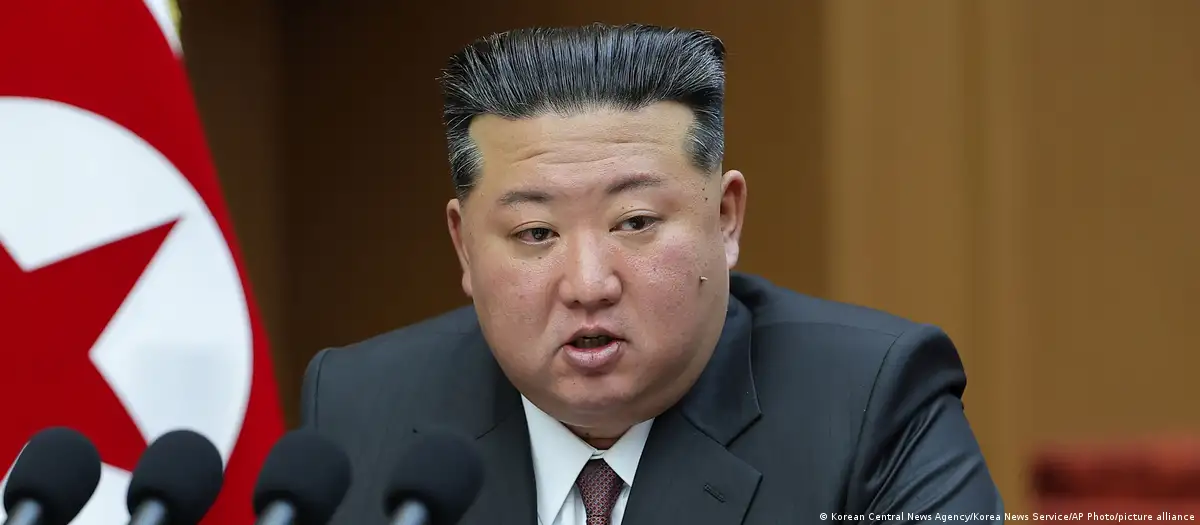
North Korea's amended constitution has removed any reference to reunification with South Korea and to a shared Korean national identity, formally framing Seoul as a "hostile state."
The changes, which leader Kim Jong Un had signaled at a Supreme People's Assembly in March, are a major policy departure for North Korea, which has technically remained at war with its southern neighbor since an armistice in 1953 halted hostilities in the Korean War.
What has changed with North Korea's revised charter?
The new constitution, distributed by South Korea's Ministry of Unification on May 6, has four major changes:
- The goal of reunifying the Korean peninsula has been officially abandoned, and South Korea is no longer viewed as part of a shared national community
- A new territorial clause has been introduced, defining North Korea as a country bordering China and Russia to the north and the Republic of Korea to the south
- Kim Jong Un has been given exclusive authority over the use of nuclear weapons
- Clauses related to the achievements of his predecessors, Kim Il Sung and Kim Jong Il, have been removed
The shift contrasts with South Korea's constitution, which claims the entire Korean Peninsula and its islands as its own territory.
Article 9 of the former constitution stated that North Korea would "strengthen the people's government in the northern half" and "strive to achieve national reunification." References to the so-called "Three Principles of National Reunification" — independence, peaceful reunification and national unity — have also been removed.
Kim had already started shifting course in late 2023, when he called Seoul the "main enemy." He later ordered the demolition of a major reunification monument in Pyongyang.
At the Supreme People's Assembly in January 2024, Kim called for a constitutional amendment that defined South Korea as the North's "primary foe and invariable principal enemy," stating that North Korean territory was separate from that of the South.
South Korea redefined as foreign enemy, not reunification partner
Hong Min, a senior researcher at the state-run Korea Institute for National Unification, framed the changes as an extension and formal adoption of the doctrine of a "struggle against the enemy" and of the two Koreas as "two hostile states" that Pyongyang has pursued since the collapse of the 2019 US-North Korea summit in Hanoi, Vietnam.
North Korea is moving toward redefining South Korea not as a partner for reunification, nor as part of the same ethnic community, but as a separate, hostile foreign power, Hong explained during a forum on North Korea's constitutional amendment held at South Korea's National Assembly on May 13.
He said removing talk of reunification language points to a shift toward a state-to-state relationship shaped by hostility, territorial separation and nuclear deterrence.
Cha Du Hyeon, vice president of South Korea's Asan Institute for Policy Studies, told the forum that North Korea's "two hostile states" doctrine is not merely a diplomatic expression, but a structural choice linked to the Kim regime's internal governance, power preservation and strategy toward South Korea.
By portraying South Korea as an external enemy, Cha said, Pyongyang seeks to contain internal dissent, reinforce the logic of regime security when it feels vulnerable, and use hostility toward Seoul as a pretext for provocation when conditions are favorable.
Cha noted, however, that the term "hostile relations" does not appear in the amended constitution. He said this may reflect Pyongyang's awareness that constitutions rarely, if ever, explicitly define relations with a specific country as hostile.
Instead, Kim stated at a Supreme People's Assembly in March that North Korea officially recognizes South Korea as a hostile state, while the removal of the concept of reunification also signals a shift to a more antagonistic relationship with Seoul.
Ambiguity over maritime borders
Hong said the new territorial clause could be viewed as North Korea's de facto acceptance of the Military Demarcation Line, or MDL, as a border between the two countries.
However, he said it should not be read as a clear recognition of the Northern Limit Line, or NLL, the disputed maritime boundary in the Yellow Sea.
That ambiguity, he warned, could give Pyongyang room to act more aggressively in future maritime disputes.
Han Ki Bum, a former deputy director of South Korea's National Intelligence Service (NIS), told DW that although North Korea's amended constitution does not explicitly define maritime boundaries, there are concerns about possible provocations near the NLL, especially after North Korea's additional deployment of destroyers to the Yellow Sea earlier in May.
Kim Jong Un's consolidation of personal power
"By enshrining Kim Jong Un's exclusive right to use nuclear weapons in the amended constitution, they have codified the theory of two hostile states and the consolidation of Kim Jong Un's one-man dictatorship," Han said.
Cha also said the amendment emphasizes that Kim is the only person authorized to deploy conventional and nuclear forces in the event of a crisis. He said this gives Pyongyang a stronger foundation for future negotiations with South Korea and other countries.
Regarding the removal of references to the achievements of the current North Korean leader's grandfather, Kim Il Sung, and father, Kim Jong Il, Hong said the previous constitution had been so heavily centered on the achievements and deified rule of Kim Jong Un's predecessors that it was often referred to as the "Kim Il Sung-Kim Jong Il Constitution."
In the amendment, however, the focus has shifted toward a national narrative centered on the state, territory, sovereignty and nuclear capabilities.
While this may appear to be an attempt by North Korea to present itself as a more conventional state, Hong said it is in reality a move to further strengthen Kim's personal power.
Edited by: Karl Sexton