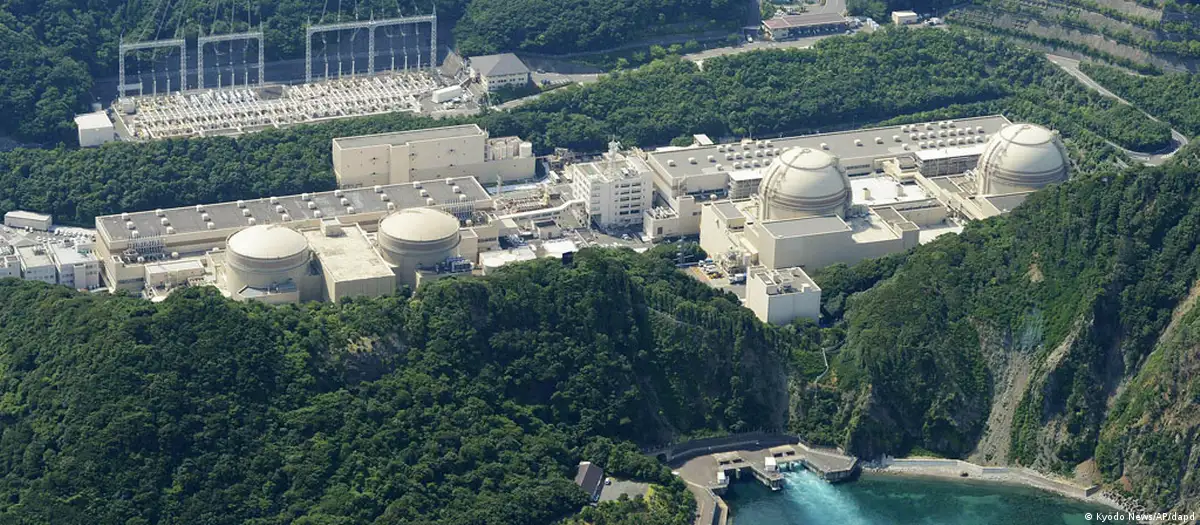
A local Japanese governor approved the restart of two nuclear reactors near Kyoto, officials said on Monday, clearing the final regulatory hurdle for the revival of the power plants early next year.
Fukui Province governor Issei Nishikawa gave the green light to operator Kansai Electric, which plans to restart reactors three and four of the Ohi nuclear plant.
The decision comes in spite of long-running opposition to atomic activity in the country.
"I have agreed to the resumption of the reactors after considering all the various factors," Nishikawa said in a press briefing.
-
Fukushima's long shadow
Tohoku earthquake and tsunami
It was the worst disaster in post-war Japanese history. Four years ago, a massive 9.3-magnitude undersea earthquake erupted off the coast of the Tohoku region, triggering a tsunami that devastated the northeastern coast of Japan, taking the lives of at least 15,880 people and leaving another 2,694 missing. Some 6,135 people were injured.
-
Fukushima's long shadow
Fukushima meltdown
But the natural disaster turned into a manmade one when a 13-meter (43-foot) tsunami hit the Fukushima Daiichi nuclear power plant. The plant's cooling systems failed, leading to overheating in three reactor cores, and radiation leaks. About 20,000 people were evacuated, while some 80,000 additional cancer cases could surface due to radiation exposure. Cleanup could take 30 years.
-
Fukushima's long shadow
Three Mile Island
The Fukushima disaster was not without precedent. In 1979, the Three Mile Island nuclear plant near Middletown, Pennsylvania, underwent a partial nuclear meltdown. Feedwater pumps stopped sending water to the steam generator that cooled the reactor core, and a malfunctioning valve allowed cooling water to pour out. Some 140,000 children and pregnant women were evacuated from the area.
-
Fukushima's long shadow
The legacy of Chernobyl
Until Fukushima, the Chernobyl disaster was the worst nuclear accident in history. In 1986, a sudden power surge at Unit 4 of the Chernobyl plant in Ukraine destroyed the reactor, releasing a radioactive cloud that spread over Russia and Europe. A 30-kilometer area was sealed off and some 335,000 people were evacuated, while at least 30 people died as a result.
-
Fukushima's long shadow
New US nuclear plant
Finishing touches are being completed at the Watts Bar Unit 2 plant in Tennessee, after a long delay due to low regional power demand. Its sister plant, Watts Bar Unit 1, was the latest nuclear plant to go online in the United States, in 1996. Further new nuclear plants are planned for the US - which sees atomic energy as a viable alternative to fossil fuels.
-
Fukushima's long shadow
Germany's atomic buffer
Even in Germany, with its strong anti-nuclear movement, Chancellor Angela Merkel's center-right coalition originally sought to delay the country's nuclear phase-out date from 2022 to 2034. The 2022 goal had been set by Merkel's center-left predecessor, Chancellor Gerhard Schröder. Merkel's coalition justified the delay by claiming that it was a buffer in the transition toward renewables.
-
Fukushima's long shadow
Merkel backpedals on nuclear
But after the Fukushima disaster in March 2011, Berlin reacted quickly by permanently shutting down eight nuclear plants. Merkel's coalition then decided to completely phase out atomic power by 2022, readopting the date originally set by Schröder. Germany has set a goal of 80 percent renewables by 2050 - the country recently reached the 27 percent mark in renewable energy production.
-
Fukushima's long shadow
Italians uphold nuclear ban
Like Germany, Italy also has a long history of anti-nuclear activism. After the Chernobyl disaster, Italians voted in 1987 to ban nuclear power. But in 2011, then-Prime Minister Silvio Berlusconi sought to reintroduce atomic energy. The question was put to Italians in a referendum, who again voted down atomic energy.
-
Fukushima's long shadow
The UK's nuclear future
In the United Kingdom, the Conservative-Liberal coalition is also seeking to promote nuclear to reduce greenhouse gas emissions. But the approved Hinkley Point C plant in Somerset (pictured above) - which would be the newest since 1996 - faces a legal challenge over use of state aid for construction. A recent estimate put the total cost of Hinkley C at 24.5 billion pounds (34.4 billion euros).
-
Fukushima's long shadow
India expands atomic reach
New Dehli is planning to quadruple its nuclear capacity by 2020, relying on atomic energy to supply 25 percent of its electricity. But the plan has sparked fierce opposition. Demonstrators have repeatedly interrupted construction work at the Kudankulam Nuclear Power Plant, which was built with Russian support. Russia has also offered to build a dozen more nuclear power reactors in India.
-
Fukushima's long shadow
China looks beyond coal
Beijing is seeking a more modest rise in its nuclear capacity. The People's Republic plans to generate 6 percent of its electricity through atomic power by 2020, compared to just 2 percent currently. The Changjiang Nuclear Power Plant, pictured above, is currently under construction in Hainan province. Nuclear power could reduce China's dependence on heavily polluting coal plants.
-
Fukushima's long shadow
France banks on nuclear
France depends on atomic energy for 75 percent of its electricity. Although President Francois Hollande had pledged to reduced the country's dependency on nuclear, only one power station - an aging plant on the German border (pictured above, with protest banner) - has been earmarked for closure. In the meantime, France's 20 nuclear reactors continue to hum away - at Europe's core.
Author: Spencer Kimball, Sonya Angelica Diehn
Public support for nuclear power dropped in the wake of the 2011 Fukushima disaster, after which Japan shut down all its nuclear operations.
The Ohi plant, located on the Sea of Japan coast, is about 60 kilometers north of Kyoto, the former Imperial capital of Japan. Its reactors three and four were taken offline in 2011, and briefly restarted in 2012, but have not been used in years.
For a while they were the only nuclear reactors operating in the country.
Read more: Six years after Fukushima - women and children still suffer most
"Persistent concerns"
Japan shut down all of its atomic reactors in 2011 after a powerful earthquake triggered a tsunami that led to meltdowns at the Fukushima nuclear plant.
The quake and flooding knocked out power for the plant's cooling systems, sending three of the six reactors into partial meltdown.
It was the world's worst nuclear accident since Chernobyl in 1986. Last month a Fukushima court ruled the plant operator Tokyo Electric Power Company (TEPCO) and the Japanese government were liable for damages.
Public opposition has seen only a handful of reactors come back into usage since the tsunami, as legal cases work their way through the courts. Only five of Japan's 43 operational nuclear reactors are currently online.
Residents in the local prefectures of Kyoto and Shiga have repeatedly expressed opposition to the restart of the reactors.
Shiga province governor Taizo Mikazuki raised objections to the reboot of the reactors, Japanese media reported on Sunday, citing concerns about contingency plans.
"We're not in an environment that allows us to agree to the restarts of the reactors, in view of persistent concern among the residents of our prefecture,” Jiji Press reported Mikazuki as saying.
Japan's reluctance to use nuclear energy has hampered its efforts to switch away from fossil fuels.
A review of Japanese energy usage by the International Energy Agency (IEA) found the Fukushima disaster had "dominated" Japanese energy policy in recent years.
"One consequence of the accident was a gradual shutdown of all nuclear power plants, which has led to a significant rise in fossil fuels use, increased fuel imports and rising carbon dioxide emissions," the IEA wrote.
an/rt (dpa, Reuters, AFP)