Germany: Neighbor attacked for pounding schnitzel too loudly
Published April 18, 2026last updated April 19, 2026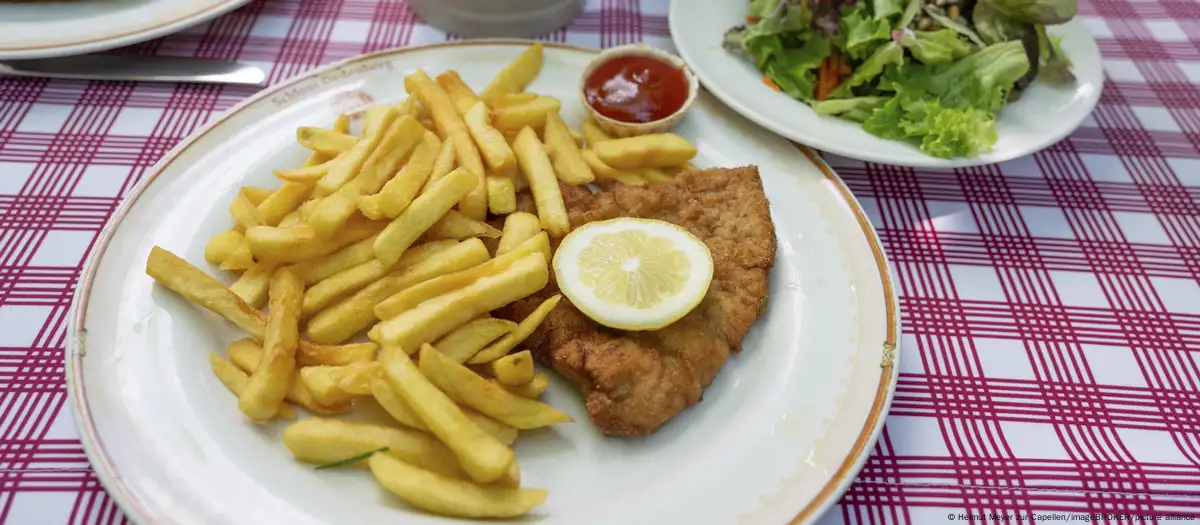
What you need to know
- Police were called in when a man attacked a neighbor over allegedly preparing schnitzel too loudly
- Interior Minister Alexander Dobrindt says the Iran war has so far not triggered a wave of migration to Europe
- Antisemitism commissioner Felix Klein has called on festivals to make a stand against what he says is rising antisemitic rhetoric in the cultural sector
- Police are investigating an explosion in an underpass in the town of Völklingen that killed one man and wounded four others
This blog is now closed. Below is a roundup of the top headlines from Germany on the weekend of April 18-19, 2026:
Merz to convene National Security Council on energy crisis
German Chancellor Friedrich Merz said he would "soon" convene the National Security Council to address the country's energy situation.
Speaking at the opening of the Hannover Messe trade fair, Merz said the aim was to ensure the reliable supply of key fuels such as diesel, petrol and aviation kerosene.
"The situation is tense, but supply is secure. If conditions worsen, we are prepared to act," he said.
The National Security Council brings together members of the federal government and security agencies. It may also include representatives from state governments.
Merz stressed that safeguarding supply chains remains a top priority and that the government would use "all available instruments" to maintain stability.
Olympic bid wins strong public support in Rhine-Ruhr region
A majority of people in Germany's Rhine-Ruhr region on Sunday voted in favor of their region bidding to host the Summer Olympic and Paralympic Games, to be held either in 2036, 2040, or 2044.
Around 1.4 million people participated in the vote, which is about one-third of eligible voters.
"I am thrilled by these results," said Hendrik Wüst, the state premier of North Rhine-Westphalia (NRW).
NRW is now the second region, after Munich, to receive the backing of its citizens to stage the games.
Hamburg will vote at the end of May, while Berlin has decided against holding such a vote.
Also on Sunday, Kiel, the capital of the northern state of Schleswig-Holstein, announced that 63.5% of eligible voters there voted in favor of the city's plans to serve as a sailing venue during the games.
"This is good for sports and for this country as a whole. This is exactly the momentum we need," Otto Fricke, CEO of the German Olympic Sports Confederation (DOSB), told German broadcaster WDR regarding the "yes" votes from North Rhine-Westphalia and Kiel.
Merz, Lula defend multilateralism, hail EU-Mercosur deal
German Chancellor Friedrich Merz on Sunday hailed the EU-Mercosur trade deal as he opened the Hannover Messe trade fair, with Brazil's President Luiz Inacio Lula da Silva as a guest of honor.
Merz noted that the agreement, which has been in the works for more than 25 years, would "make all the economies involved stronger, more independent and more resilient".
"This shows that we are sticking to the multilateral order, that we want a rules-based economic system, and that we want this cooperation with as few tariffs as possible — ideally none at all," Merz said.
Taking an indirect jab at US President Donald Trump, Lula framed the EU–Mercosur trade deal as a response to tariffs and other trade protectionism.
"Faced with unilateralism, Mercosur and the European Union have chosen cooperation," Lula said.
"We cannot allow the world to bow to the behavior of a president who thinks that by e-mail or by Twitter he can tax products, punish countries and wage war," he added.
According to Lula, the deal, which is set to take provisional effect on May 1, will create "a market of almost 720 million people and a GDP of $23 trillion."
Chancellor Merz welcomes Brazil's Lula da Silva in Hannover ahead of top-level consultations
Brazilian President Luiz Inacio Lula da Silva is set to open the Hannover Messe trade fair together with German Chancellor Friedrich Merz on Sunday evening, as their two nations seek to ramp up ties.
Merz welcomed Lula da Silva with military honors at the Herrenhausen Palace on Sunday ahead of a one-on-one meeting. The two are due to open the Hannover Messe, one of the biggest industry trade fairs in the world, and also have dinner with business representatives.
On Monday, the governments of Germany and Brazil are to hold top-level consultations, with seven Brazilian ministers joining talks with eight German Cabinet members. The two countries hope to boost cooperation in areas including defense, climate protection, digitalization and research.
Foreign policy is also likely to be on the agenda as US-driven global unrest irritates governments on both sides of the Atlantic Ocean.
"Trump was not elected emperor of the world," Lula told Germany's Der Spiegel magazine ahead of his visit. "He cannot constantly threaten other countries with war."
Police called in to settle schnitzel dispute gone violent
A dispute over the preparation of a schnitzel turned violent in the Bavarian town of Geiselhöring, prompting the police to intervene.
A 61-year-old man verbally and physically assaulted his neighbor over what he said was a loud pounding of the meat involved in making the schnitzel, Germany's DPA news agency reported.
The older man went to the neighbor's flat in an apartment block on Saturday evening, insulting him and slapping him on the face, police said.
It was not clear if the alleged loud pounding occurred during Germany's legally mandated "quiet hours," generally between 10:00 p.m. and 06:00 a.m.
Driver dies in crash during Nürburgring 24 Hour qualifier
A driver died and six others were injured in a serious crash during a qualifier for Germany's Nürburgring 24 Hours race.
Organizers said emergency services were unable to save Juha Miettinen, who was rescued from his vehicle following the seven-vehicle pile-up, which happened early in the brutal endurance race.
The 66-year-old Finnish national died in the medical center on site.
The other drivers were taken to the hospital with injuries that were not life-threatening, officials said.
The FIA motor racing association wrote of its shock at the death, saying, "Our thoughts are with his family and friends and everyone involved in the event."
Organizers called off the rest of Saturday's race and called for a minute’s silence during Sunday's grid formation.
This year's Nürburgring 24 Hours will take place on May 14-17 at the famous Nürburgring circuit in western Germany.
The race has drawn additional attention after the cancellation of F1 races in Bahrain and Saudi Arabia due to the Iran war.
Four-time F1 world champion Max Verstappen is making his debut this year in a Mercedes-AMG GT3.
Verstappen was not on track at the time of the accident. His car, driven by team-mate Lucas Auer, was not involved in the crash.
The Dutch-Belgian driver expressed his shock at the death on Instagram, saying:
"Motorsport is something we all love, but in times like these, we are reminded of how dangerous it can be."
Verstappen offered his condolences to Miettinen's family.
Germany condemns UNIFIL attack, calls for Hezbollah to lay down arms
The German government has condemned an attack on a UN peacekeeping force mission (UNIFIL) in Lebanon that left a French peacekeeper dead and three wounded, two of them seriously.
"Our heartfelt condolences go out to the family and friends of the fallen soldier," the German Foreign Office said in a post on X.
It called for those responsible for the attack to be held accountable.
The statement also demanded that the Iran-linked Shiite militant outfit Hezbollah lay down its weapons.
Tens of thousands call for faster energy transition across Germany
More than 80,000 people took part in rallies in several major German cities on Saturday.
Organizers said around 30,000 people demonstrated in Cologne, 24,000 in Berlin, 15,000 in Hamburg, and 12,000 in Munich.
In their call to action, organizers warned: "Escalating energy prices, geopolitical crises, and authoritarian regimes show how risky fossil fuels are."
They added that the demonstrations sent a "clear signal" to Economics Minister Katherina Reiche, who has been criticized for proposed legislation that could slow the expansion of renewable energy.
In Munich, Martin Geilhufe, the state chairman of Friends of the Earth Germany, described Reiche's grid package as "part of a concerted all-out attack on nature, the environment, and the climate."
He said the federal government must not hinder the expansion of wind and solar power.
New poll shows far-right AfD ahead of CDU/CSU
According to a new poll, the far-right Alternative for Germany (AfD) has widened its lead over Chancellor Friedrich Merz's conservative bloc, CDU/CSU.
In the latest "Sunday Trend" survey conducted by the INSA Institute for the Bild newspaper, the AfD gained one point to reach 27%, while the CDU/CSU fell one point to 24%.
This marks the largest gap ever recorded in an INSA "Sunday Trend" poll, according to Bild.
Support for the former "traffic light" coalition — named after the parties' colors — remains unchanged: the center-left Social Democrats (SPD) stands at 14%, the Greens at 13% and the business-focused Free Democratic Party (FDP) at 3%.
The Left Party rose to 11% while the populist-left BSW dipped to 3%.
In the ZDF Politbarometer published on Friday, the AfD also emerged as the strongest party for the first time.
Germany ready for Security Council reform — vice chancellor
The German vice chancellor and finance minister, Lars Klingbeil, has said Germany is ready for a reform of the United Nations' Security Council.
Klingbeil said that "structural reform" of the UNSC had been a clear message at a summit of progressive world leaders in Barcelona he has been attending on Saturday.
German train stations to receive €4 billion a year for renovations up to 2030
German train stations are to be modernized and renovated to the tune of €20 billion ($23.55 billion) over the next five years, with the money spent on improving appearance, safety and security.
"The train stations are particularly important to us," said the chief executive of national rail operator Deutsche Bahn (DB), Evelyn Palla.
"They are a visiting card, not just for us, but also for cities and municipalities," she said, adding: "We clearly have some catching up to do."
She said more than 1,000 stations across the country would be modernized this year at a cost of €4 billion.
Another 710 train stations across Germany will be completely made over by 2030, 130 of them this year, according to Palla.
She said an additional €50 million would be invested in improving safety and cleanliness.
The company says this will include equipping more stations with cameras and video surveillance in coordination with federal police.
Experts say the many problems with Germany's rail network, including dilipidated stations and frequent delays, are the result of decades of underinvestment in infrastructure, which the current coalition government pledged to reverse.
However, there have been reports that some of those pledges might not be fulfilled.
Germany 'setting an example' for allies in defense — NATO chief Rutte
NATO Secretary General Mark Rutte told German newspaper Die Welt that Berlin was helping lead the way in efforts for European allies to step up their military capacities.
But he also dismissed speculation Washington could leave the US-led alliance after Donald Trump lashed out at it for what the US president considered to be a lack of support in the war with Iran.
Click here for more on Rutte's comments on NATO, Trump and Europe.
Finance minister warns on kerosine, calls for faster shift from fossil fuels
German Finance Minister Lars Klingbeil has said authorities must take steps to counter an imminent shortage of kerosine — used for aviation fuel — amid the Iran war and called on the coalition goverment to accelerate the transition to renewables.
Klingbeil, who is also vice chancellor and the co-leader of junior governing coalition partner the Social Democrats (SPD), told the news magazine Spiegel: "We must take the warnings of a kerosine shortage very seriously."
"For me, it's clear: We shouldn't just address the price problem but must also keep security of supply in mind at all times."
"We are in a situation that is similarly challenging to the energy crisis following the Russian invasion of Ukraine," he said.
"We need to make the country more resilient, less dependent on fossil fuel imports," he added.
The International Energy Agency warned on Friday that European countries could face a kerosine shortage in the next six weeks, with imports from the Middle East severely hampered by the war and much oil infrastructure damaged in the conflict.
Kerosine prices have more than doubled since the start of the war on February 28.
READ: Teen makes sensational historical find in Berlin
A 13-year-old boy has discovered a 2,300-year-old coin coming from ancient Troy in a field in the German capital.
The find, rare for Germany, helps to cast light on the links that existed between Ancient Greece and northern Europe.
You can read more about the excitement caused by the discovery here:Teen discovers first ancient Greek artifact found in Berlin
Explosion kills one, wounds four in western German town
German police say an explosion in a pedestrian underpass in Völklingen in the early hours of Saturday morning has killed one man and seriously wounded four others.
Two of the men were said to have suffered life-threatening injuries in the blast, which investigators said was caused by "human action."
They initially gave no more details.
Völklingen is a town of about 40,000 people situated a few kilometers (miles) west of Saarbrücken, the capital of the state of Saarland, which borders France.