Germany news: Merz on Gulf tour talks arms deals in Doha
Published February 5, 2026last updated February 5, 2026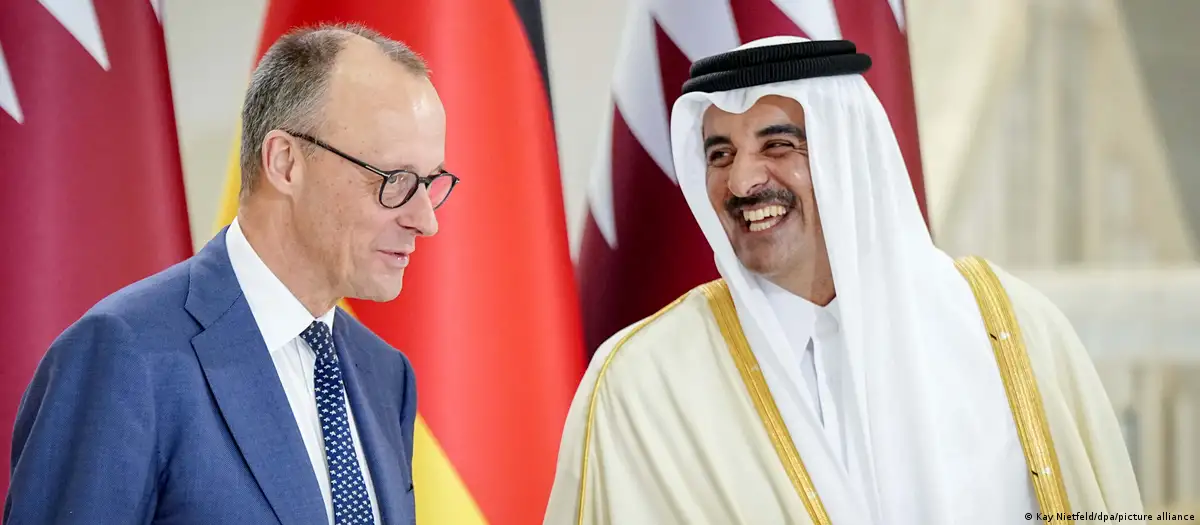
What you need to know
- Chancellor Friedrich Merz is in Doha on his second stop of a three-day visit to the Gulf region
- On Wednesday, Merz met with the Saudi Crown Prince seeking 'new level' in ties
- German factory orders jumped by a surprising 7.8% in December
These updates have been closed. Thank you for reading.
Below, you can review DW's coverage of news from Germany from Thursday, February 5.
Danone recalls tons of infant formula in Germany, Austria over toxin contamination
Danone is recalling hundreds of tons of infant formula in Germany and Austria over a toxin contamination, the company and Austrian health authorities said Thursday.
The French food giant is recalling batches of Aptamil and Milumil formula because the Cereulide toxin was detected in ingredients from a supplier in China, which also supplies other infant formula-makers, such as Nestle and Lactalis.
The Cereulide toxin can cause nausea, vomiting and diarrhea.
Several hundred tons of formula are affected by the recall, including more than 120 tons of Aptamil and Milumil in Austria and Germany. Products in France, Hungary, Poland, Romania and Switzerland are also affected by the recall.
In a statement, Danone said: "We want to reassure all parents: our infant formulas are safe. All of our baby formulas are produced in accordance with strict food safety norms and undergo rigorous controls before leaving our factories."
Memorial service held for German train conductor killed in attack
The state premier of Rhineland-Palatinate has called for greater respect towards workers in public roles after a train conductor died after he was attacked by a passenger without a ticket.
The attack occurred Monday night near the town of Kaiserslautern and made headlines across Germany.
The remains of the victim, identified as Serkan C., were taken to Turkey for burial after funeral rites were performed at a mosque in Ludwigshafen.
"He was a friend, he was a neighbor, he was a colleague, he was a resident of Ludwigshafen," Schweitzer said outside the mosque on Thursday.
Schweitzer called for greater civic courage and more respectful interactions across society.
"It didn't start with this act," said. "It starts with insults."
According to Germany's national railway operator Deutsche Bahn, there were roughly 3,000 assaults against employees in 2025 — roughly eight per day.
Germany eyes arms exports to Gulf region, says Merz in Qatar
In Qatar on Thursday, Chancellor Friedrich Merz signaled Germany would be willing to increase arms exports to countries like Qatar and Saudi Arabia as "reliable cooperation partners."
Merz is on a three day tour of Gulf states along with the CEOs of German energy company Uniper, and Diehl Defense, among others, to explore potential oil, gas and arms deals as part of a push to attract more business to Germany as US tariff policies, and high energy prices in Europe, put pressure on the economy.
Speaking to reporters in Doha, Merz said Germany would work "more intensively in arms cooperation than in recent years" with partners in the Gulf region.
Merz added Germany aims to import more liquefied natural gas from Qatar.
"This is in our mutual interest, because we want to ensure that the world becomes safer, and it will only become safer if we are able to defend ourselves," he told journalists.
The chancellor emphasized that Germany would not be exporting arms without oversight.
"This does not mean that we will now supply all arms to all countries completely unchecked. Each case will still be reviewed individually," he said, adding that Germany had already begun loosening its restrictive arms export policy last year, including with the export of Eurofighter jets to Saudi Arabia.
Previous German governments have held back on exporting arms to autocratically governed Gulf states, citing human rights concerns and regional conflicts like the war in Yemen. Saudi Arabia had been subject to a years-long arms export ban.
Fire damages German heavy ion research center in Darmstadt
Residents in the city of Darmstadt, located south of Frankfurt, were advised to windows and doors closed Thursday morning as firefighters worked putting out a blaze at the GSI Helmholtz Centre for Heavy Ion Research.
Firefighters and officials at the center said the fire caused extensive damage to the property, but no one was injured.
The GSI Helmholtz Center for Heavy Ion Research in the Wixhausen district of Darmstadt is known for its ion accelerator facility. It is used for experiments to gain insights into the structure of matter and the evolution of the universe.
A spokesperson said a short circuit occurred during preparations to power up the facility at a transformer station, involving its high-voltage power supply.
A new accelerator complex is under construction at the site. The center said this project was not directly affected by the fire, but added that the full extent of the damage had yet to be determined.
Firefighting operations are expected to continue into Thursday evening, with approximately 160 emergency personnel from Darmstadt and the surrounding region deployed to the scene.
Police investigators are scheduled to begin a probe into the cause of the fire once the area is declared safe.
The fire department said no hazardous substances have been detected in the air so far.
Merz in Gulf deflects Iran criticism amid concern over military escalation
Speaking in the Qatari capital Doha on Thursday, German Chancellor Merz called on Iran to "truly enter talks" on ending its nuclear program ahead of a planned meeting with US envoys.
"Talks will therefore be intensified in the next hours," Merz said, adding that Germany was "coordinating closely" with the US.
"The concern about a military escalation in the region is great," Merz said, while calling on Tehran to end "aggression" and "spare countries like Qatar, Jordan and Israel from further military threats."
Tensions are running high after US President Donald Trump last month repeatedly threatened Tehran's leadership with military strikes, partly in response to a brutal crackdown against demonstrators during recent mass protests.
On Wednesday, before embarking on his first trip to the Gulf region, Merz said Germany was "ready to increase the pressure on Tehran."
On Thursday, Iranian Foreign Minister Abbas Araghchi criticized Merz on X, accusing him of "political naivety" and having a "distasteful character."
"It is therefore doubly regrettable that an individual such as Mr. Merz now represents Germany on the world stage," Araghchi said, while calling Germany an "engine of regression."
"I have seen this tweet and can only say it seems to be a sign of great nervousness and insecurity," Merz said in response.
Merz seeks 'new level' of Saudi ties, delegation says
German Chancellor Friedrich Merz met with Saudi Crown Prince Mohammed bin Salman in Riyadh for more than two hours on Wednesday, with members of the German delegation telling DPA news agency on Thursday morning that the talks were "warm and open" and that Merz wants to take ties with Saudi Arabia to a "new level."
The sit-down with the crown prince kicked off Merz's three-day tour of the Gulf region, where the chancellor hopes to build partnerships centered on security, energy and infrastructure.
Merz's delegation said the talks with the crown prince covered energy, defense, AI, and geopolitical concerns like tensions in Iran and Syria.
The visit to the Gulf region comes as Germany seeks to diversify its partnerships away from China, and a mercurial US under President Donald Trump.
Germany is also eyeing access to energy supplies like liquefied natural gas and hydrogen, as Russian oil and gas remain taboo with Moscow continuing its war in Ukraine.
Other areas that could create jobs include defense cooperation and investment from wealthy Gulf states in Germany, which currently has the highest unemployment rate seen in 12 years.
On Thursday, after meeting Qatari Emir Tamim bin Hamad Al Than in Doha, Merz said "In a time of global economic upheaval, geopolitical uncertainties and technological transformation, Germany and Qatar are consciously focusing on dialogue diversification and investments in the future."
Ahead of the trip, Merz had said he would raise human rights concerns while visiting with the Saudi crown prince, while also admitting that the issue no longer played as prominent a role in relations as it has in the past.
Saudi Arabia is notorious for its treatment of women and a draconian justice system. In 2018, the brutal murder and dismemberment of Saudi journalist and crown prince critic Jamal Khashoggi at the Saudi consulate in Turkey shocked the world. Western intelligence agencies like the CIA asses Khashoggi was killed at the behest of the crown prince, who has denied all involvement. According to Human Rights Watch, Saudi Arabia carried out a record number of 356 executions in 2025.
Reuters news agency reported Thursday that Merz said he had discussed human rights, but "these are issues that play a role in discussions behind closed doors," he told journalists.
Russia expels German diplomat in tit-for-tat move
Russia has expelled a German diplomat in what it called a symmetrical response to Germany's decision in January to expel a Russian diplomat over suspected spying.
Russia's Foreign Ministry said it had declared a staff member of the German embassy in Moscow persona non grata. It said the move was a "symmetrical reaction" after Berlin expelled a Russian diplomat on January 22.
Moscow accused Germany of bearing "full responsibility for the new escalation in bilateral relations" and dismissed the spying allegation as "unfounded," saying Berlin had developed a "spy mania."
Germany said in January it expelled a Russian diplomat who was suspected of acting as a contact in an espionage case. A German-Ukrainian woman had previously been arrested on suspicion of spying for Russia.
Stuttgart hit by major power outage
A large power outage has struck parts of Stuttgart, police have said, leaving some traffic lights out and prompting officers to regulate traffic at major intersections.
Police said patrols were dispatched after signals failed across parts of the city, adding that the cause was not yet known.
A fire service spokesperson said there were several callouts triggered by fire alarm systems, but no active fire incidents so far. The fire brigade itself was also affected by the outage and was still assessing the situation.
Internet service temporarily went down in many offices, while grid operators initially could not provide details.
Passengers also reported disruptions to Stuttgart's city rail network. One witness told German news agency DPA she was on a train that stopped for several minutes, with an announcement saying there was a power outage and service would resume shortly.
Deutsche Bahn said S-Bahn and regional rail services were not affected.
Stuttgart has a population of about 600,000 and is the capital of the German state of Baden-Württemberg.
Germany sees lowest number of marriages since 1950
The number of marriages in Germany in 2024 was the lowest since record-keeping began in 1950, data released Thursday by the Federal Statistical Office (Destatis).
Just under half of Germany’s adult population was married at the end of 2024, and a total of 349,200 marriages were registered during the year, data showed.
The numbers continue a trend seen for years in Germany. Thirty years ago, Around 60% of the adult population was married.
The data also shows people are marrying at a later age, with the average age of first marriage rising by 6 years over the past three decades. For women in 2024 the average age was 32.9, and for men, 35.3 years old.
However, marriage rates in Germany remain slightly above the EU average, when measured per capita.
The most recent Eurostat data from 2023 cited by DPA news agency showed Germany recorded 4.3 marriages per 1,000 inhabitants, compared with an EU average of 4.
Romania had the highest rate in the EU at 5.8, while Italy and Slovenia came in last at 3.1 and 3.0, respectively.
German factory orders show surprising surge in December
New industrial orders jumped 7.8% month on month in December, according to preliminary numbers released Thursday by Germany's Federal Statistical Office (Destatis) on Thursday.
The increase in orders is the largest seen since December 2023, and was far higher than estimates by analysts surveyed by Reuters news agency, who had expected a pullback on average of 2.2%.
Germany's economy has been stuck in a protracted slump over high energy costs, a manufacturing slump and lagging demand from China. After taking office last year, Chancellor Friedrich Merz loosened Germany's public spending rules to finance investments in defense and infrastructure.
Thomas Gitzel, chief economist at VP Bank, told the DPA news agency that German industry is "on the verge of an upswing," adding that the increase in orders was likely driven by the defense sector.
According to Destatis, the gains in industrial orders were driven mainly by metal products manufacturing and mechanical engineering. Orders for electronic and optical products also rose.
Sebastian Dullien, scientific director at the Hans-Böckler-Foundation's Macroeconomic Policy Institute (IMK), told Reuters that in the coming months, defense orders are likely to lead to a further increase in order intake.
"In December, the German Bundestag approved defense procurement worth around €50 billion, which is now gradually being implemented," he said.
"However, the recovery is no longer driven solely by public contracts and large orders. Orders from abroad also rose sharply, as did orders beyond the large contracts. This shows that fiscal policy stimulus is likely to be able to trigger a broader recovery," he added.
However, in Germany's crucial automotive sector, the statistics showed incoming orders fell by 6.3% month-on-month.
Germany is also facing its highest unemployment rate in 12 years, with over 3 million people out of work, according to numbers released last month by the Federal Employment Agency (BA).
Analysis: Merz's Gulf tour shows how global power is shifting
Merz's Gulf states tour is a manifestation of how global power is shifting.
The German chancellor is here with a mission to attract more investment from the rich Gulf states to Germany and to secure LNG suppliers as an alternative for the United States.
Nobody here will openly criticize US President Donald Trump's administration, as all sides seem to fear his wrath, which could lead to yet more tariffs or other erratic moves in an already explosive security environment in the Gulf region.
But when Merz promises, and his partners here praise the reliability of relations with Germany, they speak of creating alternative alliances, not working against but around the US.
Icy rain halts departures at Berlin airport
Departures were suspended at Berlin Brandenburg Airport on Thursday morning after freezing rain prevented aircraft from being de-iced, an airport spokesperson said.
"Due to weather conditions, no take-offs are currently possible. Please check the flight status with your airline," an update on the airport website said.
Passengers were told to expect flight cancellations and significant delays. It said disruptions could remain in place until weather conditions improve.
The recent cold spell in Germany has resulted in widespread travel chaos, particularly on trains.
Wadephul in Australia calls for cooperation on critical raw materials
German Foreign Minister Johann Wadephul said on Thursday that Berlin wants to deepen cooperation with Australia on critical raw materials, while pushing for the swift conclusion of a free trade agreement between the European Union and Australia.
After his talks with Australian Foreign Minister Penny Wong, Wadephul said in Canberra that Germany is keen to expand partnerships on strategically important minerals.
"Your country is an important partner for us in diversifying our supply chains," Wadephul said.
"Many critical raw materials such as lithium are extracted here and we are very interested in further expanding our cooperation in the raw materials sector, especially in strategically important minerals."
Australia has the world's largest hard-rock lithium mine, which supplies around 20% of the world's output. It is also home to huge deposits of rare earths such as neodymium and terbium.
Wadephul also urged swift progress on a long-delayed free trade agreement between the EU and Australia.
Both Wong and Wadephul hoped a deal could be reached soon, to which the German minister said, "Preferably before the end of this year."
He added that both the EU and Australia would benefit from an agreement dismantling "all trade barriers."
Merz embarks on first Gulf trip
German Chancellor Friedrich Merz began his three-day Gulf tour late on Wednesday with Saudi Arabia, as Europe's largest economy seeks to diversify trade, energy and security partnerships.
Merz and a business delegation met Saudi Crown Prince Mohammed bin Salman before traveling to Qatar and the United Arab Emirates. The trip concludes on Friday.
Ahead of his trip, Merz said the Gulf could also help Germany "diversify our oil and gas supply chains" as Berlin aims to cut down reliance on US liquefied natural gas (LNG).
"We need such partnerships more than ever at a time when major powers increasingly determine politics," the German chancellor said.
Germany has deep ties with Gulf nations, including defense exports, infrastructure projects, and investments in German corporations such as Volkswagen to Deutsche Bank.
Merz's visit also comes amid heightened regional tensions regarding Iran.
The chancellor said he would raise human rights concerns during his Saudi tour, while also admitting that the issue no longer played as prominent a role in relations as in the past.
Welcome to our coverage
Hi! Welcome to our coverage of the most important news from Germany.
German Chancellor Friedrich Merz is on a three-day Gulf tour beginning with Saudi Arabia and then traveling to Qatar and the United Arab Emirates.
German Foreign Minister Johann Wadephul in Australia endorsed deepening Berlin's partnership with Canberra on critical raw materials.
More updates to follow.