Germany news: Merz booed as he advocates economic reform
Published May 12, 2026last updated May 12, 2026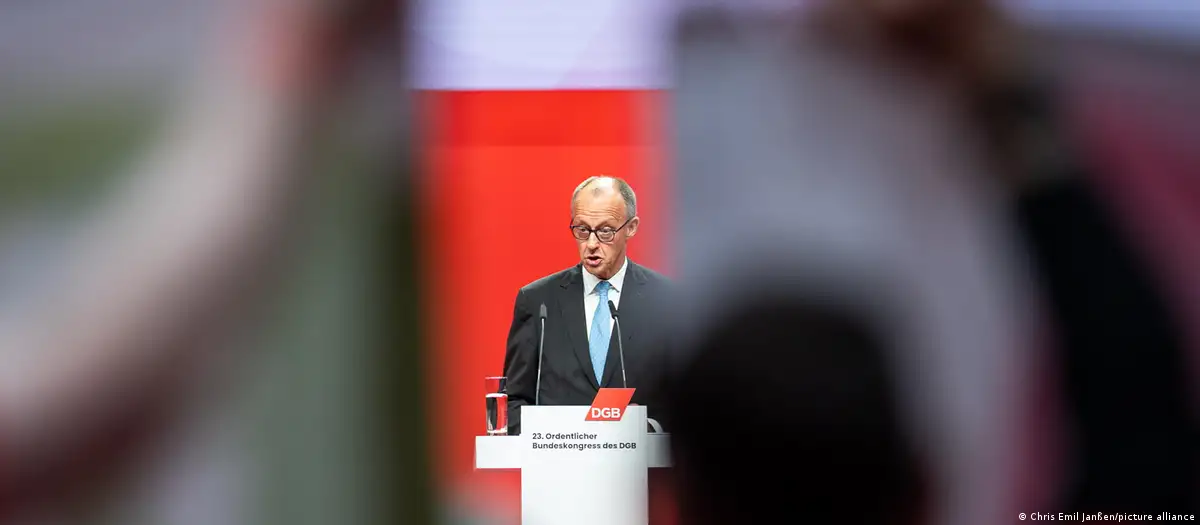
What you need to know
- Chancellor Friedrich Merz says Germany must do more to overcome years of economic stagnation
- Speaking to trade unionists amid boos, he cited global upheaval and deep structural problems
- The chancellor warned that Germany is losing more than 100,000 industrial jobs each year
- Germany’s inflation rate rose to 2.9% in April, as energy prices surged 10.1% year on year
This blog has now closed. Here are the latest developments from and about Germany on Tuesday, May 12, 2026.
German surgeon jailed for sexual abuse offences
An orthopaedic surgeon has been sentenced to five and a half years in prison for secretly filming female patients and sexually abusing them.
The Osnabrück Regional Court also found the 43-year-old guilty of producing child pornography and banned him for life from treating women.
The court found that he inappropriately lowered patients' clothing and touched them under the false pretext of medical examinations. He also secretly photographed patients during these incidents.
More than 190 cases were examined, including offenses involving a child and several teenagers. The court said many victims later lost trust in doctors and suffered lasting psychological harm.
Because all the images involved female patients, he was given a lifelong ban on the 43-year-old from treating female patients.
Weimer to travel to Vienna for Israel's Eurovision performance
Germany's State Minister for Culture and Media, Wolfram Weimer, said he will travel to Vienna to watch Israel's performance at the Eurovision Song Contest.
"It's not a place where political matters of this magnitude should play a role," German news agency dpa quoted Weimer as saying on Tuesday.
Speaking on the sidelines of a meeting of European culture ministers in Brussels, Weimer said he was very pleased Israeli singer Noam Bettan was allowed to perform.
Spain, Ireland, Slovenia, Iceland, and the Netherlands announced last year that they would boycott the 2026 song contest over Israel's participation.
The countries were upset over Israel's actions in Gaza following the Hamas attack of October 7, 2023.
On Monday, public broadcasters in Spain, Ireland and Slovenia announced they would not air the song contest.
Protests are expected in Vienna during the final this weekend.
Sarah Engels is representing Germany in the contest with the song “Fire.” Weimer said in a separate interview with German channel ntv that he hoped Sarah Engels, who is representing Germany in the contest with the song “Fire,” would do well
READ: New leadership appointment at HSV Hamburg
Hamburg have announced that Kathleen Krüger will join the club as board member for sport from July 1.
A highly respected figure in European football, Krüger brings 17 years of top-level experience from FC Bayern München.
Read more about the how the work she did at the elite club and helped shape key sporting processes.
Germany to boost customs staff amid parcel surge
Germany is moving to strengthen its customs service as parcel volumes have surged. Some 1,500 new positions have been planned this year.
Germany's customs processed nearly 790 million shipments last year, up from 595 million a year earlier. The agency also collected €157 billion in import taxes and duties in 2025, while continuing checks for counterfeit goods, protected species, and banned medications.
Finance Minister Lars Klingbeil says the agency needed more resources to handle growing pressure, particularly from low-cost imports. Customs currently employs about 49,000 people nationwide.
Klingbeil pointed to a sharp rise in shipments driven by international online trade, especially from China.
"It is a problem that Chinese junk goods are flooding our markets" Klingbeil said.
He added that Germany and the EU are tightening rules, including scrapping the duty-free threshold for packages under €150 ($176) from July and introducing an additional EU-level fee by November at the latest.
Klingbeil also stressed that cheap imports must face stricter checks on environmental and consumer protection grounds.
Cybercrime costs in Germany hit record €202 billion
Cybercrime damage in Germany has surged to a new record, topping €202 billion ($236 billion), with the government planning a new “active cyberdefense” law.
Data from Bitkom business umbrella group and Germany’s Federal Criminal Police Office (BKA) showed losses rose by €24 billion last year, while recorded offenses edged up to about 334,000 cases in 2025.
Interior Minister Alexander Dobrindt told a press conference in Berlin that many attacks originated from Russia and that the threat remains high.
He said the goal of the new law was to "disrupt and destroy the attackers' infrastructure."
"This means ensuring that someone attacking us from a server system, for example, to attack an energy company in Germany from abroad will no longer be able to do so in future with that infrastructure, that server, that software or those facilities."
Nearly two-thirds of cases originate abroad or from unknown locations, complicating investigations. The clearance rate for such cases is just 2%, compared with 31.4% for domestic offenses.
Deputy BKA chief Martina Link said Germany is a top global target for cyberattacks.
Artificial intelligence is accelerating the threat by lowering barriers for criminals and enabling more convincing phishing attacks. At the same time, AI systems themselves are increasingly being targeted.
Ransomware remains a major risk, with reported cases rising 10% to more than 1,000, though the true figure is believed to be far higher. Despite fewer companies paying, total ransom payments in Germany jumped to more than $15 million, with mid-sized firms facing average demands of around €500,000.
WATCH: The moment Merz was booed
Chancellor Friedrich Merz said Germany must "pull itself together" or risk being left
behind in a rapidly changing world, in a speech to trade unionists, sparking jeers, whistles and boos.
Lufthansa moves to take majority stake in ITA
German airline Lufthansa is moving to take a majority stake in ITA Airways as early as this summer.
CEO Carsten Spohr told shareholders in Frankfurt the group would exercise its option after what he called the fastest operational airline integration in its history.
Lufthansa's stake will rise to 90%, up from the 41% it has held since January 2025. A deal with the Italian state sets out further steps toward a full takeover.
The second tranche will cost a fixed €325 million ($381 million), with completion subject to regulatory approval and expected in the first quarter of 2027. Lufthansa said it could acquire the remaining 10% from 2028.
As part of competition remedies, Lufthansa and ITA have already had to give up takeoff and landing slots in Milan and Rome.
Shareholders gathered in person in Frankfurt for the first time since 2019, with supervisory board elections also on the agenda. Candidates include Bayer CFO Wolfgang Nickl and former Eon chief Johannes Teyssen, who is set to become the new supervisory board chair, succeeding Karl-Ludwig Kley, pending a decision by the newly formed board.
Many in Germany neglect retirement planning
A large share of workers in Germany are still not actively planning for retirement.
A survey cited by Funke Media Group of newspapers says only about four in ten respondents were seriously engaging with the issue, according to the Association of German Banks.
That marks a slight increase from the previous year, though interest remains below pandemic levels. In 2020, 56% said they had seriously addressed retirement planning, before the figure fell back in subsequent years to just over one in three in 2024.
Financial circumstances play a key role, with people in weaker economic situations far less likely to focus on retirement planning. The banking association said this means those who would benefit most from structured planning are the least likely to do so.
Germany inflation rises to 2.9% in April
Germany's inflation rate has climbed to 2.9% in April, driven by rising energy costs.
The Federal Statistical Office, Destatis, says prices increased from 2.7% in March and 1.9% in February, with consumer prices up 0.6% month on month.
Energy prices surged 10.1% year on year, with fuel costs jumping 26.2% and heating oil soaring 55.1%.
"Overall inflation increased for the second consecutive month as a result of another rise in energy prices that was due to the Iran war. Consumers are particularly feeling the persistent price pressure regarding motor fuels," said Destatis President Ruth Brand.
Food prices rose 1.2%, below the overall rate, with increases for sweets, fish and meat, while butter and cooking oils were significantly cheaper. Egg prices climbed 14.6%.
Core inflation, excluding food and energy, stood at 2.3%. Goods prices rose 2.9% overall, while services increased 2.8%, with notable gains in social services and transport.
Merz faces union boos over reform push
The chancellor took his reform message directly into the lion's den — the conference of the German Trade Union Confederation (DGB), writes DW’s Chief Political Editor Michaela Küffner.
And things unfolded exactly as expected: ranging from frosty to heated.
"Everyone will have to give something, and in return, we will gain a great deal"—this was a message no one here wanted to hear, let alone "share the burden" as the Chancellor had urged.
There were whistles, along with a few boos and shouts of "Tax the rich!"
Merz remained composed, explaining — amidst the occasional murmuring — why Germany's prosperity urgently requires greater economic growth in the near future — growth which, in his view, necessarily entails a degree of sacrifice.
Merz refused to be provoked. He vowed to continue seeking compromise — even in the face of resistance — in order to tackle healthcare, pension, and tax reforms designed to remain effective "for a decade."
DGB Chairwoman Yasmin Fahimi took the opportunity to remind the audience that the DGB had established its own pension commission after being denied access to the Federal Government's commission. It was a sore point.
The very evening before, at the unions' conference hotel, Social Democrat (SPD) Vice Chancellor Lars Klingbeil had already received a stern reminder that "the SPD emerged from the labor movement, not the other way around."
The pressure on the SPD — the chancellor's coalition partner — to offer a counterproposal to Merz’s reform plans is intense.
Whether this deeply ingrained and carefully nurtured class animosity remains mere political theater — or even derails this government's reform agenda entirely — will be judged not by the noise it generates, but ultimately by the concrete results it yields. Proposals regarding pension reform are expected before the summer recess.
Merz urges Germany to pull itself together
Chancellor Friedrich Merz has told trade unionists that Germany must do more to overcome years of economic stagnation.
He told the German Trade Union Confederation in Berlin that pressure to act had not been this intense for decades, citing global upheaval and ingrained structural problems.
The chancellor said the pressure now had "likely not been as great for politics, society, and businesses for decades as it is at present." The world was realigning itself explosively and at breakneck speed, he said, adding: "Germany must therefore pull itself together."
Merz said Germany’s economy has been stagnating for at least seven years while other countries continue to grow. Growth, he said, is essential for jobs, tax revenues, a functioning welfare state, and stable pensions.
The chancellor warned that Germany is losing more than 100,000 industrial jobs each year and said the country cannot continue on its current path.
He pointed to rising energy, production and living costs linked to the Iran war, along with heavy bureaucracy weighing on businesses. But Merz said the challenges were also homegrown, adding that Germany had failed to modernize in areas such as demographics and digitalization.
Welcome to our coverage
Guten Tag from the DW newsroom in Bonn.
You join us as Germany Chancellor Friedrich Merz says the country needs to get its act together after years of economic drift.
Merz told trade union leaders in Berlin that the pressure to act had not been this intense for decades, pointing to global shocks and long-standing structural issues at home.
Meanwhile, inflation in Europe's largest economy has risen once again.
Stick with us for these and other stories that Germany is talking about.