Germany news: Bus and tram strikes hit several states hard
Published March 19, 2026last updated March 19, 2026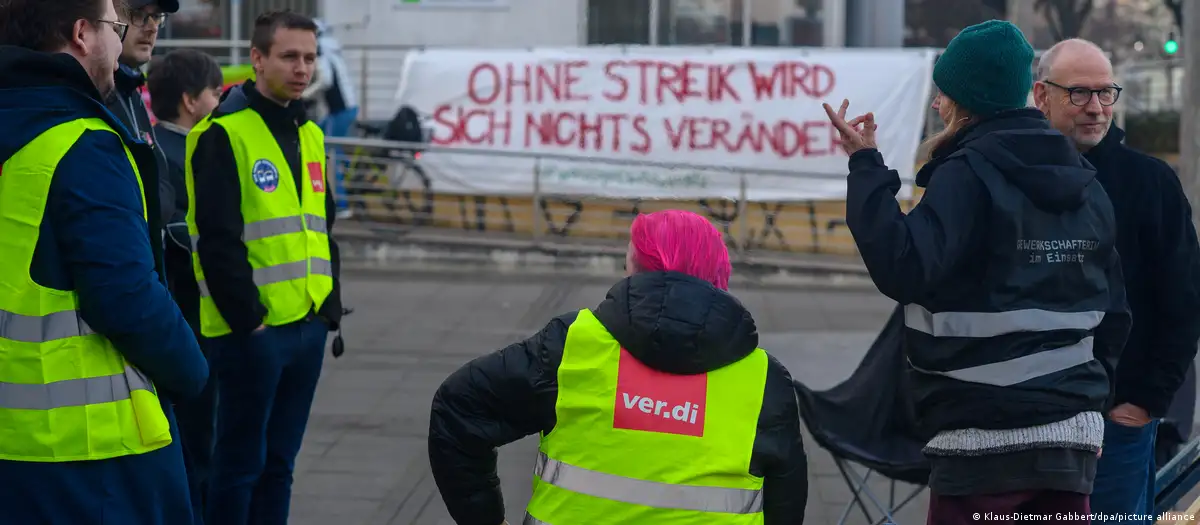
What you need to know
- Disruption for commuters as many bus and tram workers stage a walkout
- The states of Hamburg, North Rhine-Westphalia and Saxony-Anhalt particularly badly affected
- Germany says some 30,000 migrants have been turned away in border checks since last May
Here are some of the latest headlines from across Germany on Thursday, March 19:
How much have prices at the pump increased in Germany?
Fuel prices have been rising sharply since just before the US-Israeli war on Iran began at the end of February.
According to the General German Automobile Club's data, diesel has increased by €0.42 (about $0.48) per liter, while E10 petrol has risen by nearly €0.27.
The pace of increases has recently been slowing.
On Wednesday, the nationwide daily average price stood at €2.044 per liter ($8.83 per US gallon) for E10 unleaded gas and €2.167 per liter ($9.37 per US gallon) for diesel.
Germany weighs response to rising fuel prices
Germany's economy minister has been urging caution over new relief measures as fuel prices surge following the US-Israeli war in Iran.
Katherina Reiche told the Bundestag that what Germany does not need "20 days after the war" is "activism," stressing the government is acting in a measured way.
She said calls for a fuel price cap, discounts, or a windfall tax are being considered, but that they must be weighed against costs and benefits.
The coalition has introduced a fuel pricing package requiring gas stations to raise prices only once daily at noon, while allowing reductions at any time, alongside tighter antitrust rules.
The Bundestag is preparing to pass the package under an expedited procedure. A vote in the Bundestag is targeted for next week, allowing the Bundesrat to take it up the following Friday.
Racism remains widespread in Germany, study finds
Racism and discrimination remain widespread in Germany, according to a new national monitoring report highlighting persistent attitudes and everyday experiences.
The National Discrimination and Racism Monitor (Nadira), presented in Berlin, combined survey data with reports of direct and indirect discrimination, noting a slight decline that does not change the overall picture.
The study found 36% of respondents believe there are "different human races," while 66% said some cultures are "more advanced and better" than others, and 48% agreed certain groups are "naturally more hardworking."
Researchers said such biologically based hierarchies are commonly believed, even though they are scientifically disproven, with terms like "cultures" or "groups" increasingly used instead of "race."
Many people experience discrimination regularly, including people of color and visibly Muslim individuals.
Among respondents, 25% of Black people and 17% of Muslims said they face insults, harassment, threats, or attacks at least once a month, while about one-third reported such incidents over the past year.
Subtle discrimination is even more widespread, with 63% of Black respondents reporting monthly experiences such as disrespect or unfriendly treatment, compared with 26% among those not perceived as racialized.
Bavarian glaciers shrinking at record pace
Glaciers in the Bavarian Alps have been melting at record speed, with scientists warning that only remnants remain in some areas.
Glaciologist Christoph Mayer said glaciers near Berchtesgaden are now just a "small remnant," while another, the Northern Schneeferner on the Zugspitze plateau, is also nearing its end.
Operators recently announced the dismantling of Germany's last glacier ski lift after operations had already stopped in the 2023/24 season.
Researchers say that, since 2023, Bavarian glaciers have lost more than a quarter of their area, totaling around 1 million cubic meters of ice.
Average ice thickness has been shrinking by about 1.6 meters (about 5.25 feet) per year — double the rate recorded between 2018 and 2023.
The findings, released ahead of World Glacier Day on March 21, showed the Blaueis and Watzmann glaciers near Berchtesgaden losing around 40% of their area.
Scientists said human-caused climate change is driving the rapid decline, noting that average temperatures at the Zugspitze, the highest peak in Germany, in 2024 and 2025 were more than 2 degrees Celsius above the long-term average.
German intelligence warns of rising hybrid threats
Germany's domestic intelligence service has warned that espionage, sabotage, and hostile operations targeting the country are increasing, with attackers showing greater risk-taking and more varied methods.
Federal Office for the Protection of the Constitution (BfV) President Sinan Selen said at a security conference with the VSW that even "assassination operations" cannot be ruled out, adding that Russia increasingly views Germany as an adversary, sometimes even as its "number one enemy."
He said foreign operations are focusing in particular on logistics, defense, and technology sectors, with Russia the main actor but not the only one.
Estonia's ambassador Marika Linntam spoke to delegates, citing a suspected Russian-linked arson attack on a Ukrainian restaurant in Tallinn. She described this as an influence operation amplified through social media to spread fear.
Selen said a joint center to counter hybrid threats is close to launching, bringing together intelligence services, police, prosecutors, and private industry to improve information sharing.
German mathematician Faltings wins Abel Prize
German mathematician Gerd Faltings has been awarded this year's Abel Prize for mathematics, recognizing his major contributions to the field.
The Norwegian Academy of Science and Letters announced in Oslo that the prize honors Faltings "for introducing powerful tools in arithmetic geometry."
The academy described him as "an outstanding figure" in the field of arithmetic geometry.
"Gerd Faltings is a towering figure in arithmetic geometry," the Norwegian Academy of Science and Letters said in a statement.
"His ideas and results have reshaped the field, settling major long-standing conjectures, while also establishing new frameworks that have guided decades of subsequent work," it added.
The 71-year-old Faltings is a former director of the Max Planck Institute for Mathematics in Bonn, who also won the prestigious Fields Medal in 1986 for his proof of the Mordell conjecture.
The Abel Prize, named after the Norwegian mathematician Niels Henrik Abel, was created by Norway's government, partly to compensate for the lack of a Nobel prize in mathematics.
Germany reports 30,000 border turnbacks
Germany has recorded some 30,000 migrant turnbacks at its borders since the current government took office, Interior Minister Alexander Dobrindt has said.
Dobrindt told the broadcaster ARD that the figure was significant and showed controls were still necessary.
He said there continued to be a considerable number of attempted entries being refused.
While police unions have been calling for a reduction in border checks, Dobrindt defended the controls, which were extended in February for six months until mid-September.
He said the stricter measures signaled a shift in German policy and increased the risk of detection for smugglers.
At the same time, the minister said he was hoping that new EU asylum rules, to take effect in the summer, would have an impact.
Dobrindt said that if that system were successful, along with stronger protection of the EU's external borders, Germany could move away from temporary internal border controls.
Strikes disrupt public transport across Germany
Public transport has been facing widespread disruption as warning strikes have been taking place in several German states.
The union Verdi said Hamburg, North Rhine-Westphalia and Saxony-Anhalt have been particularly affected. In the Bavarian capital, Munich, buses and trams have also remained in depots.
In North Rhine-Westphalia, this is the second strike affecting local transport services this week, with a tram strike also planned for Friday in some areas.
In Saxony-Anhalt, industrial action in many areas is set to continue through Sunday.
Regional and suburban rail services operated by Deutsche Bahn and other rail companies have not been affected.
The strikes are part of an ongoing round of collective bargaining negotiations across Germany’s public transport sector.
In the states of Baden-Württemberg and Schleswig-Holstein, agreements have already been reached.
In the central state of Hesse, home to Germany’s financial capital, Frankfurt, a compromise has been negotiated and is now being put to union members for approval.
Talks are also continuing in Berlin, where the next round of negotiations at the capital’s main public transport operator is beginning.
Verdi deputy chair Christine Behle has said negotiations remain at an early stage in many regions, despite entering the fourth month.
In most states, the dispute centers on working conditions, including hours, break times and rest periods between shifts.
Welcome to our coverage
Guten Tag from the DW newsroom here in Bonn.
Danke schön for joining us as public transport across Germany faces major disruption with strikes spread across several states.
It’s tricky to get around town in many places, including our lovely former capital city, with buses and trams staying behind in depots.
With negotiations still ongoing, more disruption for commuters is likely in the days ahead.
For this and other stories that Germany is talking about, stay with us here.