Germany debates rape law to tackle AI and online abuse
March 25, 2026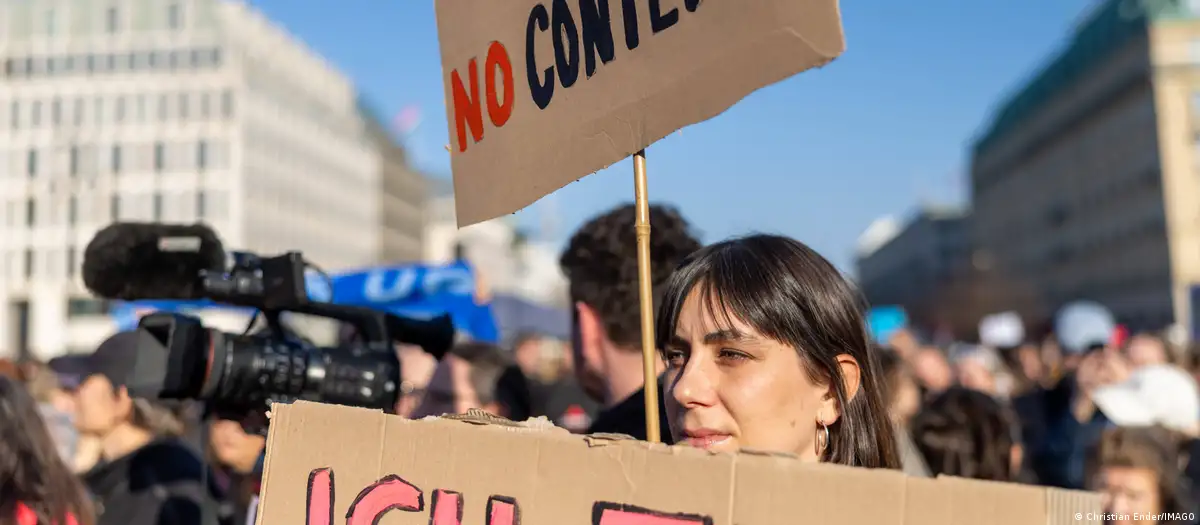
The debate around the issue of sexual consent and exactly how fit for purpose Germany's rape laws are has reignited this week following serious allegations made by actress and presenter Collien Fernandes against her ex-husband, actor Christian Ulmen.
Speaking to German weekly news magazine Der Spiegel, Fernandes accused her ex-husband of being behind the distribution of hundreds of AI-generated pornographic images of her online, as well as social media accounts pretending to be her. "You virtually raped me," Fernandes said. Ulmen denies the accusations.
In a subsequent interview with German public broadcaster ARD, Fernandes described Germany as "an absolute paradise for perpetrators" and said she had deliberately chosen to file her case in Spain "because women's rights are significantly better protected there than in Germany." This was possible because the alleged perpetrator's primary residence is in Spain.
In the wake of the allegations, thousands of people — some 13,000 according to the organizers, 6,700 according to the police — gathered at Berlin's Brandenburg Gate on Sunday March 22 to protest sexualized violence against women.
Germany's criminal laws on abuse
Rape and sexual assault are punishable under the German Criminal Code (StGB). However, these offenses require direct physical contact. Current law criminalizes the "violation of the intimate sphere through image-based recordings (§ 184k StGB) and the "violation of the most personal sphere of life and personality rights through image-based recordings" (§ 201a StGB). Whether the term "image-based recordings" includes AI-generated images or fictional depictions such as deepfakes is a matter of debate among legal experts.
Representatives from politics, society and the legal sector published a 10-point plan on Monday to protect women against sexualized violence in the digital sphere. At the core of the demands is a call to criminalize the creation and distribution of pornographic "deepfakes" and ban AI-based "nudify" apps that are used to produce fake nude images of people.
Online platforms should also be obligated to quickly remove pornographic deepfakes, with clear legal rights for victims to deletion, information and identification of the perpetrators.
Green Party lawmaker and legal policy spokesperson Lena Gumnoir told DW that the current legal situation in Germany does not protect the fundamental right to sexual self-determination, adding that there were "glaring gaps in criminal liability when it comes to deepfake pornography."
"The fact that [Fernandes'] lawyer advised her to file a criminal complaint in Spain rather than in Germany is so telling of the situation here on the ground and must serve as a wake-up call to the federal government," Gumnoir said.
Cyber criminal law reform to tackle 'deepfakes'
Whether the "violation of the most personal sphere of life and personality rights through image-based recordings" stated in Germany's criminal code includes AI-generated images has not yet been definitively settled by the supreme court.
Under the "right to one's own image," similar to the "right to publicity" in US law, private individuals have the right to determine how images of themselves are used — for example, on merchandising — and to stop people taking photos of them without their consent.
However, these rights are enforced under the Art Copyright Act (KUG) and carry much lower penalties than under criminal law. As well as being complicated to enforce, the KUG is also not designed to protect against sexualized humiliation.
A study published by the Ministry for Education (BMBFSF), the Interior Ministry (BMI) and the Criminal Police Office (BKA) in February 2026 revealed that only 2.4% of incidents of digital violence and harassment are reported by women, and just 0.9% by men.
EU pushes for 'only yes means yes' principle
In 2016, Germany amended its rape law to close loopholes that often meant cases of sexual assault were not prosecutable unless the victim tried to fight back.
The introduction of the "no means no" principle widened the definition of rape to include sexual activity that goes against the "discernible" will of the victim.
Germany is currently pushing for the introduction of an EU-wide directive to combat the sexual abuse of children and young people by adopting the "only yes means yes" principle — but this would only apply to minors.
If it became law, the principle would mean that young people between the ages of 14 and 18 must obtain or give active consent before engaging in sexual activity, either verbally or non-verbally. Instead of disproving a "no," defendants would have to prove a "yes."
"We need to be clear about one thing: even if we introduce 'yes means yes,' the burden of proof will not change," CSU lawmaker and chair of the Bundestag Committee on Legal Affairs Susanne Hierl told DW. "We face the same problem with every sexual offense, just as we do with every sexual crime. It's one person's word against another's."
France and Spain lead the way on consent law
The "only yes means yes" principle currently applies in 15 EU member states, including Sweden, Spain, France, Croatia and Greece.
In October 2025, French lawmakers passed a new consent law redefining rape as any sexual act that occurs without consent. It states that consent must be "freely given, informed, specific, prior and revocable," and that it cannot be inferred through "silence or lack of reaction."
Under French law, rape was previously solely defined as penetration or oral sex using "violence, coercion, threat or surprise."
The new legislation came in response to the high-profile case of Gisele Pelicot. Between 2011 and 2020, her now ex-husband, Dominique Pelicot, repeatedly drugged his wife and invited dozens of men to rape her while she was in a comatose state.
Spain passed its Organic Law of Comprehensive Guarantee of Sexual Freedom, making "only yes means yes" law in 2022. The legislation was introduced following the notorious "La Manada" ("wolf pack") gang rape case in 2016 involving five men who raped an 18-year-old woman in Pamplona.
In court, it was argued that the footage of the attack obtained from the men's phones was proof of consent because the woman remained "passive or neutral" — according to the wording of the police report — and kept her eyes closed throughout the ordeal.
Beatriz Chaves, a spokesperson from the Spanish advocacy group Mujeres Supervivientes de Violencias de Genero (Women Survivors of Gender-Based Violence), said the Spanish law helped women to feel more secure in the justice system and encouraged a more open culture of consent.
"The law recognizes psychological coercion or fear or power imbalances. Before this law that wasn't happening," Chaves told DW. "It's important that the law recognizes sexual violence as a manifestation of structural gender inequality."
Bundestag debate and outrage over Chancellor Merz
Lawmakers debated the topic of violence against women and girls in a plenary debate in the Bundestag on Wednesday. Justice Minister Stefanie Hubig, of the center-left Social Democrats (SPD), began her speech by saying that "the technology is new but the motive age-old."
Hubig had announced on Friday that the government had finalized a long-awaited draft law to criminalize the production and distribution of AI-generated pornographic "deepfakes."
The draft law covers secretly taken photographs or footage, for example, in saunas or changing rooms. It also includes civil measures to make it easier for victims to act against online platforms, including the right to obtain information on perpetrators and enforce account suspensions.
The ruling coalition of the conservative Christian Democrats (CDU)/Christian Social Union (CSU) and the SPD had agreed to reform cybercrime law and close loopholes, including those relating to image-based sexualized violence and deepfakes, in their 2025 coalition agreement.
Hubig said that the draft bill is expected to be submitted for cabinet review this week and that the law is expected to be passed "very soon."
Earlier in the day, Chancellor Friedrich Merz (CDU) provoked an angry reaction from the ranks of the Left Party in the Bundestag when in response to a question about his plans to combat the increasing sexualized violence against women, especially online.
"We have an explosion of violence in our society, both in the analog and the digital realm... we also have to talk about the causes... And then we also have to address the fact that a significant portion of this violence comes from immigrant groups in the Federal Republic of Germany," Merz replied.
Edited by Rina Goldenberg
While you're here: Every Tuesday, DW editors round up what is happening in German politics and society. You can sign up here for the weekly email newsletter, Berlin Briefing.