Belgium's state-owned railway shines light on Holocaust role
March 28, 2026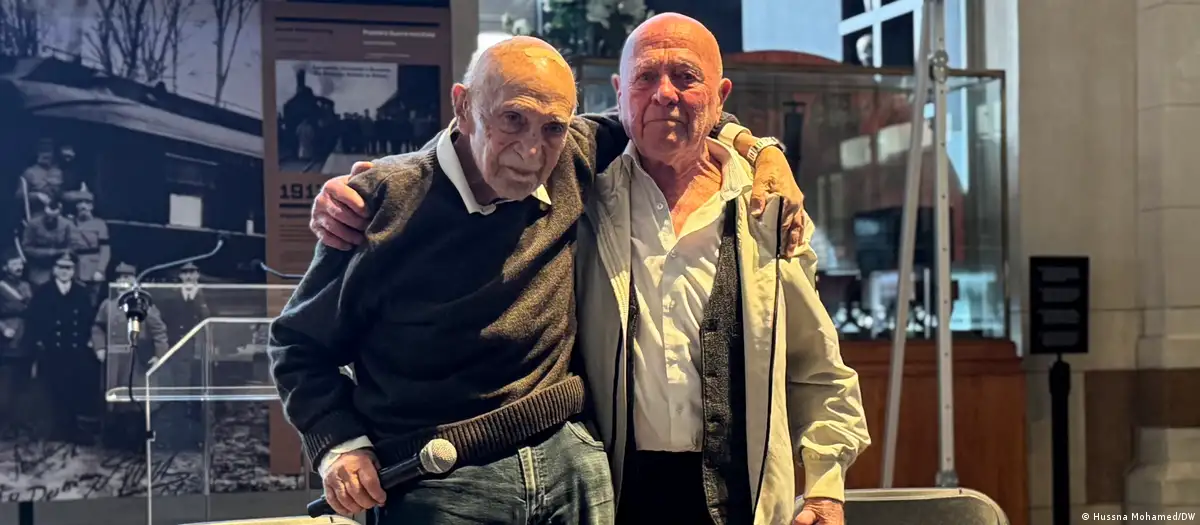
In a hall at Brussels' Train World museum, two elderly men stood side by side — one a Holocaust survivor, the other the son of a Nazi collaborator.
The event earlier this week was part of an exhibition exploring the role of Belgian railways during World War II. Organized by the German Embassy in connection with the museum, it was attended by more than 180 students.
Simon Gronowski, a 94-year-old lawyer, recalled vividly what happened one morning in March 1943, in Antwerp, Belgium.
"It's breakfast time. The bell rings, the three of us look at each other, my sister is in front of me. My mother is on my right. We were paralyzed. All our plans to escape through the back garden were in vain," he said.
He and his family ended up taken by the Gestapo. One month later, on April 19, 1943, they were put on a train bound for Auschwitz by the Nazis. He later escaped and got off the train with the help of his mother.
"My legs were dangling in the air. Then she lowered me gently until my feet were on the edge of the carriage. My mother was holding me by my clothes when the train slowed down a bit. She pushed me out of the wagon," he said.
"But she could not follow; the SS had stopped the train a little further and closed the wagon again."
Gronowski's mother and sister were unable to escape and ended up in Auschwitz, where they were murdered in the gas chambers by the Nazis. It's estimated that 6 million Jews were murdered in the Holocaust, around 1.1 million of them in Auschwitz.
"Some people argue about figures. All I'm saying is, let's accept for a moment that he didn't kill 6 million people, but only 1 million — in both cases the pain is extraordinary," said Gronowski. "Hitler also killed his own people, the disabled, homosexuals, Jehovah's Witnesses and others. All were victims."
Born into 'extreme Nazi environment'
Alongside Gronowski at the museum was Koenraad Tinel, a 92-year-old sculptor and cartoonist and the child of Belgian Nazi collaborators.
"I was born into an extreme Nazi environment. As a result, my two brothers, who were 10 years older than me, went into the SS. And my father was a camp chief in France," said Tinel, tears in his eyes. He was only 6 years old when the Holocaust started.
Tinel later cut ties with his family, and wrote, drew and made sculptures about his experience and efforts to raise awareness of the horrors of the Holocaust.
"I want to bear witness to what happened and above all I want to make people understand that what they did was serious, and very wrong," he said.
Tinel and Gronowski have been friends for more than 14 years. "When we first met, I said when I read your story, I cried. I am sorry. And Simon said, 'The children of the Nazis are not guilty,'" said Tinel.
Deportations carried out by Belgian railway employees
At the center of the exhibition is the railway system itself. During the occupation, trains were used as tools of deportation. Their organization, efficiency and the people involved raise difficult questions about how the system functioned so smoothly.
The German invasion of Belgium in May 1940 allowed the Wehrmacht Verkehrsdirektion (WVD) to take control of the Belgian railway network.
"The WVD also took over parts of the management of the company itself, the National Railway Company of Belgium (NMBS/SNCB). For example, German administrators ran the central workshops," said Nico Wouters, historian and director of the Study and Documentation Centre for War and Contemporary Society at Belgium's state archives in Brussels.
The SNCB supplied a large portion of raw materials, and food, for both Belgians and the Nazis.
"The SNCB decided to cooperate in 1940 because it was initially legally obliged to do so. Both under international wartime law and Belgian law, which required cooperation with an enemy occupier in the interest of the population and the occupied country," said Wouters.
The German WVD eventually regarded the SNCB as an executive department of the Reichsbahn, the German national rail company.
From early 1941 onwards, the Belgian company operated all railway traffic using its own rolling stock and personnel on behalf of the occupying forces.
"The deportations were carried out by Belgian personnel up to the German border, under the armed supervision of German guards," said Wouters.
According to a report by SNCB, between 1941 and 1944 the Belgian national railway assisted in the deportation of approximately 189,542 Belgian forced laborers, 25,490 Jews, 16,081 political prisoners and 353 Roma to Germany and concentration camps in the east.
Trains ran on a route through Belgium, starting from Mechelen, in northern Belgium and passing through places like Leuven, Boutersem, Liege-Guillemins, Verviers and Astenet before heading toward the German town of Aachen, just across the border. The exact route could change from time to time.
According to the data released by SNCB, the payments were done by the Mitteleuropäisches Reisebüro, a state-controlled agency that managed pro-regime tourism while providing the critical logistical and financial infrastructure for the deportation of Holocaust victims via the railway system.
Payments surged between 1941 and 1942, then steadily declined through 1944.
Out of the 28 transports of Jews to Auschwitz-Birkenau, the first 19 used third-class passenger carriages. These had benches, windows, even steps, so on the surface they looked like regular train compartments, even though the situation was anything but normal.
From the 20th transport on April 19, 1943, they switched to freight cars. That change wasn't random; it was because there had been too many escapes like the one undertaken by Gronowski.
Speaking together at Train World, both Tinel and Gronowski condemned the far right and urged students to educate themselves before voting, so that the mistakes of the past are not repeated.
"Despite everything I've never felt hatred. I've never been angry. Hate wouldn't have brought my mother and sister back to me," said Gronowski, urging students to protect their hearts against hatred. "Because hatred is bound to turn people against each other.”
Edited by: Rob Mudge