Why Ingeborg Bachmann remains a literary icon
June 24, 2026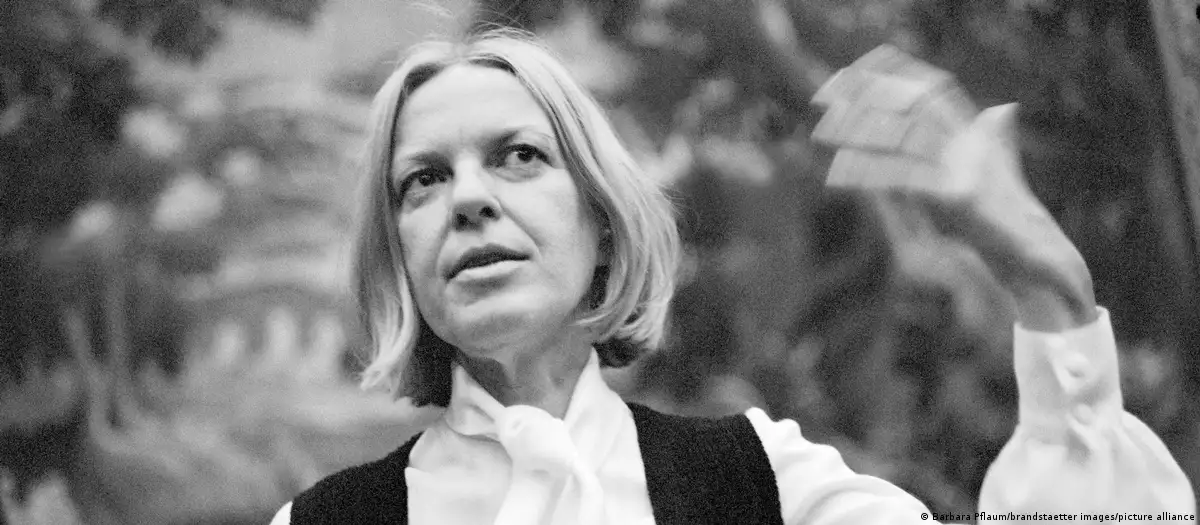
How do you put the unspeakable into words? Following the horrors of the Holocaust, this question haunted postwar German authors.
They aimed to reject the heritage of the Nazi era while documenting the trauma of bombed-out cities and the country's starving population. They explored the complexities of collective guilt and individual responsibility.
But the German-language literary scene that took up these daunting issues was dominated by male authors. Women's writing was frequently dismissed as trivial.
The anti-fascist and feminist Austrian writer and poet, Ingeborg Bachmann, was one of the few women to assert their voice in the face of a deeply sexist literary industry.
The literary icon remains extremely relevant today, notes Regina Schilling, a longtime Bachmann fan and director of the new documentary, "Ingeborg Bachmann: Someone who was once me."
Through her research for the film, Schilling was particularly struck by "how visionary and contemporary Bachmann's texts are."
"She addressed themes that are central to today's social discourse, such as gender identity," said Shilling, adding that the author described what came to be known today as "mansplaining."
"She was definitely ahead of her time," added the filmmaker.
Bachmann confronted the way language upheld ruling power structures. "No new world without a new language," says the narrator in her story "Among Murderers and Madmen."
Fighting the limits of language
Born in 1926 in the Austrian city of Klagenfurt, Bachmann was the daughter of an early Nazi Party member. Even though she never discussed this publicly, the troubling background profoundly influenced her work, which dealt with collective guilt, trauma and patriarchal violence.
Escaping her home town in the Carinthian Alps was a vital first step towards emancipation. "Though I later traveled to Paris, London and Germany, that matters little; for in my memory, the journey from the valley to Vienna will always remain the longest one," she once said.
A student of philosophy, psychology and German literature, Bachmann's doctoral thesis focused on the existentialist thought of philosopher Martin Heidegger.
She was also considered an expert on another thinker, Ludwig Wittengenstein, whose philosophy suggested that there are things that cannot be logically described, and that we should rather remain silent about them. Disproving Wittengenstein's conclusion became one of Bachmann's lifelong goals: through her writing, she strived to express "the unsayable, the mystical, the limit."
An iconic group of avant-garde authors
Through her work at the radio station of the US forces occupying Vienna after the war, Bachmann came in contact with the wider German-language literary scene.
She was invited to read her poetry at a gathering of Gruppe 47 (Group 47), an influential avant-garde literary collective. The informal association of German-speaking writers founded in 1947 aimed to free German literature from the propaganda and corruption of the Nazi era. It launched the careers of major writers such as Heinrich Böll and Günter Grass — as well as Bachmann.
In 1953, Bachmann won the Gruppe 47 Literature Prize, the organization's highest honor, for poems published as her debut collection, "Die gestundete Zeit" (Borrowed Time). The works evoke worlds that are at once hauntingly beautiful and horrifyingly violent.
She also achieved success with her radio plays.
Her only completed novel, "Malina," published in 1971, is considered her magnum opus. The work explores the psychological fragmentation of a female writer living in a strained love triangle in Vienna.
Bachmann was working on a vast project of many volumes, titled "Ways of Dying," before she died at the age of 47, in 1973, from complications following an accidental fire in her Rome apartment.
Her tragic death cemented her myth, as it mirrored the existential unraveling and trauma that were key themes of her work.
High-profile literary love stories
The author's romantic and intellectual relationships also contributed to her mythology. As a young adult, she fell in love with Romanian Jewish poet and Holocaust survivor Paul Celan. Even though he married another woman, they kept writing letters for years, documenting their complex love story.
She also shared a profound partnership, both in life and in art, with Hans Werner Henze, one of Germany's most significant contemporary music composers. They collaborated on operas, and even considered getting married. But Henze being homosexual, Bachmann walked away from the platonic union.
Bachmann was also in a relationship with prominent Swiss playwright and novelist Max Frisch. While they became the most famous couple in German-language literature, their intense exchange of ideas was also plagued by tensions. Their letters — only published in 2022 — offer insight into how their open relationship and love affairs were a cause of distress to both of them.
Sandra Hüller in new film
Several works are mark the 100th anniversary of Ingeborg Bachmann's birth on June 25, 1926.
Schilling's documentary interweaves archival footage and interviews with Bachmann, along with excerpts of her texts and improvised scenes with Oscar-nominated star Sandra Hüller.
A new autobiography by Andrea Scholl, "Zwei Menschen sind in mir" (Two People Are Within Me), also draws on recently published letters and diary entries. The title represents the core tension in Bachmann's life, the duality between an uncompromising, intellectually brilliant writer and an individual struggling profoundly with addiction, isolation and self-doubt.
But even with the extensive body of work analyzing all aspects of Bachmann's writing and life, she remains an enigmatic figure, embodying the characteristics of her modernist masterpiece, "Malina": a work that is vulnerable and brave, elegant and razor-sharp, eerie yet profoundly human.
Edited by: Stuart Braun