US government 'chipping away' at press freedom
March 27, 2026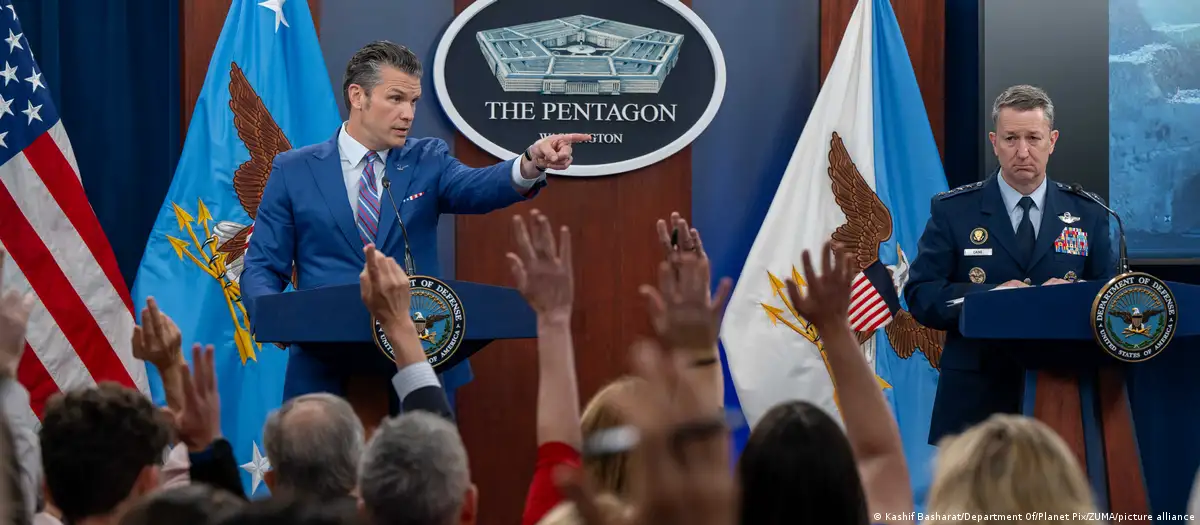
The increased hostility in the Pentagon's treatment of the press is the latest escalation in a pattern of behavior from the Trump administration that is creating a "significant chilling effect on journalism," a US press freedom expert told DW.
On Tuesday, The New York Times accused the Pentagon, the US defense headquarters, of ignoring "both in letter and spirit" a court ruling that unpicked most of the restrictions journalists were asked to agree to in a new set of policies last October in order to maintain access. Those guidelines had included prohibiting "solicitation" of information and led to many outlets returning press passes, saying the Pentagon's policy "threatens core journalistic principles."
US District Judge Paul Friedman, who ruled on the case, said the "undisputed evidence" was that the policy aimed to replace "disfavored journalists" with those "on board and willing to serve" the government.
In the absence of these traditional outlets, the press pack, down to 26 journalists after the walkout, was replenished with 60 new accreditations in November, mostly from pro-Trump and MAGA outlets such as Turning Point USA and RedState.
But the White House's interim policy, released after the judgement, has largely flouted the court ruling, according to the newspaper's lawyers.
Pentagon wants journalists escorted in
"Among other things, for the first time in history, the interim policy bars reporters with press passes from entering the building without an escort, sets up unprecedented rules governing when a reporter can offer anonymity to a source, and leaves in place provisions that this court's order struck," the Times statement read. The Pentagon also plan to shut the reporters' work space, known as "Correspondents’ Corridor," and move reporters to an annex away from the building.
"Closing the Correspondents' Corridor and forcing escorted access undermines independent reporting at the Pentagon at a moment when the public needs clear, unfiltered information about the US military," said National Press Club President Mark Schoeff Jr. on Monday.
"For decades, that corridor has been central to independent reporting on the Pentagon. Eliminating it and requiring escorted access would sharply limit how journalists gather news, build sources and cover one of the most powerful institutions in government — reducing what the public is able to see and understand about decisions made in its name."
It is the Pentagon's position on standard journalistic practices that most concerns Seth Stern, from the New York-based Freedom of the Press Foundation.
Trump administration aims to 'criminalize' journalists risk for reporting
"The notion that journalists are not entitled to ask for information from unauthorized personnel, that journalists have a responsibility to help the government keep secrets [...] that's antithetical to what the First Amendment stands for in the United States," said Stern, the foundation's chief of advocacy. Under the US Constitution, the First Amendment provides for the protection of fundamental freedoms of religion, speech, press, assembly and petition.
A few days before the ruling, it became clearer still that the administration, and particularly Defense Secretary Pete Hegseth, disagrees. Hegseth has consistently criticized reporting on the US-Israel war with Iran in his press conferences.
"The court removed every provision that allowed the Department to screen press credential holders for security risks and every provision that allowed the Department to deny, revoke, or suspend a press credential based on security considerations — while simultaneously ordering the Department to immediately reinstate press credentials for the New York Times," said Pentagon spokesman Sean Parnell on March 23. "The Department always complies with court orders but disagrees with the decision."
For Stern, this is all part of a pattern of governmental behavior that seeks to "criminalize much of what journalists do every day." If unchecked, he said, its effects on the freedom of the press and information could be dramatic.
"If courts don't push back and give their rulings teeth — issue sanctions, issue contempt findings, not just a slap on the wrist — so the administration can find an opportunity to try again on different facts in front of a different judge, there is that risk that journalists feel that they risk prosecution for criminal solicitation or for violating the Espionage Act or for violating the Computer Fraud Act by doing what in the past was considered routine," said Stern.
"Even if they're not ultimately convicted, nobody wants to be arrested, nobody wants to stand trial."
Press freedom decreasing under Trump
While the court broadly ruled in favor of press freedom this time around, the backslide is clear. The US was ranked 57th for press freedom in the last annual Press Freedom Index in 2025 and will likely fall further when next year's results are published.
Compilers Reporters Withour Borders have said "the country is experiencing its first significant and prolonged decline in press freedom in modern history, and Donald Trump's return to the presidency is greatly exacerbating the situation."
Stern said this is an attempt to create an environment where reporters must be willing to sacrifice their freedom to tell the truth. "It will certainly become a lot more difficult, a lot more dangerous, and will limit the pool of people willing to do journalism to those that are exceptionally courageous and heroic and don't mind risking prison," he said.
As well as individuals, the Trump administration has often sought to sue news organizations and is currently pursuing cases against The Wall Street Journal, The New York Times, the BBC and CNN, among others. ABC and Paramount have previously settled with the president for about $16 million each. But Stern said the money isn't the point.
"The outcome is the creation of a significant chilling effect. They know they're unlikely to succeed on a lot of the legal theories they bring before the courts. If they didn't know that going in, they know it now because they lose cases all the time," he said. "But if they lose, it doesn't really cost them anything. They're not paying their legal fees, [the taxpayer is]. Why not throw it against the wall and see if it sticks? And if they win one out of 10 or one out of 100 cases, then they're chipping away at the constitutional rights of journalists and of the public. They're opening doors that they can barge through."
Freedom of information under threat
The press freedom advocate also has grave concerns about what he characterizes as the "shattering” of the Freedom of Information Act (FOIA) by the Trump administration. The government cut the budget and staff levels for FOIA in early 2025, and the FOIA backlog rose by 42% last year to more than 30,000 cases across the department, according to government figures. A case is considered to be in the backlog if there is no response within 20 days.
Stern said previous presidents paved the way for this dismantling of a vital journalistic tool, and turning back the clock will be difficult, whoever wins power next.
"Convincing a future administration to even rebuild FOIA back to where it was before Trump, let alone make the much-needed improvements that were called for decades ago, is going to be a tall order," he said. "That's because generally there is not much appeal to politicians of helping the public find out about and air their dirty laundry. I suspect that after Donald Trump has destroyed FOIA, that'll be a slow rebuild that'll require a lot of political pressure."
Despite the increasingly bleak picture for press freedom in the US, Stern did find some hope in Trump's definition of the press.
"Trump, being a product of the 1980s, is focused largely on the major broadcast networks. And that is not necessarily the source of news that most Americans and particularly younger generations are relying on. So there is still a lot of very good journalism going on below Trump's radar. That is a positive sign."
Edited by: M. Kuebler