Skeleton in Magdeburg Cathedral is almost certainly Otto I
March 18, 2026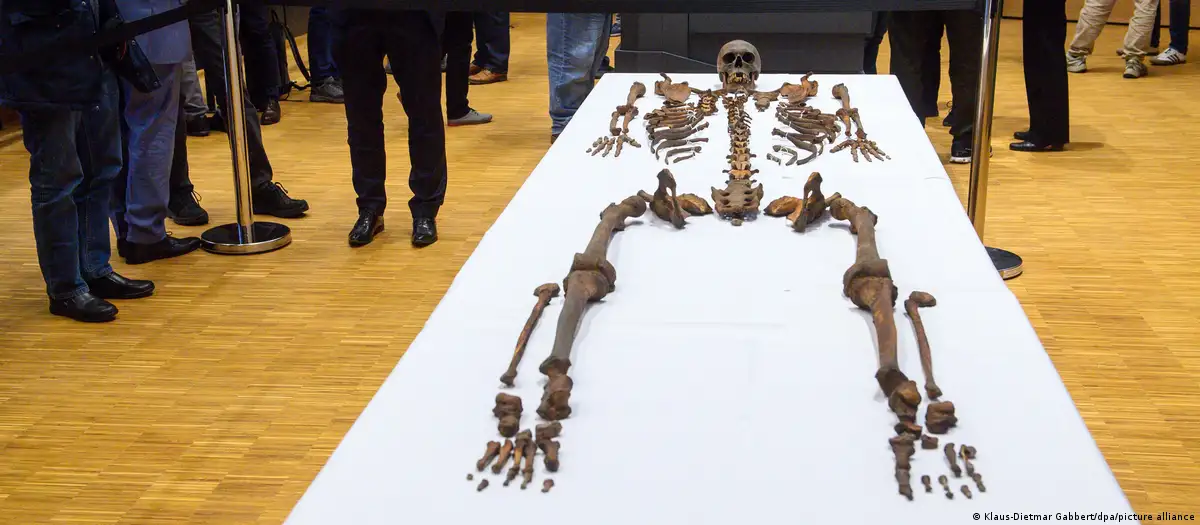
The skeleton found in a simple wooden coffin in Magdeburg Cathedral inside the official sarcophagus of 10th century king Otto I of Saxony almost certainly belonged to the man himself, officials said at a presentation in the city's university hospital on Wednesday.
"With a probability bordering on certainty what we have here in front of us are indeed the mortal remains of Otto the Great," Harald Meller, the director of the Saxony-Anhalt State Office for the Preservation of Historical Monuments and Archaeology, said in Magdeburg, standing in front of the carefully laid out and remarkably complete 1,050-year-old skeleton.
What points to the remains' authenticity?
Several indicators reinforce the probability that the sarcophagus in Magdeburg Cathedral contained the genuine remains of the late emperor, according to Meller's office.
- The bones belonged to a man who died at roughly 60 years of age
- Analysis points to a very well-fed man for the era, a member of the elite
- Muscular structures also point to a man who regularly rode horses in a saddle
- Signs of past injuries indicate a man with an active lifestyle and probably combat experience
- "Genetically, it also fits perfectly," Meller said, in reference to DNA evidence that the skeleton was a blood relative of Heinrich II, the last Holy Roman Emperor of the Ottonian dynasty, a grandson of one of Otto's brothers
- Heinrich II's remains are in Bamberg in Bavaria
Who was Otto the Great of Saxony?
According to historical records, Otto I, or Otto of Saxony, or Otto the Great, was born in 912 AD and died in 973.
He was the East Frankish king, presiding over a kingdom incorporating much of modern-day Germany, from 936, when he inherited the Duchy of Saxony after the death of his father, Henry the Fowler.
He married Edith of England, one of the half-sisters of the Anglo-Saxon King Aethelstan, and continued his father's work unifying the German tribes and kingdoms.
His victory, outnumbered against a Magyar invasion force in 955, at the Battle of Lechfeld, led to his Otto the Great moniker and laid the foundations for another titular upgrade a few years later, especially after his conquest of the Kingdom of Italy in 961.
Pope John XII, in 962, crowned Otto Holy Roman Emperor, reviving the title. He would hold the position until his death 11 years later, aged roughly 62.
The Holy Roman Empire would endure in various forms until 1806, incorporating territory across a number of modern northern, central and western European countries.
Historian David Bachrach credits the work of Otto I and his father in particular for having "made possible the establishment of Germany as the preeminent kingdom in Europe from the tenth through the mid-thirteenth century."
Magdeburg city's highest honor, awarded each year, is the King Otto the Great Prize, given to people for noteworthy contributions to "the process of European unity particularly in regard to eastern and southern European countries" as well as the "promotion of European thought."
Where is Otto buried and why were the remains removed?
A memorial to Otto and his wife, Edith, can be found in Magdeburg Cathedral, as can an elaborate sarcophagus that had long been designated the resting place of the Holy Roman Emperor.
Last June, severe damage forced researchers to open a simple wooden coffin inside the limestone sarcophagus for thorough restoration work. As well as bones, researchers also found textiles inside and started work analyzing all the contents.
The textile fragments inside the coffin included a red shroud made of either Byzantine or Spanish silk and a blue-dyed blanket with silver threads. Eggshells, fruit pits and a 13th-century Magdeburg-area coin known as a Moritzpfennig were also found inside. Researchers said there was evidence of the coffin having been opened and altered several times.
The analysis also showed that the man had lost three teeth because of a force trauma and suffered from severe gum disease. The dilation of arteries supplying blood to the brain around the throat and base of the skull may have been a contributing factor to Otto's death.
Conservation work on the sarcophagus continues in the cathedral, and the bones will remain in Magdeburg, the capital of Saxony-Anhalt, in the meantime before being put back into a restored coffin.
Saxony-Anhalt State Premier Sven Schulze praised the findings and the presentation on Wednesday.
"Otto the Great wrote European history from his base in Magdeburg. That our scientists can today analyze his remains with the most modern methods is a testament to the strength of Saxony-Anhalt as a science hub. We can be proud of that," he said.
Edited by: Sean Sinico