North Korea drops reunification goal from constitution
May 6, 2026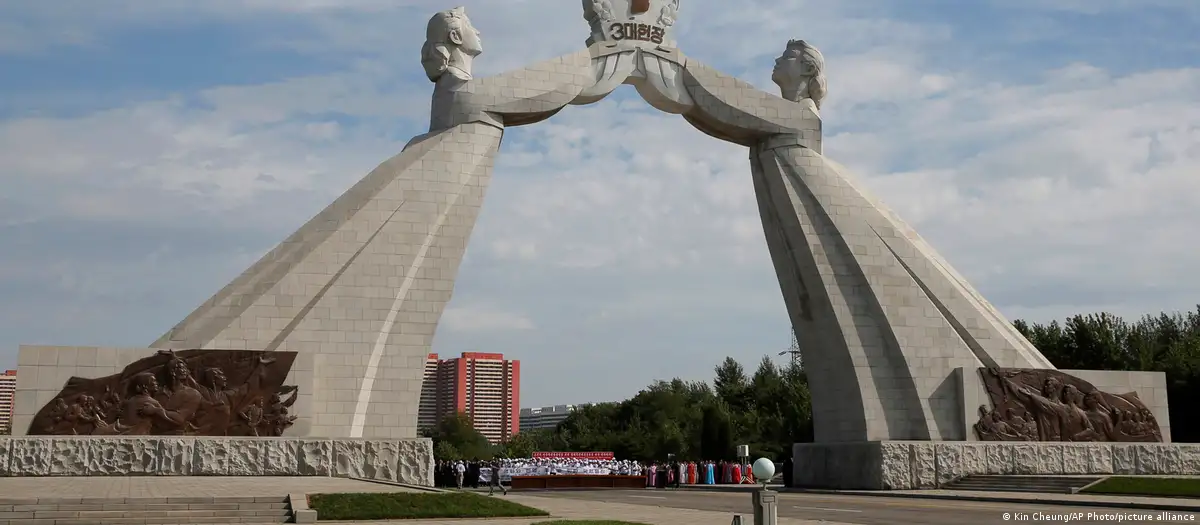
North Korea has removed all references to reunification with South Korea from its constitution, according to a document circulating on Wednesday.
The revision marks a sharp break from decades of policy dating back to 1948, when Pyongyang had formally committed to pursuing unification.
How has North Korea changed its constitution?
The change was reported after the South Korean Unification Ministry shared a document seen by the country's Yonhap News Agency and international media.
The updated constitution, introduced in March, also has a new clause defining North Korea's territory. It says this includes the area bordering China and Russia to the north, "and the Republic of Korea to the south," using South Korea's official name.
The revision also sees leader Kim Jong Un, as chairman of the State Affairs Commission, designated as North Korea's head of state. Previous language has described the chairman post differently — as the country's supreme leader who represents the state.
It adds that command over North Korea's nuclear forces rests with the State Affairs Commission chairman, formalizing Kim's authority over the country's nuclear forces and describing North Korea as a "responsible nuclear weapons state."
What does change mean for relations with South Korea?
Political scientist Lee Jung Chul of Seoul National University, cited by Yonhap, said the new policy could form a basis for "peaceful coexistence" between the two Korean states.
Lee said the omission of a specific inter-Korean border suggested that Pyongyang was seeking to avoid confrontation for the time being.
Pyongyang has adopted an increasingly hostile policy toward Seoul in recent years, while rejecting calls for dialogue from South Korean President Lee Jae Myung.
Kim began shifting course in late 2023, calling Seoul the "main enemy," and later ordered the demolition of a major reunification monument in Pyongyang.
In January 2024, he urged a constitutional amendment that defined South Korea as the North's "primary foe and invariable principal enemy,” stating that North Korean territory was separate from the South.
Kim has vowed to expand nuclear forces, while Pyongyang carried out four missile tests in April — the highest monthly total in more than two years.
The North has also been drawing closer to Russia, sending troops and artillery shells to support its invasion of Ukraine.
Edited by: Dmytro Hubenko