New Chinese surveillance leaves foreigners nowhere to hide
May 21, 2026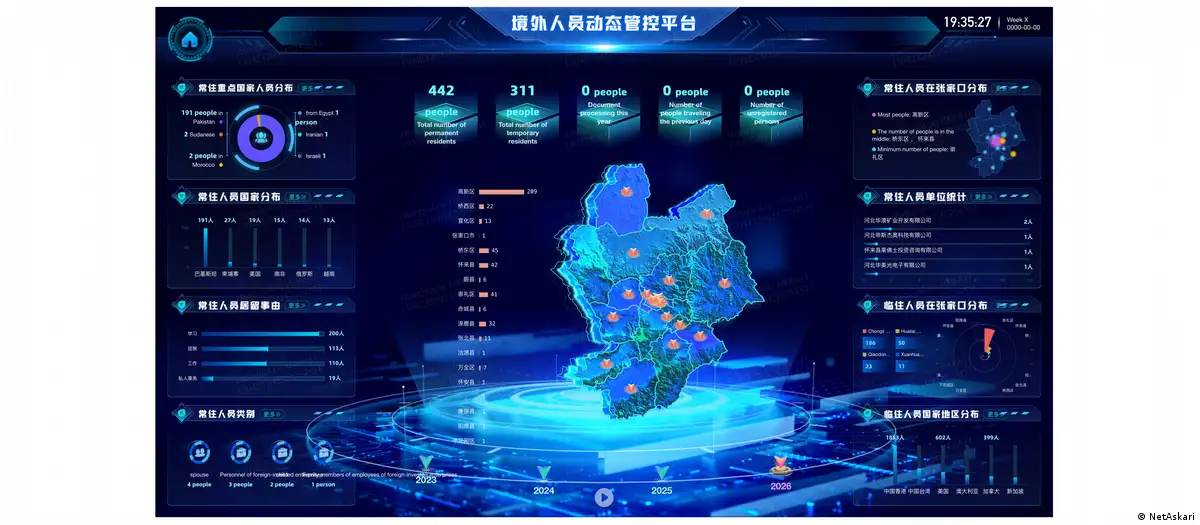
When a cybersecurity researcher known by the pseudonym NetAskari recently clicked on a tab labeled "Inquiry for journalist files" on an unsecured Chinese web dashboard, he expected to see a jumble of auto-generated mock data.
Instead, familiar faces popped up on the screen. It was a comprehensive database of almost every foreign journalist based in the Chinese capital Beijing around 2021, including official passport photos taken at the entry/exit bureau, private cell phone numbers, visa details, and dates of birth. He also found his own exact personal information lying dormant on this Chinese police watchlist.
"It was more interesting than shocking," NetAskari told DW. "When you work as a journalist in China, you basically assume you are always on their radar. But what surprised me was simply how easy it was to access this highly sensitive system."
China's granular system of social control
What NetAskari had stumbled upon is part modern China's emerging system of "holographic profiles."
He had unwittingly accessed a demonstration version of a remote tracking system designed for the Public Security Bureau in Zhangjiakou, the Hebei province city that hosted the 2022 Winter Olympics.
Though it was only a test panel, it was populated with real datasets, clearly outlining the trajectory of China's state surveillance machine, which is rapidly evolving from a network of simple street cameras into a data-fused, 24/7, predictive social control behemoth.
For years, China has operated the world's most extensive CCTV network. A massive initiative known as the "Xueliang" (Bright Eyes) project aims to merge these isolated islands of surveillance spread across the country.
But the data on the Zhangjiakou police dashboard shows the granular detail with which authorities can track an individual.
This system no longer relies solely on police cameras on street corners. It accurately records the specific train carriage and seat number a target occupies when arriving from Beijing or Shanghai.
It even synchronizes photos taken by facial-recognition ticket gates at local ski resorts directly into its tracking mechanism. The movements of the researcher's acquaintances who recently skied in Zhangjiakou were precisely flagged and mapped out with detailed trajectories in the system.
"The idea is simply to process as much data as possible from as many sensors as possible in real time," the researcher noted.
The system logs daily behaviors like gasoline consumption, regular shopping locations, and whether an individual frequently visits "petition areas."
This massive data-fusion effort attempts to stitch together a person's physical whereabouts, consumption habits and digital footprints into a flawless "holistic personnel archive."
Tracking foreign journalists
Within this increasingly airtight net, foreigners — especially journalists and other citizens from Western countries — are being looked at more by authorities.
The system's "smart report" statistics shows Chinese security agencies disproportionately focus on citizens from the "Five Eyes" countries, comprising the US, the UK, Australia, New Zealand, and Canada.
Deep in the backend, certain foreign journalists are assigned a special real-time tracking tag called "trackable." The moment they step into a jurisdiction, the system can automatically trigger early warnings for the police.
For independent journalism in China, this is an existential threat.
In the past, foreign reporters traveling to sensitive regions such as Xinjiang often relied on experience to shake off plainclothes police trailing them in the rearview mirror. Now, algorithmic upgrades to the policing system render this traditional cat-and-mouse game obsolete.
"They don't need to send two or three cars to follow you anymore," NetAskari said.
Because the system has access to your mobile payments, ticket purchases, and social networks, authorities can perfectly anticipate your itinerary, ensuring you only see what they want you to see upon arrival.
If the data network detects you interacting with certain individuals, police can simply call and intimidate your sources behind the scenes. In this perfectly closed surveillance loop, the concept of an "under-the-radar investigation" is being systematically eradicated.
The system knows where you'll be
What truly transforms this surveillance is the system's capability for group analysis and relationship modeling.
Traditional tailing requires immense police resources. But modern "smart policing" attempts to visualize interpersonal relationships through algorithms.
In the dashboard's core, the system automatically generates intricate network graphs based on how frequently targets are captured interacting on camera, revealing exactly who knows who, and how much time they spend together.
This technology has been in development for years. In 2019, Chinese tech giant Hisense filed a patent for "holistic relationship models for people involved in cases," which aimed to map out travel, call records, and vehicle usage. In 2025, the Shanghai Putao Public Security Bureau awarded a $200,000 contract for a "Holistic Personnel Archive System."
The high error rates and manpower bottlenecks of past manual surveillance are rapidly being replaced by cold, highly efficient, and tireless automated algorithms.
Admittedly, Western democracies are also grappling with controversy over the abuse of surveillance technologies such as Palantir.
But as the researcher NetAskari points out, the comparison with China's authoritarian system only goes so far.
"In Western democracies, there are debates... In China, this debate doesn't exist at all. The police and the Ministry of State Security just do whatever they want with relatively little oversight."
Whether it is a foreign journalist navigating Beijing's hutongs for a story, or a regular tourist vacationing at a ski resort, everyone ultimately dissolves into cold code on a colossal data dashboard.
NetAskari said in this system, people are reduced to numbers, patterns, and vector operations. They become "a 'datamass' that can be controlled, shaped and coerced as needed."
Edited by: Wesley Rahn