Middle East conflict: Do US voters back Trump's Iran war?
March 6, 2026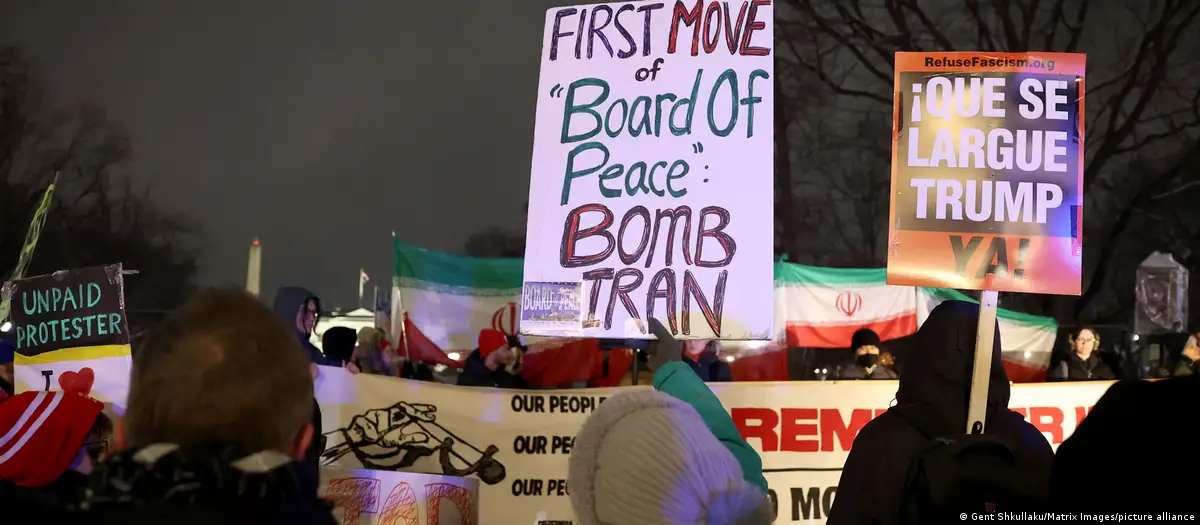
Until a few months ago, Donald Trump cast himself as a president of peace, boasting about how many conflicts around the world he had allegedly settled. He even founded a new international body, the Board of Peace, and suggested he should be awarded the Nobel Peace Prize.
But since the start of US and Israeli strikes on Iran on February 28, Trump looks anything but a peace-seeking president. Not least because Trump also used US military might to remove Venezuelan ruler Nicolas Maduro in January. Last year, he launched airstrikes on various countries, including Iran.
This is all the more remarkable given that Trump had promised in his 2024 election campaign to end old wars and avoid starting new ones. After all, Trump's mantra of "no more forever wars" resonated strongly with his MAGA base. The domestic political fallout of his Iran war could end up being serious for Trump.
Iran war 'likely to exacerbate domestic concerns
Polls show a majority of Americans reject the ongoing US attacks on Iran. A survey conducted by US broadcaster CNN found that 59% of respondents were against the decision to go to war, whereas 41% said they were in favor. Another poll, by the Reuters news agency, showed that 43% of Americans reject the war, with 27% in support. Of the remainder, 29% said they were unsure.
Surveys did show that supporters of Trump's Republican party largely back the war. But a rift has nevertheless formed inside the otherwise united MAGA camp, with influential ex-Fox News commentator Tucker Carlson calling the strikes on Iran "absolutely disgusting and evil."
Domestic resistance to Trump'swar will likely grow, said Johannes Thimm, who heads the Americas research group at the German Institute for International and Security Affairs (SWP). "As soon as the economic consequences are felt in the US, criticism will increase."
The price of fuel is rising because shipments are being blocked, Thimm said, adding that the war is driving inflation, which runs counter to Trump's key promises to keep prices down. "And the war will place a heavy burden on the American budget."
"The current situation in the Middle East is more likely to exacerbate domestic concerns and refocus American attention on a questionable and shaky US economy, including rising energy prices and inflation," said Jonathan Katz, who previously worked for Democratic lawmaker Amy Klobuchar and is now with the Brookings Institution. "The fact that the US Congress led by Republicans is laser-focused on Jeffrey Epstein, ICE and war power resolution, including this week highlights that domestic issues of interest to Americans are not going away — even as this conflict unfolds."
Unilateral action without Congressional backing
The Democrats have introduced a War Powers Resolution in both chambers of Congress as a means to check Trump's power to wage war without congressional approval, even though the move is regarded as largely symbolic with little prospect of succeeding. As expected, the Senate has already rejected the resolution.
The US Constitution is unambiguous on matters of war. It states that Congress, not the president, has the right to declare war. That said, modern wars usually begin without a formal declaration. And presidents may, under certain conditions, conduct limited military operations for 60 days without congressional approval.
"But since the Vietnam War, major wars — before Donald Trump's time — were always authorized [by Congress]," said SWP researcher Thimm. "George W. Bush got approval for the Iraq war and Afghanistan war."
Current operations against Iran should be seen as a major war, even without troops on the ground, Thimm added. "So this is something that would definitely require approval."
Could the war weaken the president?
Thomas Warrick, a political analyst with the Atlantic Council think tank, wrote in an analysis that Trump's unilateralism could hurt his presidency.
"Because he did not seek the support of Congress and the American people in advance, he will own the outcome. If it succeeds, he may receive a mild domestic boost, but he risks a significant setback to his domestic agenda if he fails," he wrote on February 28.
Matters are further complicated by the midterm elections at the beginning of November, when all 435 seats in the House of Representatives, and one‑third of the 100 Senate seats are up for election.
Trump's Republican party faces a dilemma over this war, said Thimm. "The Republicans don't want to withhold support for their president, but they also don't really want to be associated with this war because they know that it's unpopular." Overall public approval and electoral chances of individual candidates in the midterm elections depend on how the war plays out.
The Trump administration, meanwhile, is sending mixed signals over its war aims and its projected duration. "We can sustain this fight easily for as long as we need to. And as I said yesterday, we set the terms," said Defense Secretary Pete Hegseth on Wednesday. But not everyone is so confident.
In the US, some have questioned if the military possesses enough defensive weapons to take down ballistic missiles and drones, given that these weapons are also needed to deter enemies elsewhere.
MAGA pundit Tucker Carlson even accused the Trump administration of having been dragged into the war by Israel. Speaking on his podcast, he said "it's hard to say this, but the United States didn't make the decision here. Benjamin Netanyahu did." Numerous other MAGA figures share this view, some of whom marshal antisemitic stereotypes to make their point.
Brookings analyst Katz agrees that the Trump administration has been unclear about its strategy, war goals and the expected duration of hostilities. He wonderec if the "administration [had] also considered the consequences of the war," for example protecting thousands of Americans in the Middle East, and said the fighting will have serious consequences in the US and around the world.
During his eight-minute speech at the start of the war, Trump said the US was taking action to protect the American people from of an "acute threat" posed by the Iranian regime. Yet the exact nature of this threat remains nebulous.
Many experts deem this war a breach of international law. The grounds for waging this war will therefore come under close scrutiny and could pile extra pressure on the Trump administration.
This article was originally written in German.
Correction, March 9, 2026: A previous version of this article mistakenly stated in a photo caption that US missile strikes on Iran occured in summer 2026. DW apologizes for the error.